
- 0
- 2,462 words
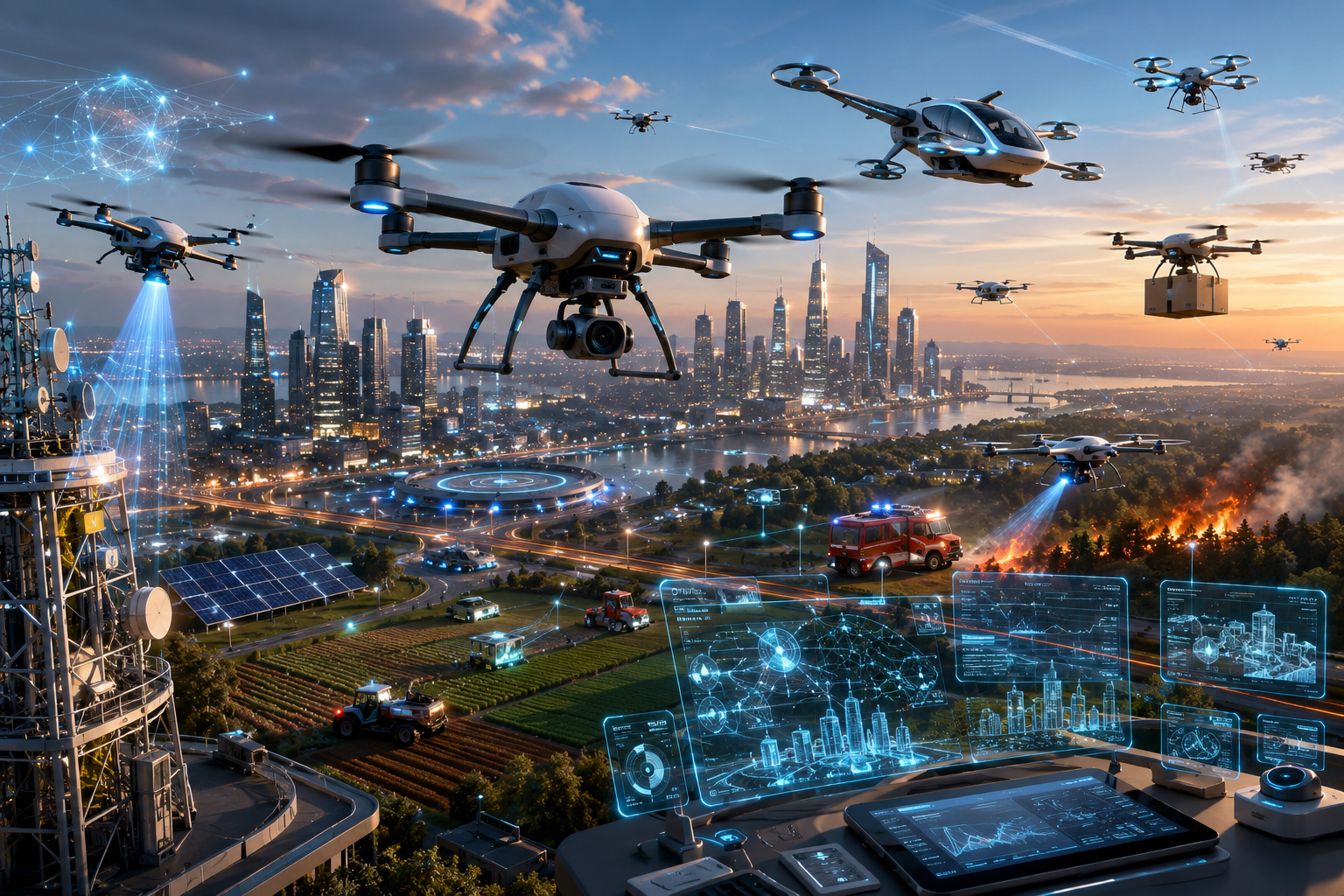
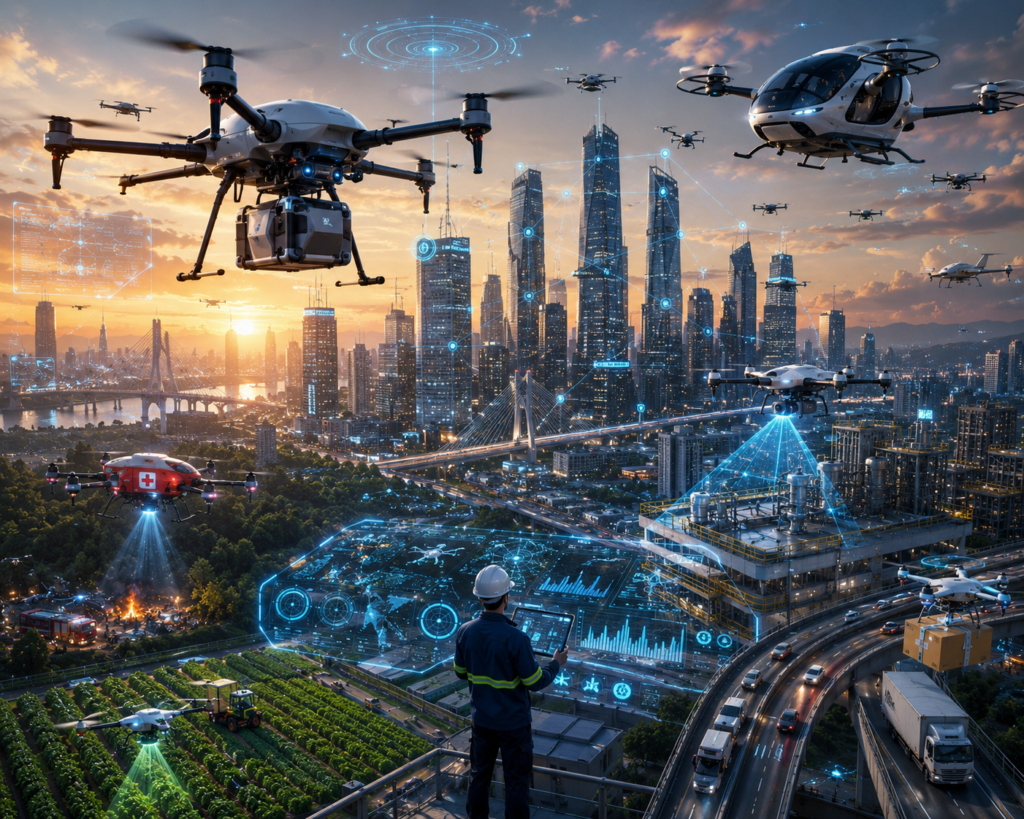
Over the past two decades, I have witnessed technology evolve at an astonishing pace, but few innovations have advanced as rapidly as drone technology. What began as specialized military equipment has transformed into an indispensable tool across industries ranging from agriculture and healthcare to logistics, construction, public safety, and environmental conservation. Today, the future of drones is no longer a distant vision—it is unfolding before our eyes.
One of the most remarkable developments has been the rise of autonomous drones. Modern drones are no longer simple remote-controlled flying devices. Equipped with artificial intelligence, computer vision, advanced sensors, GPS navigation, and real-time data processing, today’s UAVs can independently inspect bridges, deliver medical supplies, monitor crops, and even coordinate with other drones to complete complex missions.
The rapid growth of commercial drone technology has significantly improved operational efficiency for businesses worldwide. Companies that once relied on helicopters, manual inspections, or expensive surveying equipment are increasingly replacing those methods with intelligent aerial robotics capable of collecting precise data in a fraction of the time and cost.
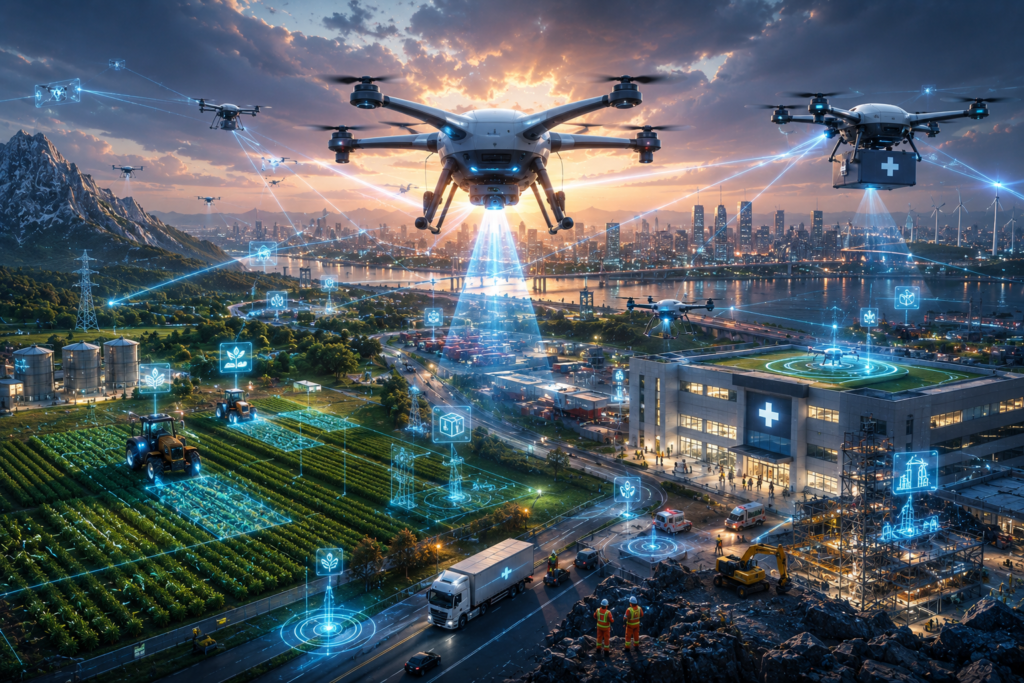
Governments are also investing billions of dollars into drone innovations. National aviation authorities continue developing drone regulations to safely integrate unmanned aircraft into public airspace, while defense organizations are advancing next-generation UAV technology for surveillance, reconnaissance, and autonomous mission planning. At the same time, private companies are pioneering drone delivery services, infrastructure inspections, precision agriculture, and smart city solutions that were unimaginable only a decade ago.
What Is Drone Technology?
Drone technology refers to the design, development, operation, and application of Unmanned Aerial Vehicles (UAVs) capable of flying without an onboard human pilot. These aircraft range from compact consumer drones weighing only a few hundred grams to sophisticated industrial systems equipped with LiDAR, thermal cameras, AI-powered analytics, multispectral imaging, and autonomous flight capabilities.
Unlike conventional aircraft, drones combine multiple technologies into a single intelligent platform:
- Artificial Intelligence (AI)
- Computer Vision
- GPS Navigation
- Machine Learning
- Advanced Sensors
- Autonomous Flight Systems
- Cloud Connectivity
- Real-Time Data Analytics
- Edge Computing
- Intelligent Robotics
Together, these technologies enable drones to perform highly specialized tasks with remarkable speed and precision.
Consumer vs Commercial Drone Technology
Although both categories share similar flight principles, their purposes differ significantly.
Consumer Drones
Designed primarily for:
- Photography
- Videography
- Recreation
- Travel
- Hobby Flying
- Social Media Content
Consumer drones emphasize portability, ease of use, and affordability.
Commercial Drone Technology
Commercial drones are engineered for demanding professional applications such as:
- Infrastructure Inspection
- Precision Agriculture
- Mining Operations
- Energy Infrastructure
- Oil & Gas Inspection
- Surveying
- Mapping
- Construction Monitoring
- Environmental Research
- Emergency Response
- Search and Rescue
These platforms typically feature industrial-grade sensors, longer flight times, enhanced redundancy, AI-powered navigation, and enterprise software integration.
Why the Future of Drones Matters
In my experience, drones are no longer simply replacing manual labor—they are fundamentally changing how organizations make decisions.
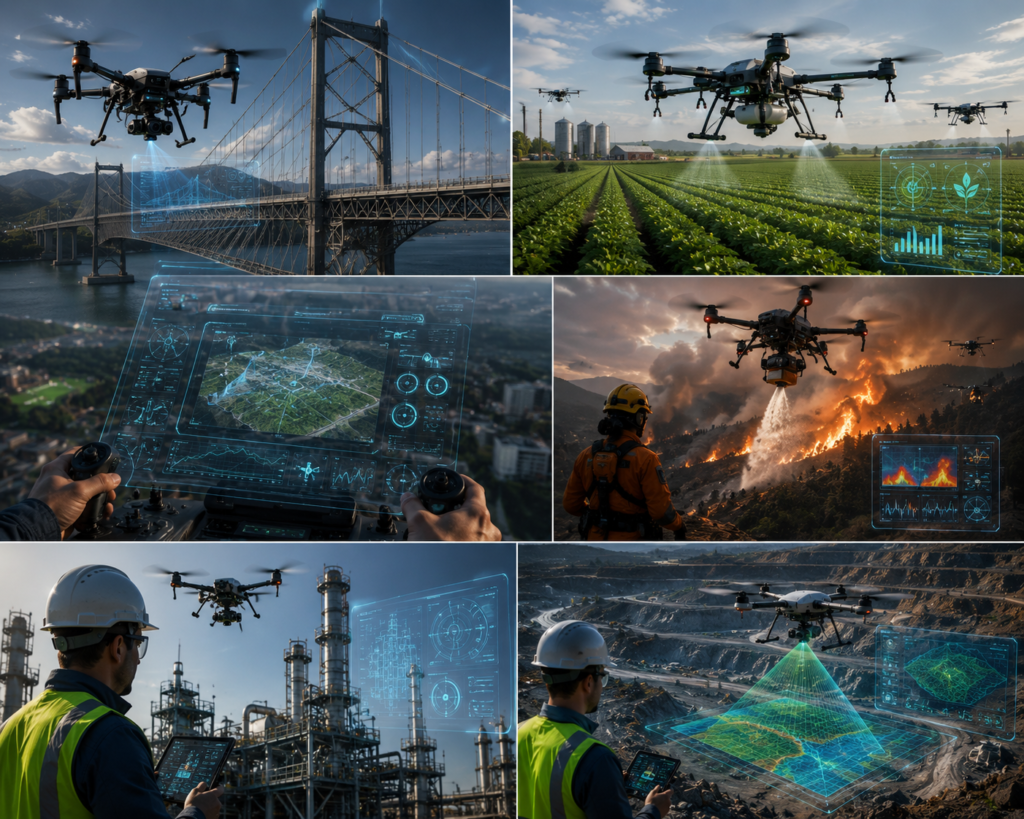
For example, a bridge inspection that once required lane closures, cranes, and several days of work can now be completed within hours using autonomous drone inspection systems equipped with high-resolution cameras and AI defect detection software.
Similarly, farmers can monitor hundreds of acres in a single flight, identifying irrigation problems, pest infestations, or nutrient deficiencies long before they become visible to the human eye. These practical improvements demonstrate why the future of drones is about much more than flying machines; it is about smarter, data-driven decision-making.
Top Drone Innovations Transforming the Future
AI-Powered Autonomous Drones
Artificial intelligence has become the driving force behind the latest generation of autonomous drones. By combining AI algorithms, computer vision, machine learning, and advanced sensors, these drones can perform complex tasks with minimal human intervention.
How It Works
AI-powered drones process real-time data from cameras, LiDAR, GPS, radar, and onboard sensors to understand their surroundings. They continuously analyze this information to make split-second decisions such as adjusting flight paths, avoiding obstacles, identifying objects, and optimizing mission performance.
Current Applications
- Infrastructure inspection
- Precision agriculture
- Search and rescue
- Wildlife monitoring
- Border surveillance
- Disaster assessment
- Warehouse inventory management
Benefits
- Reduced human error
- Increased operational efficiency
- Enhanced safety
- Faster data collection
- Lower operational costs
- High-precision inspections
Future Potential
By 2035, autonomous drones are expected to operate in coordinated fleets, perform complex logistics missions, and integrate seamlessly with smart city infrastructure and autonomous transportation systems.
Market Impact
The growing adoption of AI-powered drones is driving significant investment across industries, creating new business models and accelerating the shift toward intelligent automation.
Professional Observation
One trend I have consistently observed is that organizations initially adopt drones for cost savings but quickly discover that the real value lies in the high-quality data and insights these systems provide. In many cases, the information collected by drones transforms decision-making far beyond the original operational goals.
Environmental Monitoring
Researchers deploy drones to monitor forests, wildlife habitats, glaciers, coastlines, pollution levels, and climate-related environmental changes.
Defense
Military organizations continue advancing UAV technology for intelligence gathering, surveillance, reconnaissance, electronic warfare, logistics support, and autonomous operations.
Smart Cities
Connected drone ecosystems will support infrastructure inspection, intelligent traffic management, environmental monitoring, public safety, and urban planning.
Autonomous Drones: The Biggest Aviation Revolution
Among all the advancements I have witnessed in drone technology, autonomous drones stand out as the most transformative. They are redefining what aircraft can accomplish without constant human control.
Computer Vision
Modern drones use AI-powered computer vision to recognize roads, buildings, people, vehicles, power lines, crops, and obstacles in real time, enabling highly accurate autonomous decision-making.
AI Navigation
Unlike traditional GPS-only navigation, AI navigation combines satellite positioning, cameras, LiDAR, radar, and onboard sensors to create adaptive flight paths capable of responding to changing environments.
Autonomous Flight Planning
Mission planning software enables drones to generate optimized routes, complete inspections, collect data, and safely return to base without continuous pilot input.
Obstacle Avoidance
Advanced obstacle avoidance systems use multiple sensors and machine learning to detect trees, buildings, wires, birds, and other aircraft, significantly reducing collision risks.
Drone Fleet Management
Enterprise organizations now manage hundreds of drones simultaneously through centralized cloud platforms that monitor battery health, mission status, maintenance schedules, compliance records, and operational analytics.
Predictive Maintenance
Artificial intelligence continuously analyzes flight data to predict component wear, battery degradation, and potential failures before they affect operations, improving safety and reducing downtime.
Benefits
- Higher productivity
- Improved operational safety
- Lower labor costs
- More consistent data collection
- Better scalability
- Enhanced mission reliability
Risks and Ethical Concerns
Despite their advantages, autonomous drones raise important questions about privacy, cybersecurity, airspace integration, accountability, and ethical AI decision-making. Governments, manufacturers, and operators must work together to establish responsible standards that protect public trust while encouraging innovation.
Expert Outlook
In my view, autonomous drones represent the biggest leap in aviation since the widespread adoption of GPS navigation. As AI continues to mature, these intelligent aerial systems will become trusted partners across industries rather than simply remote-controlled tools.
Commercial Drone Technology vs Traditional Methods
| Feature | Traditional Methods | Commercial Drone Technology |
|---|---|---|
| Inspection | Manual climbing, scaffolding, helicopters | Fast aerial inspections with AI-powered analysis |
| Surveying | Ground crews and total stations | High-precision drone mapping and LiDAR |
| Delivery | Trucks and couriers | Autonomous drone delivery for short distances |
| Operating Cost | High labor and equipment costs | Lower long-term operational expenses |
| Speed | Hours or days | Minutes to hours |
| Safety | Higher worker exposure to risks | Remote operations reduce hazards |
| Accuracy | Manual measurements | Centimeter-level precision with GPS and sensors |
| Environmental Impact | Higher fuel consumption and emissions | Lower emissions with electric drone fleets |
Commercial drone technology does not replace every traditional method, but it complements and enhances existing workflows. For hazardous inspections, rapid mapping, and time-sensitive deliveries, drones offer unmatched efficiency, safety, and data accuracy. Traditional methods will remain valuable for complex tasks requiring direct human intervention, while drones increasingly handle repetitive, risky, and data-intensive operations.
Benefits of Drone Technology
The widespread adoption of drone technology is delivering measurable advantages across industries.
- Increased Productivity: Tasks that once required days can often be completed in hours.
- Faster Operations: Real-time aerial data accelerates inspections, surveys, and emergency response.
- Better Safety: Drones reduce the need for workers to operate in dangerous environments.
- Cost Savings: Lower labor, equipment, and maintenance expenses improve return on investment.
- Real-Time Data Collection: High-resolution imagery and sensor data support faster decision-making.
- Environmental Sustainability: Electric drones produce fewer emissions than many traditional aircraft and vehicles.
- Better Decision Making: AI-powered analytics convert aerial data into actionable business insights.
- Improved Accuracy: Advanced sensors, GPS, and LiDAR deliver highly precise measurements for mapping, inspection, and monitoring.
Organizations that integrate drones into their operations often discover that the greatest value lies not only in automation but also in the ability to make faster, more informed decisions based on reliable aerial intelligence.
1. What is drone technology?
Drone technology refers to the design, development, and operation of Unmanned Aerial Vehicles (UAVs) equipped with advanced hardware and software. Modern drones integrate GPS, AI, computer vision, sensors, and autonomous flight systems to perform tasks such as aerial photography, infrastructure inspection, precision agriculture, mapping, surveillance, and package delivery. As AI continues to evolve, drone technology is becoming more intelligent, efficient, and capable of operating with minimal human intervention.
2. What is the future of drones?
The future of drones is centered on autonomy, artificial intelligence, and seamless integration into everyday life. Over the next decade, drones will expand beyond photography into large-scale logistics, emergency response, smart city management, industrial inspections, environmental monitoring, and autonomous transportation. By 2035, AI-powered drone fleets, drone highways, and advanced air traffic management systems are expected to become part of modern infrastructure.
3. What are autonomous drones?
Autonomous drones are aircraft capable of flying and completing missions without continuous human control. They use artificial intelligence, computer vision, machine learning, GPS navigation, and obstacle avoidance systems to analyze their surroundings, make real-time decisions, avoid collisions, and safely complete complex operations. These intelligent systems are becoming essential in industries where speed, precision, and safety are critical.
4. How does commercial drone technology work?
Commercial drone technology combines high-performance aircraft with intelligent software platforms. Operators plan missions using mapping software, while onboard cameras, LiDAR scanners, thermal sensors, and GPS systems collect detailed data during flight. After landing—or even in real time—the captured information is processed using AI-powered analytics to generate reports, 3D models, digital maps, and actionable insights for industries such as construction, agriculture, utilities, mining, and logistics.
5. What industries use drones?
Drone technology is now widely used across numerous sectors, including:
- Agriculture and precision farming
- Construction and land surveying
- Logistics and package delivery
- Healthcare and medical transport
- Energy and utilities
- Oil and gas inspection
- Mining operations
- Environmental monitoring
- Public safety and emergency response
- Telecommunications
- Defense and security
- Smart city infrastructure
As drone capabilities continue to improve, even more industries are expected to adopt autonomous aerial systems.
Drone technology
Yes, autonomous drones are becoming increasingly safe thanks to AI-powered navigation, redundant flight systems, obstacle detection, geofencing, return-to-home functions, and predictive maintenance technologies. However, safe deployment also depends on proper regulations, operator training, cybersecurity protections, and reliable air traffic management. Continuous improvements in AI and aviation standards are making autonomous drones more dependable every year.
Can drones replace delivery vehicles?
Drones are unlikely to replace all delivery vehicles, but they will complement existing logistics networks. They are particularly effective for transporting lightweight packages, medical supplies, emergency equipment, and urgent deliveries over short distances. Traditional trucks and cargo vehicles will continue to handle heavy freight and long-distance transportation, while drones improve speed and efficiency in last-mile delivery.
What are drone swarms?
Drone swarms are groups of autonomous drones that communicate and coordinate with one another using artificial intelligence and wireless networking. Instead of operating independently, swarm drones collaborate to complete tasks such as large-scale inspections, disaster response, environmental monitoring, agricultural surveys, and defense missions. This technology increases efficiency, reliability, and scalability while reducing mission completion time.
What regulations affect drones?
Drone operations are governed by aviation authorities that establish rules covering pilot certification, aircraft registration, operational limits, airspace restrictions, privacy requirements, and commercial licensing. Regulations continue to evolve as governments integrate drones safely into national airspace systems. Businesses should always ensure compliance with local aviation laws before conducting commercial drone operations.
What careers are available in drone technology?
The rapid expansion of the drone industry has created exciting career opportunities, including:
- Drone Pilot
- UAV Systems Engineer
- Aerospace Engineer
- Robotics Engineer
- AI and Computer Vision Specialist
- Drone Software Developer
- GIS and Mapping Analyst
- Surveying Specialist
- Infrastructure Inspection Consultant
- Agricultural Drone Operator
- Drone Maintenance Technician
- Aviation Safety Specialist
- Airspace Management Analyst
- Drone Fleet Manager
- Research Scientist
Professionals with expertise in AI, robotics, aviation, data analytics, and software engineering are expected to remain in high demand as the industry grows.
Conclusion
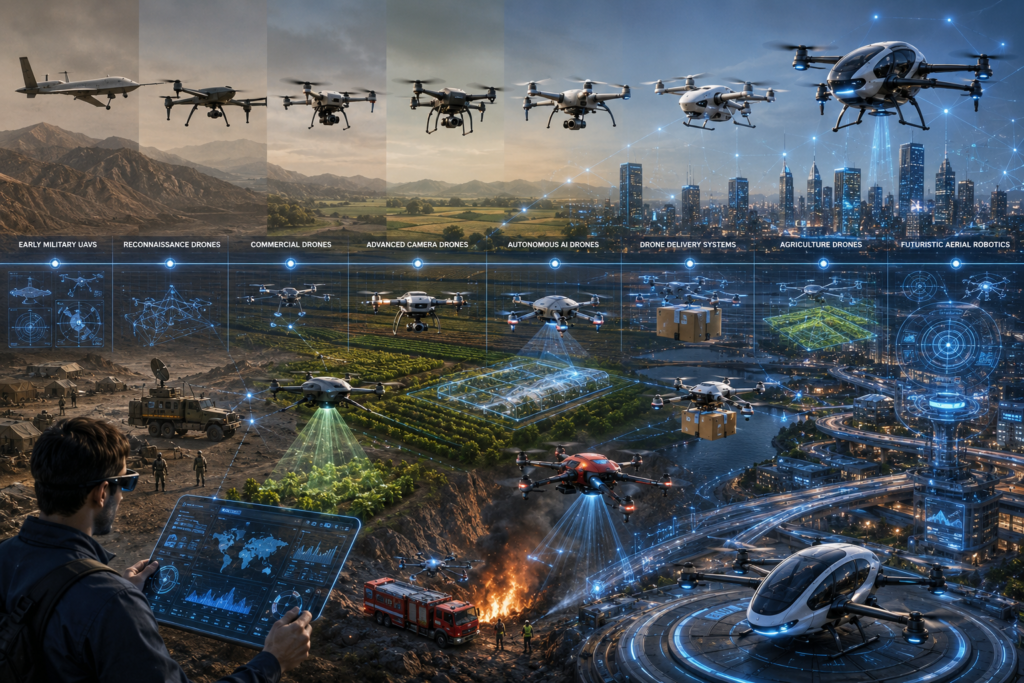
Drone technology has evolved from its military origins into one of the most transformative innovations of the modern era. What was once limited to surveillance and reconnaissance has become an intelligent ecosystem of AI-powered autonomous drones supporting agriculture, construction, logistics, healthcare, energy, environmental monitoring, public safety, and smart city infrastructure.
Throughout this article, we explored how commercial drone technology, drone innovations, and autonomous drones are reshaping industries by improving productivity, reducing costs, enhancing safety, and delivering real-time data that drives smarter decisions. From precision agriculture and infrastructure inspections to emergency response and drone delivery networks, UAV technology is no longer an emerging trend—it is a strategic business capability.
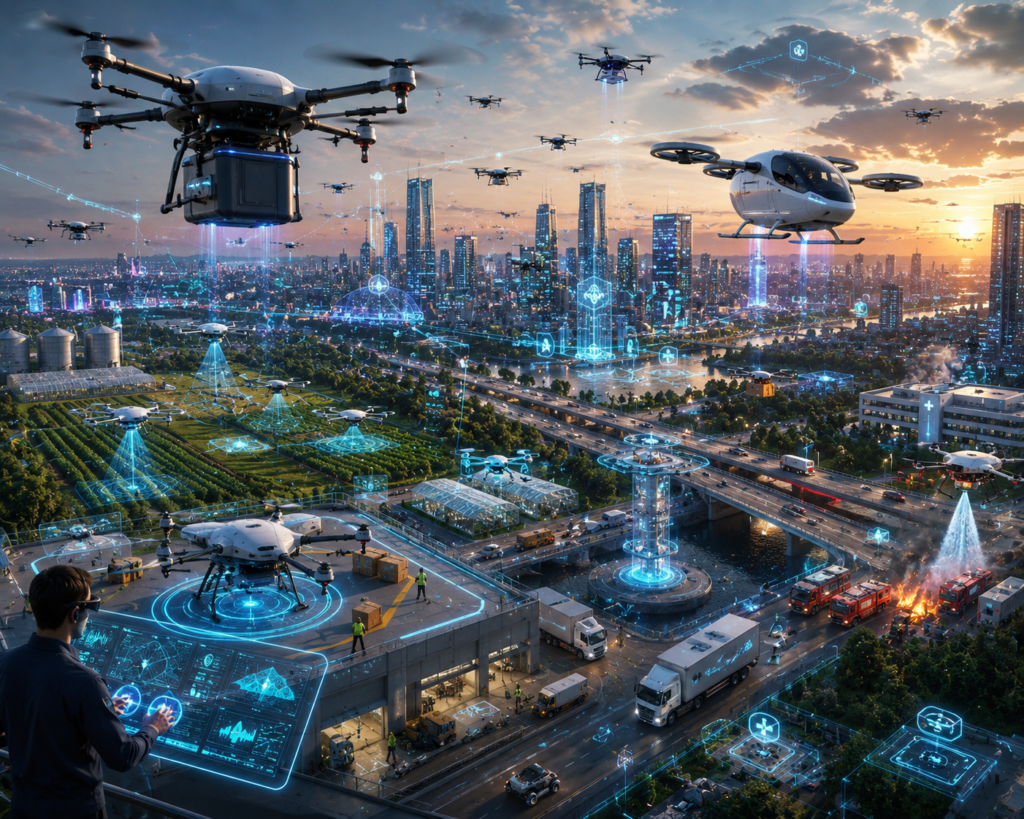
Looking ahead to 2035, the future of drones promises even greater advancements. Autonomous delivery fleets, AI-powered air traffic management, drone swarm intelligence, flying taxis, and connected urban air mobility systems will redefine how people, goods, and services move through the world. As artificial intelligence, computer vision, battery technology, and communication networks continue to mature, drones will become an integral part of intelligent digital infrastructure.
From my perspective, after more than 25 years of following advancements in aviation, robotics, and autonomous systems, one thing is clear: organizations that embrace drone technology today will be better prepared for tomorrow’s opportunities. Businesses can streamline operations, governments can strengthen public services, and researchers can solve complex challenges more efficiently with the support of intelligent aerial systems.
The future of drones is not simply about flying machines—it is about creating safer workplaces, smarter cities, more sustainable industries, and faster, data-driven decision-making. Investing in drone technology today is an investment in the future of intelligent autonomous aviation, and those who adapt early will be best positioned to lead in the next generation of innovation.
Author

razakh6402@gmail.com
Related Posts

Lead Generation Software: 12 Best Lead Generation Tools for B2B Sales (2026 Guide)
- 0
- 2,300 words
If someone had asked me 15 years ago what the biggest challenge in sales was, my answer would have been simple: finding...

Survey Software: 12 Best Online Survey Tools & Feedback Software for Businesses (2026 Guide)
- 0
- 1,871 word
Whether I was helping a SaaS startup validate a new feature, assisting an HR team with employee engagement, or optimizing customer experience...
Read out all
Online Course Platform: 12 Best LMS Software & eLearning Platforms for Course Creators (2026 Guide)
- 0
- 1,900 word
The online education industry has changed dramatically over the last 15 years. When I built my first digital training portal, simply uploading...

Team Communication Software: 12 Best Business Messaging Apps for Modern Workplaces in 2026 (Expert Tested)
- 0
- 2,305 words
I’ve personally tested dozens of team communication software platforms while consulting for marketing agencies, software companies, HR departments, remote development teams, and...

Invoice Software: 12 Best Invoicing Software for Small Business in 2026 (Expert Tested)
- 0
- 2,493 words
I’ve worked with freelancers chasing late payments, agencies managing hundreds of monthly invoices, startups scaling internationally, and established businesses struggling with outdated...
Generate one SEO-optimized title thatdigital asset management software
- 6
- 2,632 words
One of the most memorable projects I led involved migrating nearly half a million digital assets from a traditional file server into...