
- 1
- 1,922 word
Financial planning has changed dramatically over the last decade.
When I began advising clients nearly 15 years ago, financial plans were built using spreadsheets, manual calculations, and periodic reviews. Advisors spent countless hours gathering data, analyzing investment portfolios, projecting retirement scenarios, and helping clients make informed decisions.
Today, artificial intelligence is transforming every aspect of financial management.
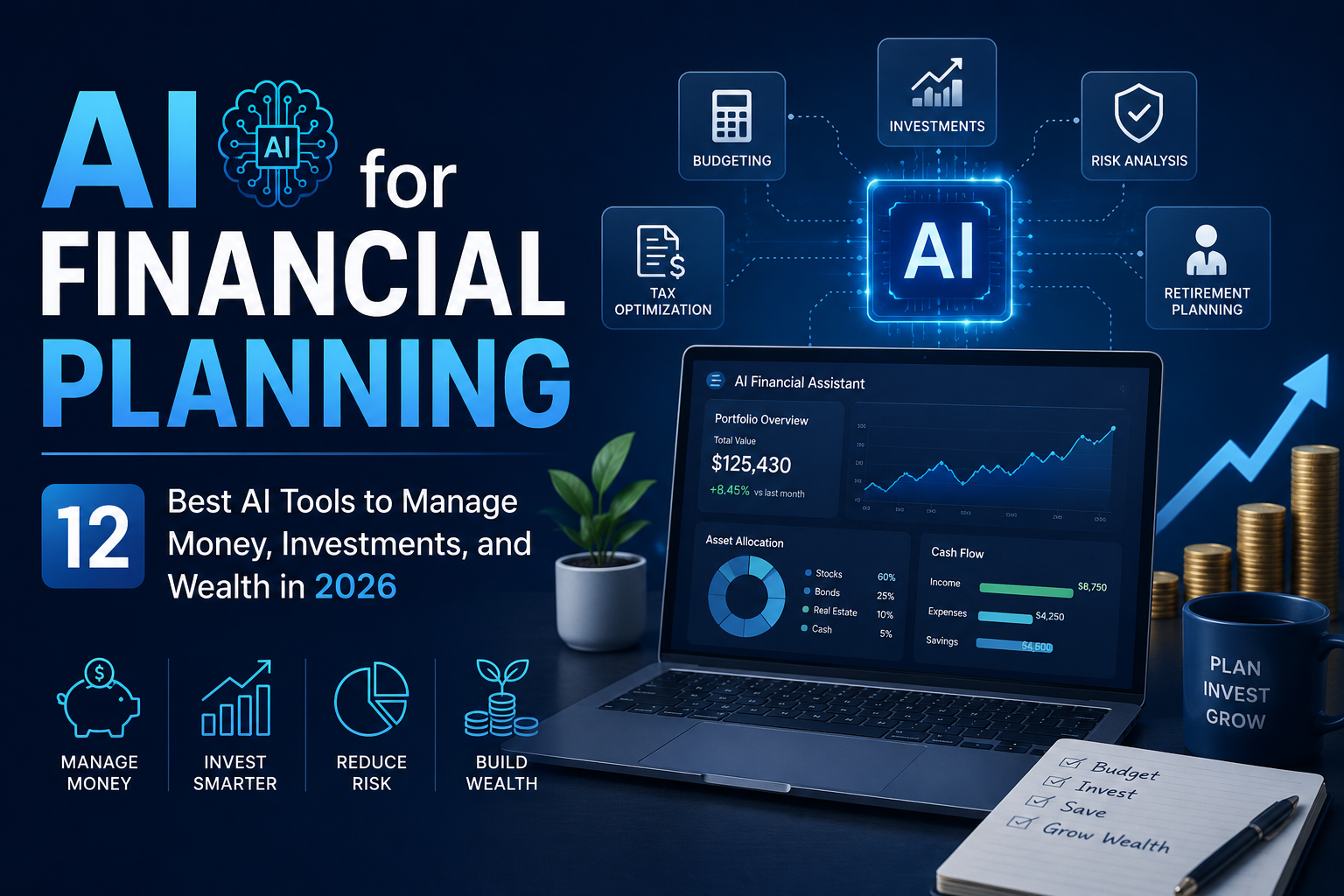
From automated budgeting and investment analysis to retirement forecasting and wealth preservation, AI for financial planning is helping individuals and businesses make smarter financial decisions faster than ever before.
What makes this shift particularly exciting is that AI is no longer reserved for large institutions or wealthy investors. Modern AI financial advisor tools and personal finance AI tools are accessible to students, professionals, entrepreneurs, retirees, and families alike.
In this guide, I’ll share practical insights from years of financial planning experience and review the best AI-powered solutions available in 2026.
What Is AI for Financial Planning?
AI for financial planning refers to the use of artificial intelligence technologies to analyze financial data, automate decision-making, provide personalized recommendations, and improve financial outcomes.
These systems combine several technologies:
- Machine Learning
- Predictive Analytics
- Natural Language Processing
- Financial Automation
- Data Modeling
- Behavioral Analysis
Modern platforms continuously analyze spending habits, investment performance, savings behavior, debt levels, tax situations, and long-term goals.
Instead of manually reviewing hundreds of financial variables, AI systems process enormous datasets within seconds and generate personalized recommendations.
For example, an AI-powered platform may identify:
- Excessive subscription spending
- Portfolio imbalance
- Retirement savings gaps
- Tax optimization opportunities
- Debt repayment improvements
The result is faster and often more accurate financial decision-making.

Why AI Is Revolutionizing Financial Planning
Better Financial Decision-Making
One of the biggest challenges I have observed among clients is information overload.
People often struggle because financial decisions involve dozens of variables simultaneously.
AI simplifies complexity by analyzing data patterns and presenting actionable recommendations.
Automated Budgeting
Traditional budgeting requires manual tracking.
Today’s personal finance AI tools automatically:
- Categorize expenses
- Monitor cash flow
- Detect unusual spending
- Recommend savings opportunities
Many users discover spending leaks they never knew existed.
Smarter Investing
AI investment planning software evaluates:
- Asset allocation
- Risk tolerance
- Market conditions
- Historical performance
- Diversification opportunities
This enables investors to make more informed decisions.
Retirement Planning
Retirement forecasting has become significantly more accurate.
AI can model thousands of retirement scenarios based on:
- Inflation
- Life expectancy
- Investment returns
- Spending behavior
Risk Assessment
Risk profiling has improved dramatically.
AI systems can identify hidden vulnerabilities in portfolios and suggest corrective actions before problems become costly.
Best AI Financial Advisor Tools in 2026
Wealthfront
Wealthfront remains one of the strongest AI wealth management tools available.
Features
- Automated investing
- Tax-loss harvesting
- Goal planning
- Retirement forecasting
- Portfolio rebalancing
Pros
- Excellent automation
- User-friendly interface
- Strong tax optimization
Cons
- Limited human advisor interaction
Best Use Cases
Ideal for long-term investors seeking automated portfolio management.
Betterment
Betterment continues to lead the robo-advisor market.
Features
- Automated investing
- Goal-based planning
- Tax optimization
- Retirement projections
Pros
- Beginner-friendly
- Excellent goal planning
- Competitive pricing
Cons
- Fewer customization options
Best Use Cases
Perfect for new investors.
Empower Personal Dashboard
Previously known as Personal Capital.
Features
- Net worth tracking
- Investment analysis
- Retirement planning
- Cash flow monitoring
Pros
- Powerful analytics
- Comprehensive dashboard
Cons
- Premium services can be costly
Best Use Cases
Ideal for investors managing multiple accounts.
Monarch Money
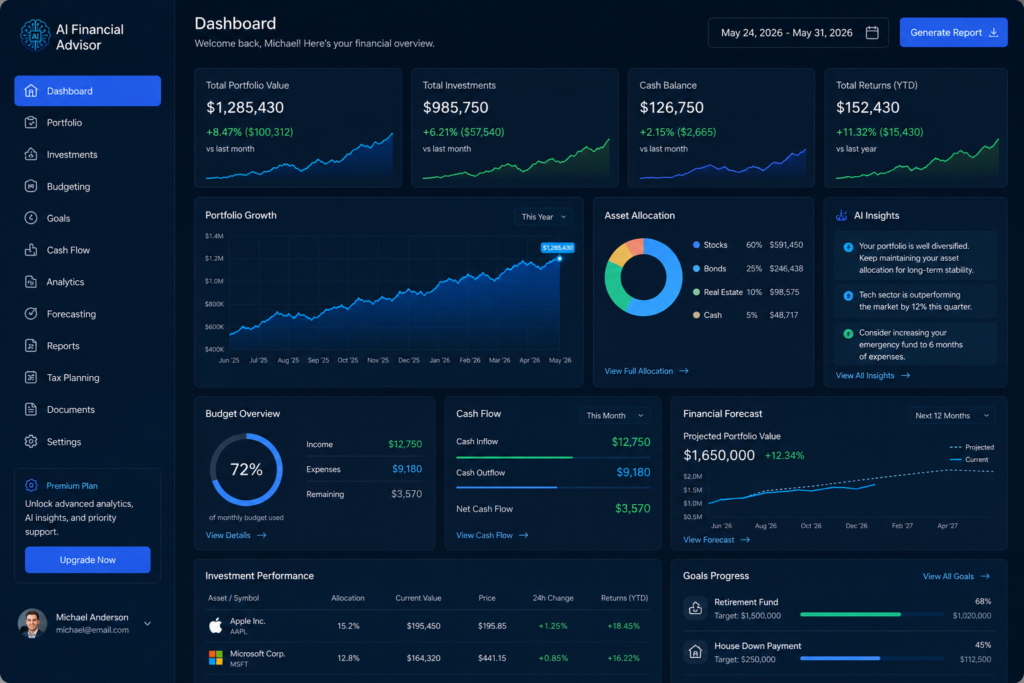
Monarch Money has become one of the most popular personal finance AI tools.
Features
- Budgeting
- Family financial planning
- Goal tracking
- Subscription monitoring
Pros
- Excellent user experience
- Collaborative planning
Cons
- Subscription fee required
Best Use Cases
Best for families and households.
Quicken Simplifi
Features
- Spending analysis
- Budget tracking
- Financial forecasting
- Savings planning
Pros
- Easy setup
- Affordable pricing
Cons
- Limited investment tools
Best Use Cases
Great for budgeting-focused users.
ChatGPT for Financial Planning
Although not a regulated financial advisor, ChatGPT has become a valuable financial planning assistant.
Uses
- Budget creation
- Financial education
- Expense analysis
- Goal planning
- Scenario modeling
Pros
- Flexible
- Fast information access
- Strong educational value
Cons
- Not personalized investment advice
Best Use Cases
Financial learning and planning support.
Copilot Money
Features
- Automated budgeting
- Spending insights
- AI categorization
- Financial monitoring
Pros
- Modern design
- Excellent automation
Cons
- Platform limitations in some regions
Best Use Cases
Professionals seeking detailed spending visibility.
Origin Financial
Features
- Wealth tracking
- Financial planning
- Investment monitoring
- Family finance management
Pros
- Comprehensive platform
- Integrated financial tools
Cons
- Premium pricing
Best Use Cases
High-income households and professionals.
Comparison Table of the Best AI Financial Advisor Tools
| Tool | Best For | AI Features | Pricing | Ease of Use | Overall Rating |
|---|---|---|---|---|---|
| Wealthfront | Investing | Automated portfolios | Medium | Excellent | 9.5/10 |
| Betterment | Beginners | Robo-advising | Medium | Excellent | 9.3/10 |
| Empower | Portfolio Analysis | Investment insights | Free/Premium | Good | 9.2/10 |
| Monarch Money | Families | Budget automation | Subscription | Excellent | 9.1/10 |
| Simplifi | Budgeting | Expense tracking | Affordable | Excellent | 8.9/10 |
| ChatGPT | Financial Education | AI assistance | Flexible | Excellent | 8.8/10 |
| Copilot Money | Expense Management | Smart categorization | Subscription | Excellent | 9.0/10 |
| Origin Financial | Wealth Planning | Financial intelligence | Premium | Good | 9.1/10 |
Personal Finance AI Tools That Simplify Money Management
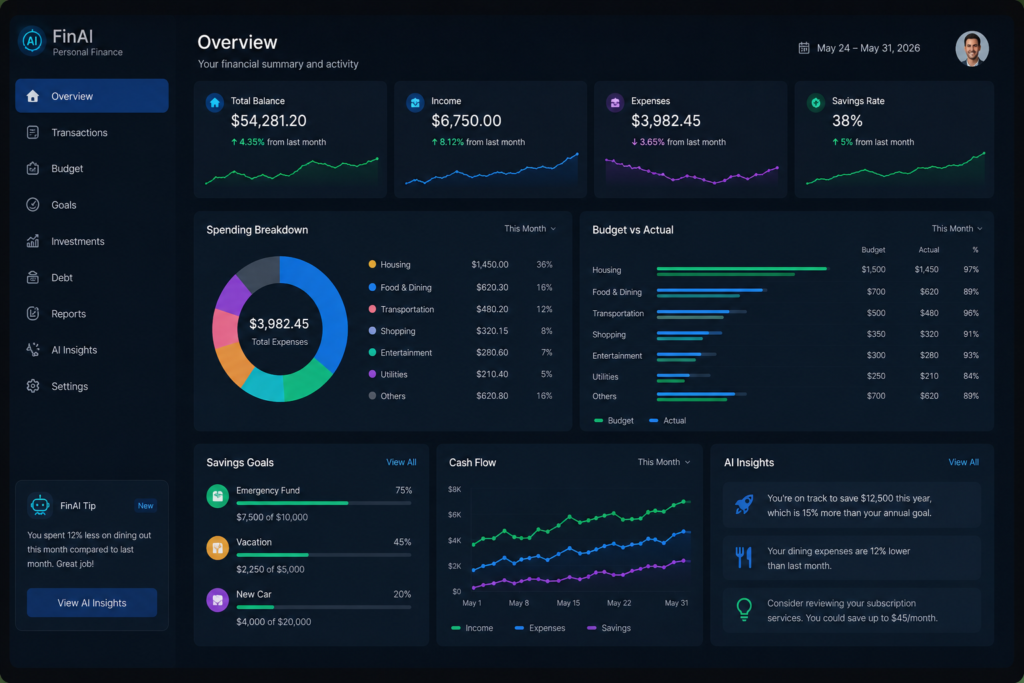
Budget Tracking
AI automatically monitors income and expenses.
Expense Categorization
Transactions are categorized without manual effort.
Savings Optimization
Systems identify opportunities to increase savings rates.
Debt Reduction Planning
AI can recommend repayment strategies that reduce interest costs.
Goal-Based Financial Planning
Users can create customized goals such as:
- Home purchases
- Retirement
- Education funding
- Emergency savings
This level of personalization significantly improves financial discipline.
AI Investment Planning Software for Smarter Investing
Portfolio Analysis
AI reviews portfolio performance continuously.
Asset Allocation
Sophisticated algorithms recommend optimal allocations.
Market Trend Analysis
Machine learning identifies trends faster than traditional analysis methods.
Risk Management
Risk exposure is monitored in real time.
Automated Investing
Robo-advisors execute investment decisions automatically.
Tax Optimization
Tax-loss harvesting and tax-efficient investing are becoming standard features.
From my experience, investors often underestimate how much tax efficiency can improve long-term returns.
AI Wealth Management Tools for High-Net-Worth Investors
High-net-worth individuals face unique challenges.
Modern AI wealth management tools assist with:
- Wealth preservation
- Estate planning
- Tax strategy
- Family wealth management
- Succession planning
- Investment diversification
One client with multiple business interests reduced portfolio concentration risk after AI analysis identified exposure that traditional reviews had overlooked.
These tools are becoming indispensable for complex financial situations.

Benefits and Limitations of AI for Financial Planning
Benefits
Faster Analysis
AI processes large datasets instantly.
Personalized Recommendations
Advice becomes increasingly tailored.
Reduced Human Error
Automation improves consistency.
Better Financial Visibility
Users gain a clearer understanding of their finances.
Increased Efficiency
Time-consuming tasks become automated.
Limitations
Data Privacy Concerns
Financial information requires strong security.
Algorithm Limitations
AI depends on data quality.
Market Unpredictability
No system can predict markets perfectly.
Lack of Emotional Intelligence
Financial decisions often involve human emotions.
Human Oversight Still Required
The best outcomes usually combine AI insights with professional judgment.
Which AI Financial Planning Tool Is Best for You?
Best for Beginners
Betterment
Best for Budgeting
Monarch Money
Best for Investing
Wealthfront
Best for Wealth Management
Empower Personal Dashboard
Best for Families
Origin Financial
Best Overall
Wealthfront
Its balance of automation, investment management, and planning capabilities makes it the strongest all-around solution for most users.

Future of AI in Financial Planning
The next generation of AI financial advisor tools will be significantly more sophisticated.
Key developments include:
Hyper-Personalized Financial Advice
Recommendations tailored to individual behavior and goals.
AI-Powered Robo-Advisors
Increasingly autonomous investment management.
Predictive Wealth Management
Proactive financial forecasting.
Real-Time Financial Coaching
Continuous financial guidance.
Autonomous Portfolio Management
Advanced portfolio optimization with minimal intervention.
Future Fintech Innovations
Integration with digital banking, insurance, tax systems, and wealth platforms.
Industry research from organizations such as the CFP Board, Investopedia, Vanguard, Fidelity, Morningstar, McKinsey, Gartner, and the World Economic Forum suggests AI adoption will continue accelerating throughout the financial services sector.
Frequently Asked Questions
Is AI good for financial planning?
Yes. AI improves budgeting, investing, forecasting, and financial decision-making through data-driven insights.
Can AI replace financial advisors?
Not entirely. AI enhances advisor capabilities but human expertise remains essential for complex planning and emotional decision-making.
What is the best AI financial planning tool?
For most users, Wealthfront and Betterment remain leading choices, while Monarch Money excels for budgeting and household finance management.
Are AI wealth management tools safe?
Most reputable platforms employ strong security measures, but users should always verify compliance and security standards.
Can AI help create a personalized financial plan?
Yes. Modern AI financial planning platforms analyze your income, expenses, savings, debt, investment portfolio, risk tolerance, and financial goals to create highly personalized recommendations. Many AI financial advisor tools continuously update these recommendations as your financial situation changes.
What are the best personal finance AI tools for budgeting?
Some of the most popular personal finance AI tools for budgeting include Monarch Money, Copilot Money, Quicken Simplifi, and Empower Personal Dashboard. These platforms automatically track expenses, categorize transactions, identify spending trends, and suggest ways to improve cash flow and savings.
Is AI investment planning software suitable for beginners?
Absolutely. Most AI investment planning software is designed to simplify investing for users with little or no experience. Robo-advisors such as Betterment and Wealthfront automatically build diversified portfolios, rebalance investments, and provide goal-based investment strategies, making investing more accessible to beginners.
How do AI wealth management tools help high-net-worth investors?
AI wealth management tools help affluent investors manage complex financial situations by providing advanced portfolio analysis, tax optimization, estate planning insights, risk assessment, and wealth forecasting. These tools can uncover opportunities and risks that may be difficult to identify through manual analysis alone.
What should I look for when choosing an AI financial planning tool?
When selecting an AI financial planning platform, consider the following factors:
- Ease of use
- Security and data protection
- Budgeting capabilities
- Investment management features
- Retirement planning tools
- Goal tracking functionality
- Pricing structure
- Integration with banks and financial accounts
- Availability of human advisor support
Final Verdict
AI is fundamentally changing how people manage money.
The best AI for financial planning platforms now offer capabilities that were once available only to wealthy investors and institutional advisors.
For budgeting and everyday money management, Monarch Money and Simplifi provide excellent value.
For investing, Wealthfront and Betterment continue to lead the industry.
For comprehensive portfolio analysis and wealth management, Empower and Origin Financial stand out.
After working with financial planning technologies for over 15 years, I believe the most successful approach is not choosing between humans and AI it is combining both.
AI delivers speed, data analysis, and automation.
Human expertise provides judgment, context, and emotional intelligence.
Together, they create a more effective financial planning experience than either could achieve alone.
Author

razakh6402@gmail.com
Related Posts
Document Management Software: Top Document Management Software Compared (2026 Guide)
- 0
- 1,895 word
Not long ago, managing business documents meant overflowing filing cabinets, misplaced contracts, and countless hours spent searching for the right file. Even...
Read out all
AI Website Builder: Best AI Website Builders Compared (2026 Guide)
- 0
- 2,412 words
A decade ago, building a professional website meant writing HTML, CSS, JavaScript, and often PHP from scratch. Later, drag-and-drop builders like WordPress...
Read out all
AI vs Human Creativity: Can AI Replace Creative Jobs in 2026? (Expert Analysis)
- 0
- 2,449 words
The conversation around AI vs human creativity has become one of the most fascinating and controversial topics in technology. Every week, new...

AI Course Creator: Top AI Tools for Online Courses in 2026 (Expert-Tested Guide)
- 0
- 1,935 word
I’ve spent years researching instructional design, evaluating learning platforms, and following the evolution of educational technology. One trend has become impossible to...
Read out all
AI Browser Extensions: Best AI Chrome Extensions for Productivity in 2026 (Expert-Tested Guide)
- 0
- 2,414 words
Artificial intelligence has quietly become one of the biggest productivity upgrades I’ve experienced during my career. Over the past 15 years of...
Read out all
AI Agents in 2026: How AI Agents for Work Are Transforming Everyday Productivity
- 2
- 2,405 words
A few years ago, most businesses viewed artificial intelligence as a helpful assistant for answering questions or generating content. Today, the conversation...
Read out all
1 comment