
- 1
- 2,007 words
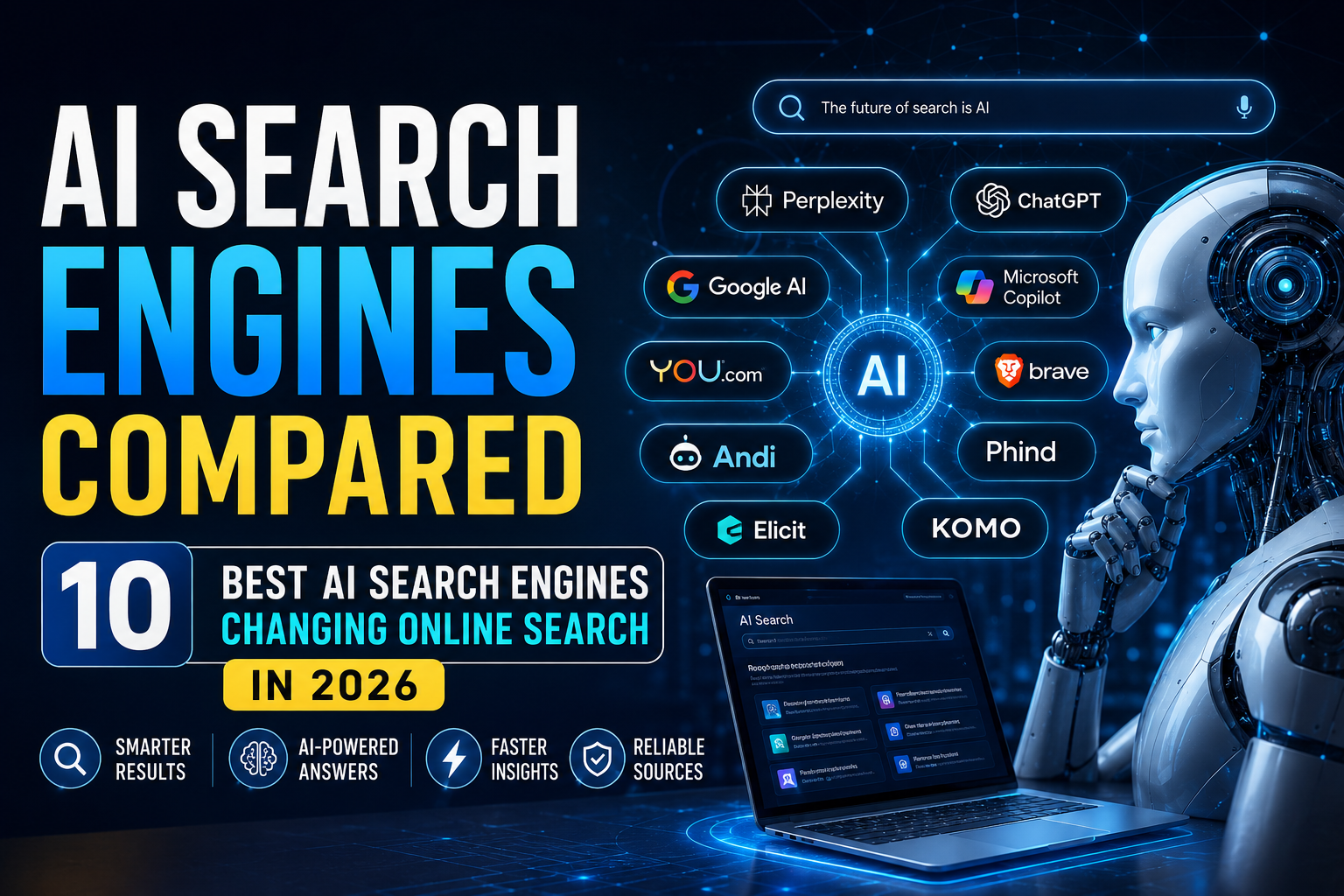
The rise of AI search engines is reshaping how people discover information online. After spending more than 15 years evaluating search technologies, research platforms, enterprise knowledge systems, and AI-powered assistants, I can confidently say that search is experiencing its biggest transformation since Google revolutionized the web.
Traditional search engines were designed to help users find webpages. Modern search engines powered by AI are designed to help users find answers.
Instead of scrolling through dozens of links, users can now ask complex questions and receive summarized responses, source-backed insights, recommendations, and even step-by-step explanations in seconds.
The rapid adoption of generative AI, Large Language Models (LLMs), semantic search systems, and conversational interfaces has accelerated the shift toward intelligent information retrieval. Students, researchers, marketers, business professionals, and content creators increasingly rely on AI-driven search experiences to improve productivity and reduce research time.
In this comprehensive AI search engine comparison, I’ll share practical insights, strengths, weaknesses, and real-world observations from extensively testing today’s leading platforms.
What Are AI Search Engines?
AI search engines are intelligent search platforms that combine traditional web indexing with artificial intelligence technologies to understand user intent, analyze context, and generate direct answers.
Unlike conventional search engines that primarily return links, AI-powered systems synthesize information from multiple sources and present it in a conversational format.
Core Technologies Behind AI Search
Modern AI search platforms rely on:
- Large Language Models (LLMs)
- Natural Language Processing (NLP)
- Semantic Search
- Machine Learning
- Knowledge Graphs
- Retrieval-Augmented Generation (RAG)
- Generative AI
These technologies enable search systems to understand nuanced questions, recognize context, and deliver more relevant responses.
For example, instead of searching:
“Best laptop for graphic design 2026”
Users can ask:
“I’m a freelance graphic designer working with Adobe Creative Cloud. Which laptop should I buy under $1,500?”
The AI understands the context and provides a personalized recommendation.

Why AI Search Engines Are Transforming Online Research
The biggest reason users are switching to AI search engines is efficiency.
Over the years, I have watched research workflows evolve from manually reviewing dozens of webpages to obtaining comprehensive summaries within seconds.
Key benefits include:
Faster Answers
Users receive direct responses instead of searching through multiple websites.
Conversational Search
Questions can be asked naturally, similar to speaking with a knowledgeable assistant.
Reduced Information Overload
AI summarizes large amounts of information into digestible insights.
Better Context Understanding
Follow-up questions maintain context without requiring repeated searches.
Increased Productivity
Researchers, students, and professionals often save hours every week.
AI Search Engine Comparison – Top Platforms Reviewed
Perplexity AI
Perplexity AI has quickly become one of the strongest contenders for the best AI search engine title.
Features
- Real-time web search
- Source citations
- Follow-up conversations
- Research-focused interface
- Multiple AI model options
Pros
- Excellent citations
- Fast answers
- Strong research capabilities
- Transparent sourcing
Cons
- Advanced features require subscription
- Occasional source inconsistencies
Best Use Cases
- Academic research
- Fact-checking
- Market analysis
- Content research
ChatGPT Search
ChatGPT Search combines conversational AI with real-time web access.
Features
- Natural language interaction
- Live web search
- Deep reasoning capabilities
- Multimodal support
Pros
- Outstanding user experience
- Excellent explanations
- Strong contextual understanding
Cons
- Responses may occasionally be verbose
- Citation depth varies by query
Best Use Cases
- Learning
- Content creation
- Professional research
- Business analysis
Google AI Mode
Google’s AI-powered search experience represents a major evolution of traditional search.
Features
- AI-generated overviews
- Deep integration with Google Search
- Real-time indexing
- Context-aware responses
Pros
- Massive web coverage
- Familiar interface
- Strong factual retrieval
Cons
- Less conversational than competitors
- AI summaries may reduce website traffic
Best Use Cases
- General web research
- Everyday search tasks
- Product discovery
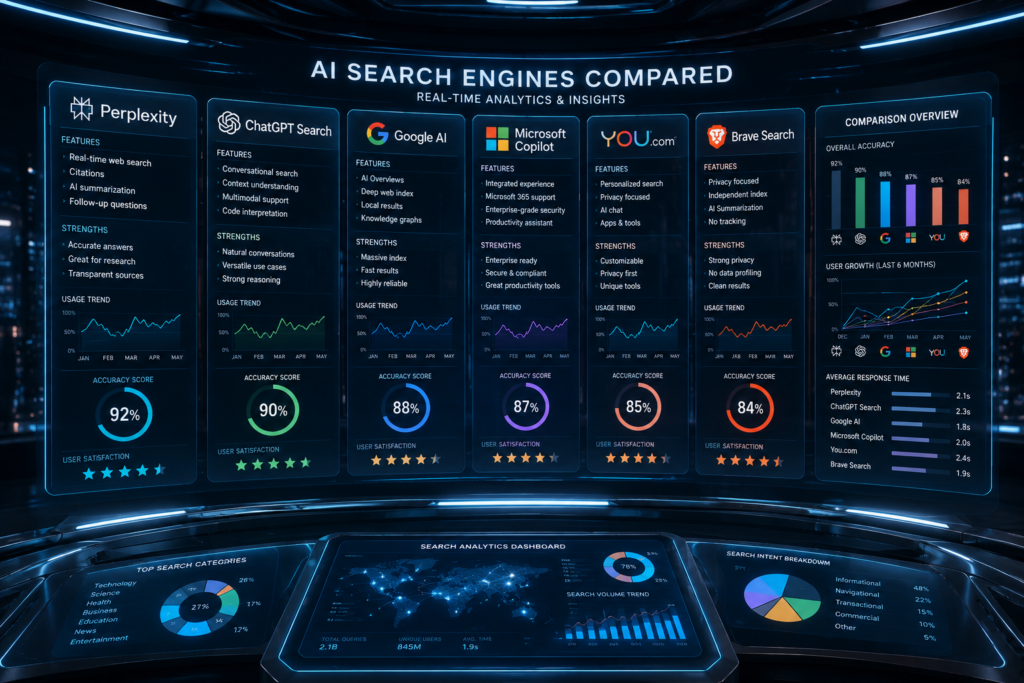
Microsoft Copilot Search
Microsoft continues expanding AI search through Copilot.
Features
- Web-grounded answers
- Enterprise integration
- Productivity tools
- Microsoft ecosystem connectivity
Pros
- Strong workplace integration
- Excellent business applications
- Reliable web citations
Cons
- Best experience within Microsoft’s ecosystem
Best Use Cases
- Enterprise users
- Corporate research
- Productivity workflows
You.com
You.com pioneered customizable AI search experiences.
Features
- AI chat
- Search personalization
- Productivity tools
- Multiple AI models
Pros
- Flexible interface
- Good customization
- Strong productivity focus
Cons
- Smaller user ecosystem
Best Use Cases
- Power users
- Developers
- Productivity enthusiasts
Brave Search AI
Brave Search AI appeals strongly to privacy-conscious users.
Features
- Independent search index
- AI-generated summaries
- Privacy-first architecture
Pros
- Strong privacy protections
- Minimal tracking
- Independent infrastructure
Cons
- Smaller index than Google
Best Use Cases
- Privacy-focused users
- Independent research
- Secure browsing
Comparison Table of the Best AI Search Engines
| AI Search Engine | Best For | AI Features | Citations | Pricing | Overall Rating |
|---|---|---|---|---|---|
| Perplexity AI | Researchers | RAG, AI Answers, Follow-Up Search | Excellent | Free + Premium | 9.5/10 |
| ChatGPT Search | General Users | Conversational Search, Reasoning | Very Good | Free + Premium | 9.4/10 |
| Google AI Mode | Everyday Search | AI Overviews, Search Integration | Good | Free | 9.2/10 |
| Microsoft Copilot | Business Users | AI Search + Productivity | Good | Free + Premium | 9.0/10 |
| You.com | Power Users | Personalized AI Search | Good | Free + Premium | 8.8/10 |
| Brave Search AI | Privacy Users | Independent AI Search | Good | Mostly Free | 8.9/10 |
Search Engines Powered by AI vs Traditional Search Engines
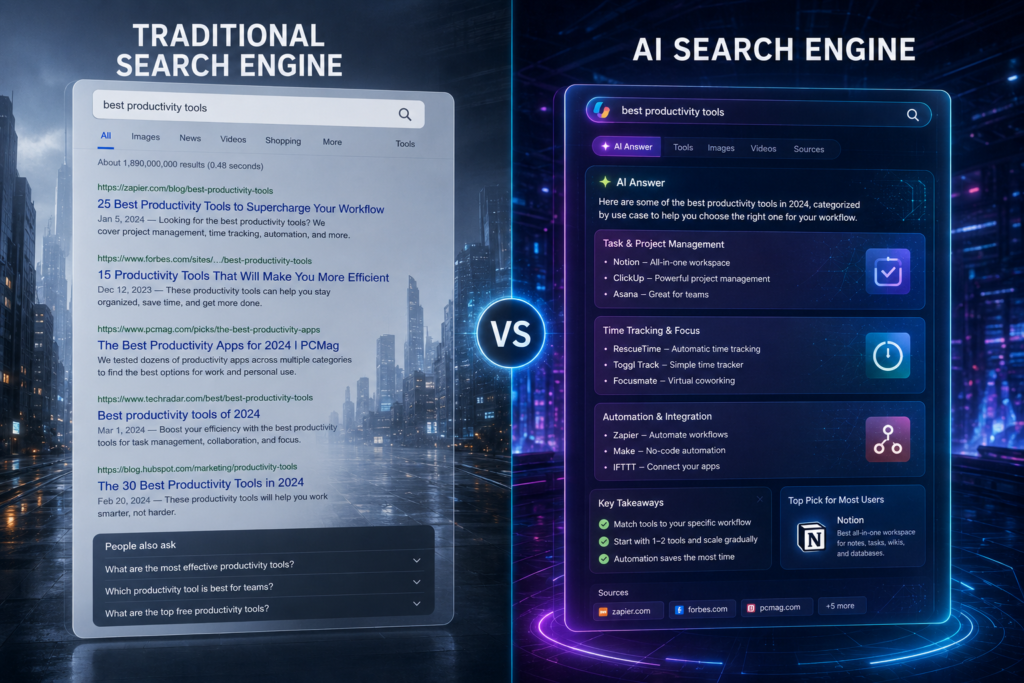
The difference between AI-powered search and traditional search is significant.
| Feature | AI Search Engines | Traditional Search Engines |
|---|---|---|
| Answer Quality | Direct Answers | Links Only |
| Speed | Faster Research | More Manual Effort |
| Context Awareness | High | Limited |
| Follow-Up Questions | Supported | Limited |
| User Experience | Conversational | Keyword-Based |
| Research Efficiency | Excellent | Moderate |
| Citations | Usually Included | Page-Based |
| Learning Curve | Low | Very Low |
Key Observation
Traditional search remains valuable for discovering original sources, while AI search excels at synthesizing information.
The most effective researchers often combine both approaches.
Alternative AI Search Engines Worth Exploring
Beyond mainstream platforms, several alternative AI search engines deserve attention.
Emerging Platforms
- Phind
- Komo Search
- Andi Search
Privacy-Focused AI Search
- Brave Search AI
- Neeva-inspired privacy projects
Research-Focused AI Tools
- Elicit
- Consensus
- Semantic Scholar AI tools
Specialized Search Systems
- Enterprise knowledge search
- Scientific research platforms
- Industry-specific AI databases
These alternatives often excel within niche use cases.
Which Is the Best AI Search Engine in 2026?
After extensive testing, different platforms excel for different users.
Best for Researchers
Perplexity AI
Outstanding citations and research transparency.
Best for Students
ChatGPT Search
Excellent explanations and learning support.
Best for Professionals
Microsoft Copilot
Deep productivity integration.
Best for Content Creators
ChatGPT Search
Superior ideation and content planning.
Best for Businesses
Microsoft Copilot
Enterprise-grade workflows.
Best Overall Choice
Perplexity AI
Currently offers the strongest balance of accuracy, transparency, usability, and research quality.

Common Limitations of AI Search Engines
Despite rapid progress, AI search systems still face challenges.
Hallucinations
AI can occasionally generate inaccurate information.
Source Reliability
Not all cited sources are equally trustworthy.
Privacy Concerns
User queries may be processed by external AI systems.
Bias
Training data may introduce unintended biases.
Cost Limitations
Premium research features often require subscriptions.
Accuracy Challenges
Complex topics still require human verification.
My recommendation is simple: always verify important information using primary sources.
Future of AI Search Engines
The future of AI search appears exceptionally promising.
Key trends include:
Agentic Search
AI agents will complete research tasks autonomously.
Personalized Search
Search results will adapt to user preferences and goals.
Multimodal Search
Text, image, video, and voice search will merge seamlessly.
Voice-Powered AI Search
Conversational voice interfaces will become mainstream.
Enterprise AI Search
Organizations will deploy AI across internal knowledge systems.
Future Predictions
Within five years, many users may interact with AI assistants first and traditional search interfaces second.
Industry research from organizations such as OpenAI, Google AI, Microsoft, Stanford, Gartner, McKinsey, and MIT Technology Review continues to highlight AI’s growing role in information retrieval and decision-making.

Final Verdict
The evolution of AI search engines is fundamentally changing how information is discovered, analyzed, and consumed.
From my experience evaluating search technologies over the past 15 years, today’s leading platforms already deliver substantial productivity gains compared to traditional search alone.
Key Findings
- Perplexity AI leads research-focused search.
- ChatGPT Search offers the most natural conversational experience.
- Google AI Mode benefits from Google’s massive index.
- Microsoft Copilot excels in business environments.
- Brave Search AI remains a strong privacy-focused option.
- You.com provides valuable customization capabilities.
Recommendations by User Type
| User Type | Recommended Platform |
|---|---|
| Researchers | Perplexity AI |
| Students | ChatGPT Search |
| Professionals | Microsoft Copilot |
| Content Creators | ChatGPT Search |
| Privacy Users | Brave Search AI |
| General Users | Google AI Mode |
The best AI search engine ultimately depends on your goals. However, if I were recommending a single platform today for most users, Perplexity AI currently provides the strongest overall balance of accuracy, citations, usability, and research efficiency.
As AI continues advancing, expect search experiences to become more conversational, personalized, multimodal, and proactive. The era of simply typing keywords into a search box is gradually giving way to intelligent assistants capable of understanding, reasoning, and helping users navigate an increasingly complex information landscape.
FAQS
1. What is an AI search engine?
An AI search engine uses artificial intelligence technologies such as natural language processing (NLP), machine learning, and generative AI to understand user queries and provide direct, context-aware answers instead of simply displaying a list of links.
2. How do AI search engines differ from traditional search engines?
Traditional search engines primarily rank and display web pages based on relevance, while AI search engines analyze information from multiple sources and generate concise, conversational responses tailored to the user’s question.
3. Which is the best AI search engine in 2026?
The best AI search engine depends on your needs. Some excel at research and fact-finding, while others focus on real-time web search, academic content, or productivity features. Popular options include AI-powered platforms like Perplexity, ChatGPT Search, Google AI Search, and You.com.
4. Are AI search engines more accurate than Google?
AI search engines can provide faster and more direct answers, but accuracy varies depending on the model and sources used. It’s still important to verify critical information using authoritative sources.
5. Can AI search engines provide real-time information?
Many modern AI search engines offer real-time web access and can retrieve current news, market updates, weather information, and recent events, making them useful for up-to-date research.
6. Are AI search engines free to use?
Most AI search engines offer free versions with basic features. Premium plans often include advanced AI models, faster response times, higher usage limits, and additional research tools.
7. Which AI search engine is best for academic research?
For academic research, AI search engines that provide source citations, scholarly references, and research summaries are generally preferred. Some platforms specialize in scientific papers and educational content.
8. Do AI search engines replace traditional search engines?
Not entirely. AI search engines complement traditional search by providing summarized answers, while conventional search engines remain valuable for discovering websites, comparing sources, and conducting in-depth research.
9. Are AI search engines safe and private?
Privacy policies vary by platform. Users should review data collection practices, search history policies, and security features before choosing an AI search engine for sensitive research or business use.
10. What is the future of AI search engines?
The future of AI search includes personalized search experiences, multimodal capabilities (text, image, video, and voice), real-time reasoning, and AI assistants that can complete tasks rather than simply finding information.
Will AI search engines replace Google in the future?
While AI search engines are transforming how people find information, Google and other traditional search engines continue to evolve by integrating AI features. The future is likely to involve a combination of AI-generated answers and traditional web search results rather than a complete replacement.
Author

razakh6402@gmail.com
Related Posts
Document Management Software: Top Document Management Software Compared (2026 Guide)
- 0
- 1,895 word
Not long ago, managing business documents meant overflowing filing cabinets, misplaced contracts, and countless hours spent searching for the right file. Even...
Read out all
AI Website Builder: Best AI Website Builders Compared (2026 Guide)
- 0
- 2,412 words
A decade ago, building a professional website meant writing HTML, CSS, JavaScript, and often PHP from scratch. Later, drag-and-drop builders like WordPress...
Read out all
AI vs Human Creativity: Can AI Replace Creative Jobs in 2026? (Expert Analysis)
- 0
- 2,449 words
The conversation around AI vs human creativity has become one of the most fascinating and controversial topics in technology. Every week, new...
AI Course Creator: Top AI Tools for Online Courses in 2026 (Expert-Tested Guide)
- 0
- 1,935 word
I’ve spent years researching instructional design, evaluating learning platforms, and following the evolution of educational technology. One trend has become impossible to...
Read out all
AI Browser Extensions: Best AI Chrome Extensions for Productivity in 2026 (Expert-Tested Guide)
- 0
- 2,414 words
Artificial intelligence has quietly become one of the biggest productivity upgrades I’ve experienced during my career. Over the past 15 years of...
Read out all
AI Agents in 2026: How AI Agents for Work Are Transforming Everyday Productivity
- 2
- 2,405 words
A few years ago, most businesses viewed artificial intelligence as a helpful assistant for answering questions or generating content. Today, the conversation...
Read out all
1 comment