- 0
- 1,920 word
Over the past 25 years, I have watched industries evolve from isolated automation systems and basic engineering simulations to highly connected, intelligent ecosystems driven by data. Among all the technologies that have emerged during this transformation, digital twin technology stands out as one of the most impactful innovations reshaping modern business operations.
Today, organizations are under immense pressure to improve efficiency, reduce costs, enhance sustainability, and accelerate innovation. Traditional monitoring systems can no longer keep up with the complexity of modern industrial environments. This is where digital twins are changing the game.
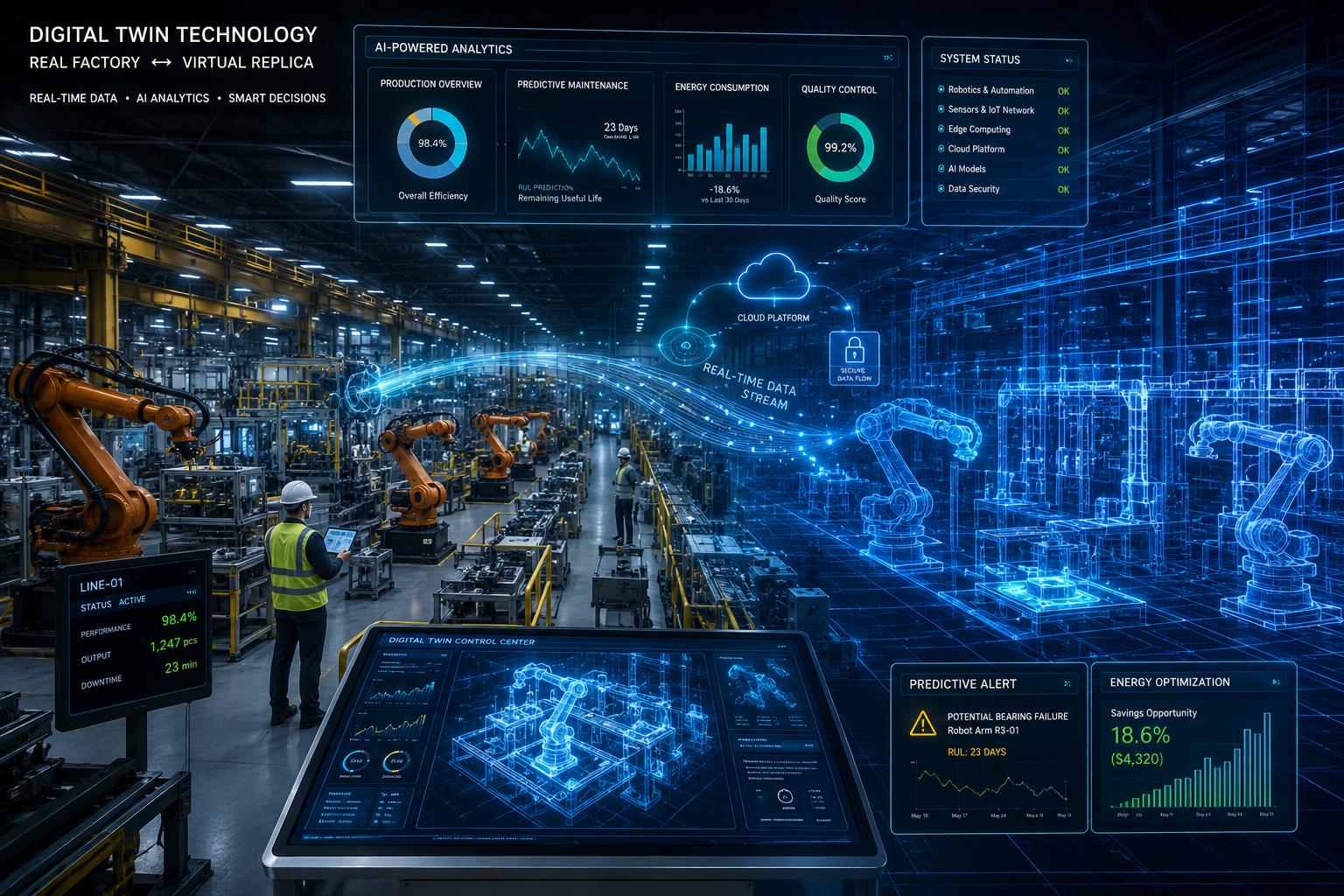
From manufacturing plants and aerospace systems to hospitals, smart cities, energy grids, and autonomous vehicles, digital twin technology enables organizations to create dynamic virtual replicas of physical assets, processes, and systems. These virtual models continuously receive real-time data, allowing businesses to predict problems, optimize performance, and make smarter decisions.
As Industry 4.0 continues to mature in 2026, digital twins are no longer experimental projects. They are becoming a strategic foundation for digital transformation initiatives worldwide.
What Is Digital Twin?
When people ask, “what is digital twin?”, I often explain it in simple terms:
A digital twin is a living digital representation of a physical object, process, system, or environment that continuously receives data from its real-world counterpart.
Definition of Digital Twin Technology
Digital twin technology combines IoT sensors, cloud computing, artificial intelligence, engineering simulations, and analytics to create a virtual model that mirrors real-world behavior in real time.
Unlike traditional simulations that operate with static data, digital twins constantly evolve based on live operational information.
How Digital Twins Create Virtual Replicas
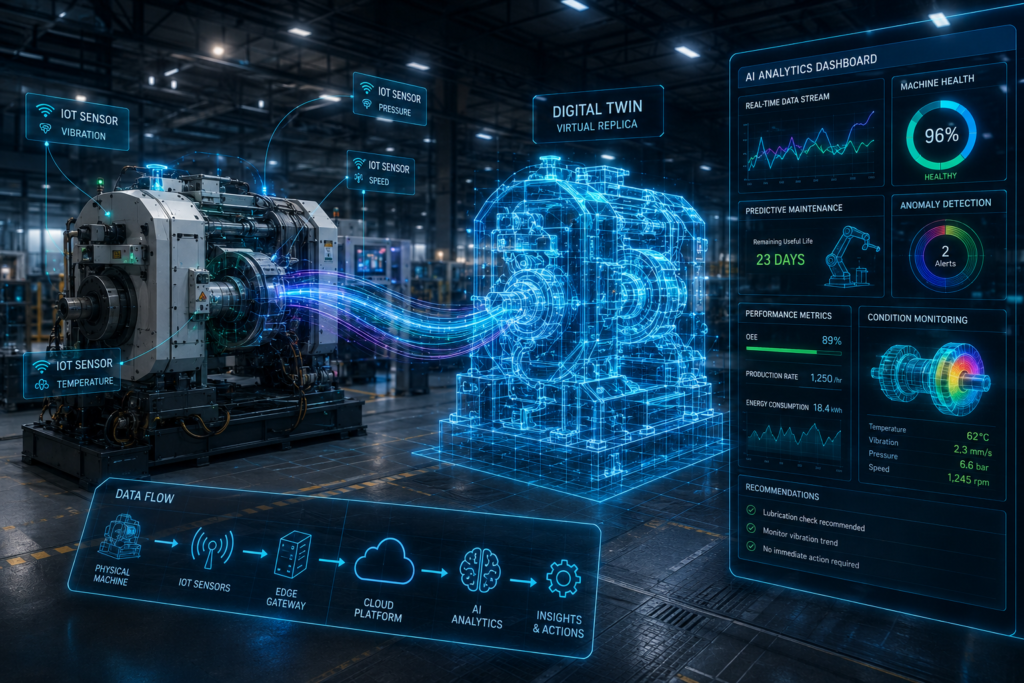
A digital twin captures operational data from sensors installed on physical assets. This information is transmitted to digital platforms where advanced algorithms recreate the asset’s current condition, performance, and behavior.
Real-Time Synchronization
The key difference between a digital model and a digital twin is synchronization.
A digital twin continuously updates itself based on real-world conditions, allowing operators to monitor performance, predict failures, and simulate future scenarios.
Why Organizations Are Investing in Digital Twins
In my consulting projects, executives are increasingly investing in digital twins because they provide:
- Greater operational visibility
- Improved asset utilization
- Predictive maintenance capabilities
- Reduced downtime
- Faster product development
- Better decision-making
Simple Real-World Example
Consider a wind turbine. Sensors collect data about temperature, vibration, wind speed, and energy production. The digital twin receives this information in real time and can predict component failures before they occur, helping maintenance teams intervene proactively.
Data Collection Layer
The foundation of digital twin technology is data acquisition.
Modern industrial assets are equipped with:
- IoT sensors
- Connected devices
- Smart controllers
- Edge computing systems
These technologies continuously collect information such as temperature, pressure, vibration, energy consumption, and performance metrics.
Real-time monitoring allows organizations to gain instant visibility into operational conditions.
Digital Model Creation
Once data is collected, engineers create digital representations using:
- 3D modeling tools
- CAD integration
- Engineering simulation software
- Physics-based modeling
These models replicate the physical characteristics and operational behavior of assets.
AI and Analytics Layer
Artificial intelligence transforms raw data into actionable insights.
This layer enables:
- Machine learning analysis
- Predictive maintenance
- Process optimization
- Anomaly detection
- Real-time decision making
In many factories I have worked with, AI-powered digital twins have reduced unexpected equipment failures by identifying subtle warning signs weeks before breakdowns occur.
Feedback Loop
The most powerful aspect of digital twins is the continuous feedback loop.
As physical systems generate new data, the digital twin updates itself, learns from operational patterns, and recommends improvements. This cycle continuously enhances efficiency and performance.
Evolution of Digital Twins
The journey of digital twins did not begin recently.
In the early stages of my career, engineering teams relied heavily on static simulations to test equipment designs. While useful, these models lacked real-time connectivity.
The evolution followed several key phases:
- Engineering simulations
- Product lifecycle management (PLM)
- Industrial IoT integration
- Cloud computing adoption
- AI-powered analytics
- Autonomous digital ecosystems
The Industrial IoT revolution dramatically accelerated adoption by enabling continuous data collection at scale.
Today, AI-powered digital twin technology is capable of learning, adapting, and even recommending autonomous actions.
Looking ahead, digital twins will evolve into self-optimizing systems capable of managing entire industrial ecosystems with minimal human intervention.
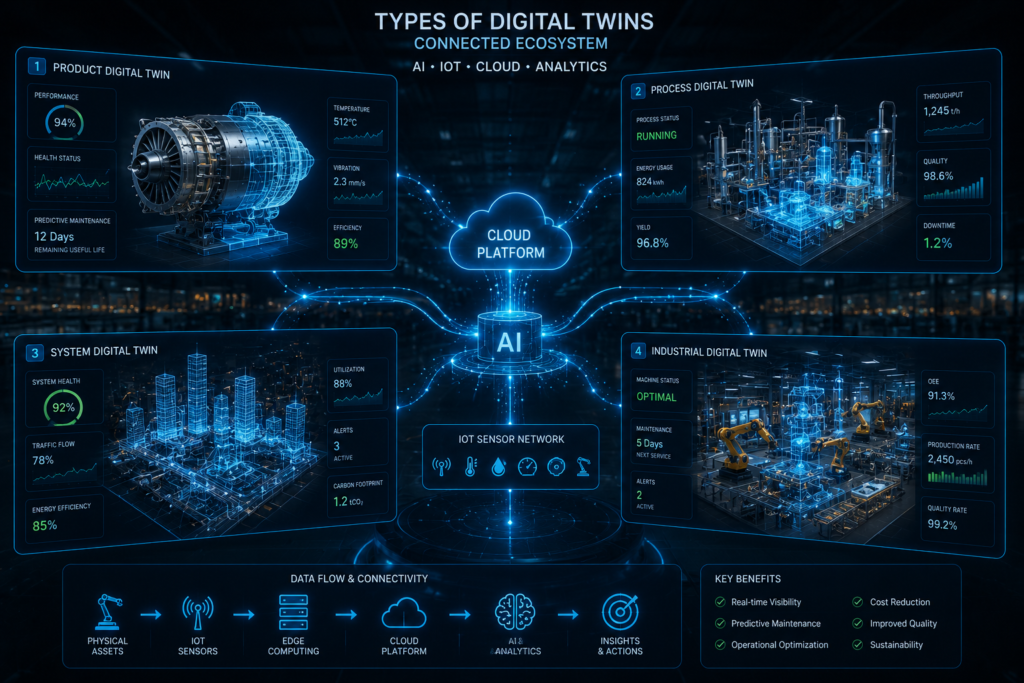
Types of Digital Twins
Product Digital Twins
Product digital twins represent individual products throughout their lifecycle.
Common applications include:
- Product design validation
- Performance monitoring
- Quality improvement
- Lifecycle management
Process Digital Twins
Process digital twins model workflows and operational procedures.
Organizations use them to:
- Improve efficiency
- Reduce bottlenecks
- Optimize production flows
- Enhance resource allocation
System Digital Twins
System digital twins represent interconnected assets working together.
Examples include:
- Transportation networks
- Smart buildings
- Utility infrastructure
- Logistics systems
Industrial Digital Twin
An industrial digital twin combines assets, processes, and systems into a comprehensive operational model.
These solutions provide end-to-end visibility across factories, production lines, supply chains, and maintenance operations.
Manufacturing
Manufacturing remains one of the largest adopters of digital twin applications.
Key benefits include:
- Smart factory optimization
- Predictive maintenance
- Production scheduling
- Quality control
- Resource management
Healthcare
Healthcare organizations use digital twins for:
- Patient monitoring
- Surgical planning
- Personalized treatment
- Medical device optimization
Smart Cities
Smart city initiatives leverage digital twins for:
- Traffic optimization
- Infrastructure monitoring
- Public safety
- Urban planning
Automotive Industry
Automotive manufacturers use digital twins to:
- Simulate vehicle performance
- Test autonomous driving systems
- Improve vehicle reliability
- Accelerate product development
Aerospace
Aerospace companies rely on digital twins for:
- Aircraft maintenance
- Flight performance analysis
- Fuel optimization
- Fleet management
Energy Sector
Energy providers use digital twin applications to optimize:
- Power plants
- Wind farms
- Solar installations
- Smart grids
- Energy distribution networks
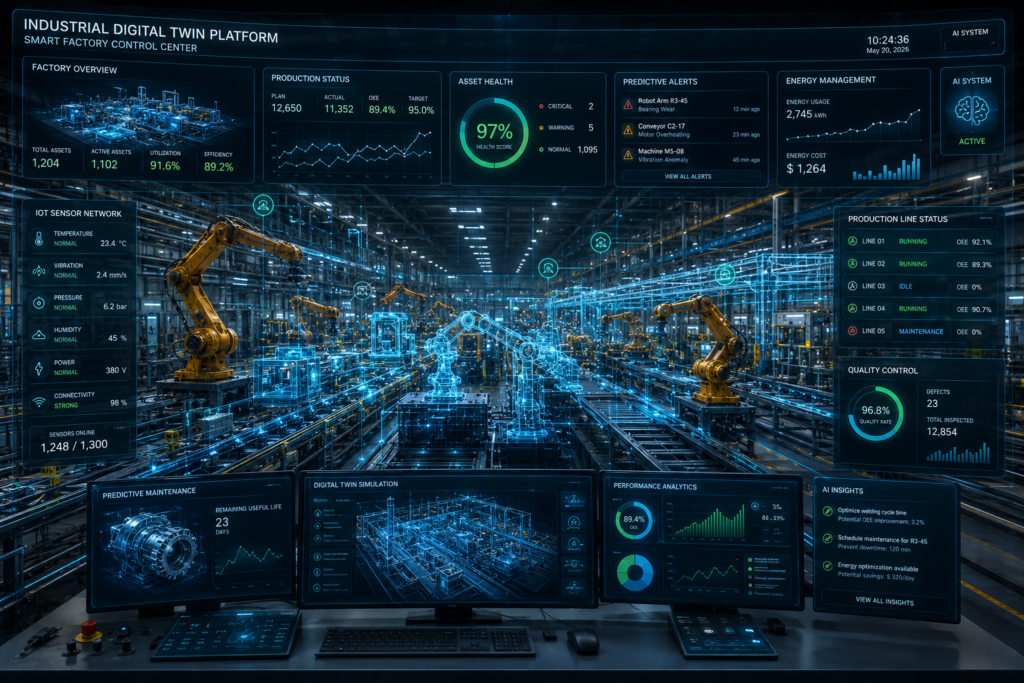
Industrial Digital Twin in Smart Manufacturing
The rise of Industry 4.0 has transformed manufacturing environments into connected ecosystems.
An industrial digital twin serves as the central intelligence platform for these smart factories.
Key capabilities include:
- Real-time equipment monitoring
- Factory optimization
- Supply chain visibility
- Predictive maintenance
- Quality assurance
- Production forecasting
In one manufacturing deployment I observed, a digital twin identified recurring vibration anomalies across multiple production assets. Maintenance teams corrected the issue before major failures occurred, preventing millions of dollars in potential downtime.
This demonstrates why industrial digital twin platforms are rapidly becoming essential operational tools.
Benefits of Digital Twin Technology
Improved Operational Efficiency
Organizations gain complete visibility into operational performance and can continuously optimize processes.
Reduced Downtime
Predictive maintenance helps identify issues before failures occur.
Better Product Quality
Digital twins enable continuous monitoring and quality improvements throughout production cycles.
Cost Savings
Reduced maintenance costs, lower energy consumption, and improved resource utilization contribute to significant savings.
Faster Innovation
Engineers can test new ideas virtually before implementing them physically.
Enhanced Sustainability
Organizations reduce waste, optimize energy usage, and improve environmental performance.
Risk Reduction
Potential failures can be identified and addressed before they impact operations.
Data-Driven Decision Making
Executives gain access to accurate, real-time operational intelligence.
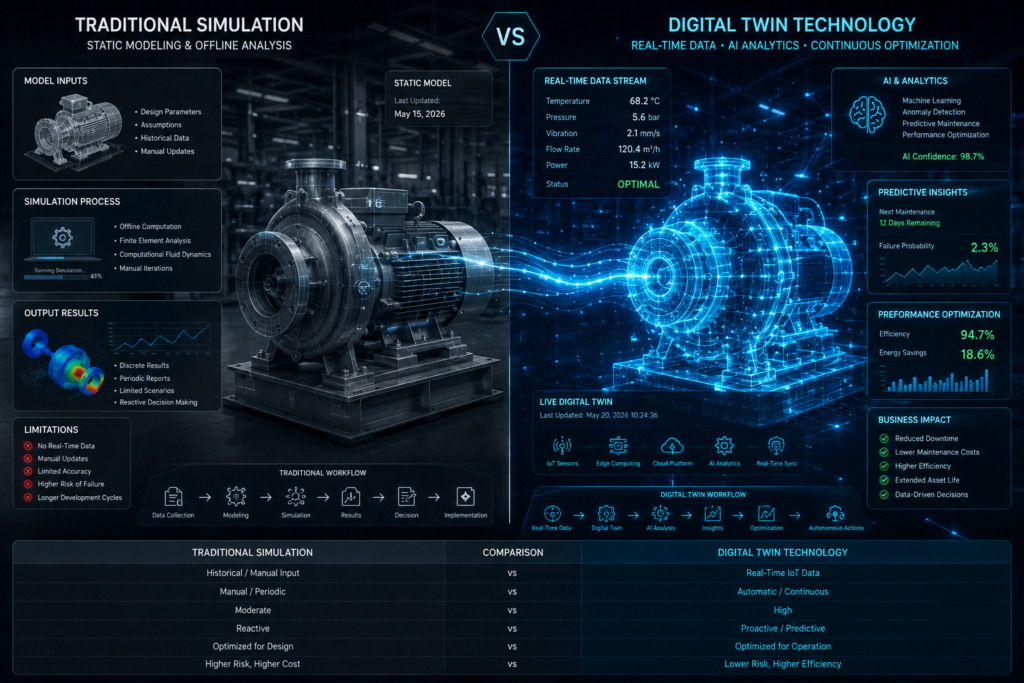
Digital Twin Technology vs Traditional Simulation
| Feature | Digital Twin Technology | Traditional Simulation |
|---|---|---|
| Real-Time Data | Yes | No |
| AI Integration | Extensive | Limited |
| Continuous Updates | Continuous | Static |
| Predictive Analytics | Advanced | Basic |
| Accuracy | High | Moderate |
| Industrial Applications | Extensive | Design-focused |
| Operational Visibility | Real-Time | Historical |
| Decision Making | Dynamic | Scenario-based |
Traditional simulations remain valuable during design phases. However, digital twin technology delivers far greater operational value because it remains connected to real-world assets throughout their lifecycle.
Challenges of Implementing Digital Twins
Despite their benefits, organizations often face implementation challenges.
High Implementation Costs
Initial investments can be substantial, especially for large-scale deployments.
Data Integration Complexity
Connecting legacy systems with modern platforms can be difficult.
Cybersecurity Concerns
Greater connectivity increases cybersecurity risks.
Skilled Workforce Requirements
Successful implementation requires expertise in AI, IoT, data science, and industrial engineering.
Legacy Infrastructure Issues
Older equipment may lack sensor connectivity.
Data Quality Challenges
Poor-quality data can undermine digital twin effectiveness.
Expert Recommendations
Based on my experience, organizations should:
- Start with pilot projects
- Focus on high-value assets
- Invest in data governance
- Build cybersecurity frameworks
- Train internal teams
- Establish measurable success metrics
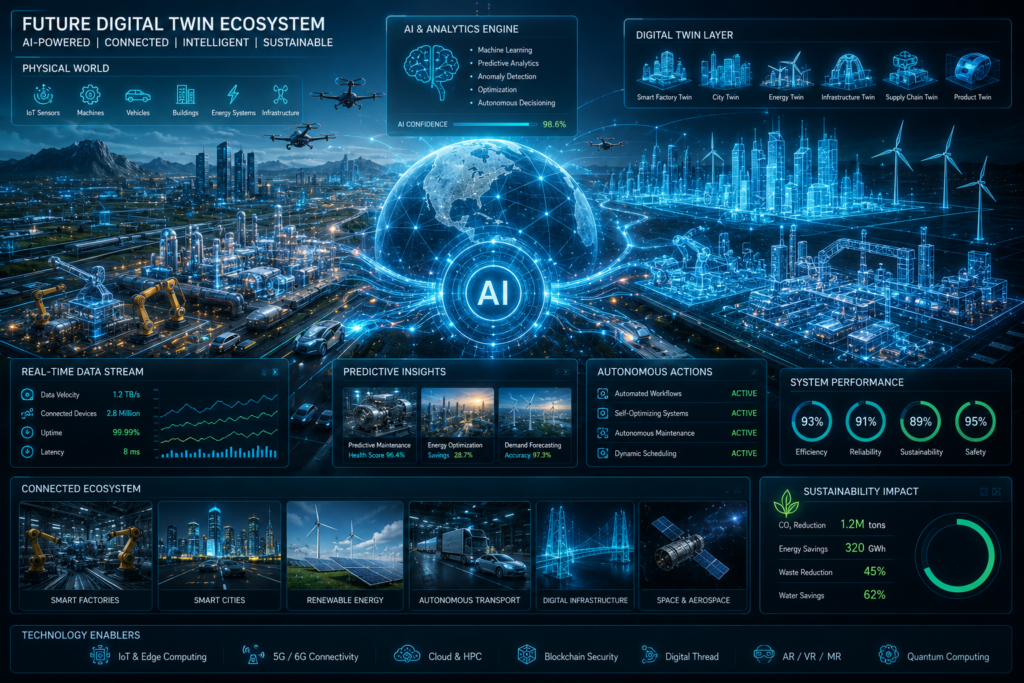
Future of Digital Twin Technology in 2026 and Beyond
The future of digital twin technology is incredibly exciting.
AI-Powered Autonomous Twins
Digital twins will increasingly make autonomous operational decisions.
Generative AI Integration
Generative AI will help create simulations, recommendations, and optimization strategies automatically.
Smart Cities Expansion
Cities worldwide will use digital twins to improve infrastructure management and public services.
Industrial Metaverse
Digital twins will become foundational components of immersive industrial metaverse environments.
Sustainable Operations
Organizations will leverage digital twins to achieve carbon reduction goals and sustainability targets.
Digital Twin Applications in Renewable Energy
Renewable energy operators will increasingly rely on digital twins to maximize efficiency and reliability across solar, wind, and energy storage systems.
Many industry experts believe the next decade will see digital twins become as common as enterprise resource planning systems are today.
Frequently Asked Questions
What is digital twin technology?
Digital twin technology creates virtual replicas of physical assets, systems, or processes that continuously receive real-time operational data.
How do digital twins work?
They combine IoT sensors, cloud platforms, AI analytics, and simulation models to mirror real-world conditions.
What industries use digital twins?
Manufacturing, healthcare, aerospace, automotive, energy, construction, logistics, and smart cities.
What is an industrial digital twin?
An industrial digital twin is a comprehensive virtual representation of industrial assets, processes, and operational systems.
Are digital twins expensive to implement?
Costs vary depending on complexity, but many organizations achieve strong ROI through improved efficiency and reduced downtime.
How does AI improve digital twins?
AI enables predictive analytics, anomaly detection, optimization, and intelligent decision support.
What are the major digital twin applications?
Predictive maintenance, product development, process optimization, quality assurance, and operational monitoring.
Can digital twins improve sustainability?
Yes. They help reduce waste, optimize resource usage, lower emissions, and improve energy efficiency.
What is the future of digital twins?
Future digital twins will become more autonomous, AI-driven, and integrated with industrial metaverse platforms.
How do digital twins support Industry 4.0?
Digital twins provide the real-time intelligence, connectivity, and analytics required for smart manufacturing and autonomous operations.
Conclusion
Digital twin technology has evolved from a specialized engineering concept into one of the most powerful drivers of digital transformation.
As organizations seek greater efficiency, resilience, sustainability, and competitiveness, digital twins are becoming indispensable tools for operational excellence. Whether deployed in manufacturing, healthcare, energy, aerospace, automotive, or smart city environments, these systems provide unprecedented visibility and control.
From my experience working with industrial automation and digital transformation initiatives, the organizations that embrace digital twins today are positioning themselves for long-term success. The combination of AI cloud computing, and industrial digital twin platforms will redefine how businesses operate over the coming decade.
The future belongs to organizations that can see, predict, simulate, and optimize their operations in real time and digital twin technology is making that future a reality.
Author

razakh6402@gmail.com
Related Posts
Lead Generation Software: 12 Best Lead Generation Tools for B2B Sales (2026 Guide)
- 0
- 2,300 words
If someone had asked me 15 years ago what the biggest challenge in sales was, my answer would have been simple: finding...
Survey Software: 12 Best Online Survey Tools & Feedback Software for Businesses (2026 Guide)
- 0
- 1,871 word
Whether I was helping a SaaS startup validate a new feature, assisting an HR team with employee engagement, or optimizing customer experience...
Read out all
Online Course Platform: 12 Best LMS Software & eLearning Platforms for Course Creators (2026 Guide)
- 0
- 1,900 word
The online education industry has changed dramatically over the last 15 years. When I built my first digital training portal, simply uploading...
Team Communication Software: 12 Best Business Messaging Apps for Modern Workplaces in 2026 (Expert Tested)
- 0
- 2,305 words
I’ve personally tested dozens of team communication software platforms while consulting for marketing agencies, software companies, HR departments, remote development teams, and...
Invoice Software: 12 Best Invoicing Software for Small Business in 2026 (Expert Tested)
- 0
- 2,493 words
I’ve worked with freelancers chasing late payments, agencies managing hundreds of monthly invoices, startups scaling internationally, and established businesses struggling with outdated...
Generate one SEO-optimized title thatdigital asset management software
- 6
- 2,632 words
One of the most memorable projects I led involved migrating nearly half a million digital assets from a traditional file server into...