
- 0
- 2,288 words
Over the last fifteen years, I’ve watched financial services evolve from products that required customers to visit a bank into experiences seamlessly integrated into the apps and platforms they already use every day. This transformation is largely driven by embedded finance, one of the most significant innovations reshaping the global financial industry.
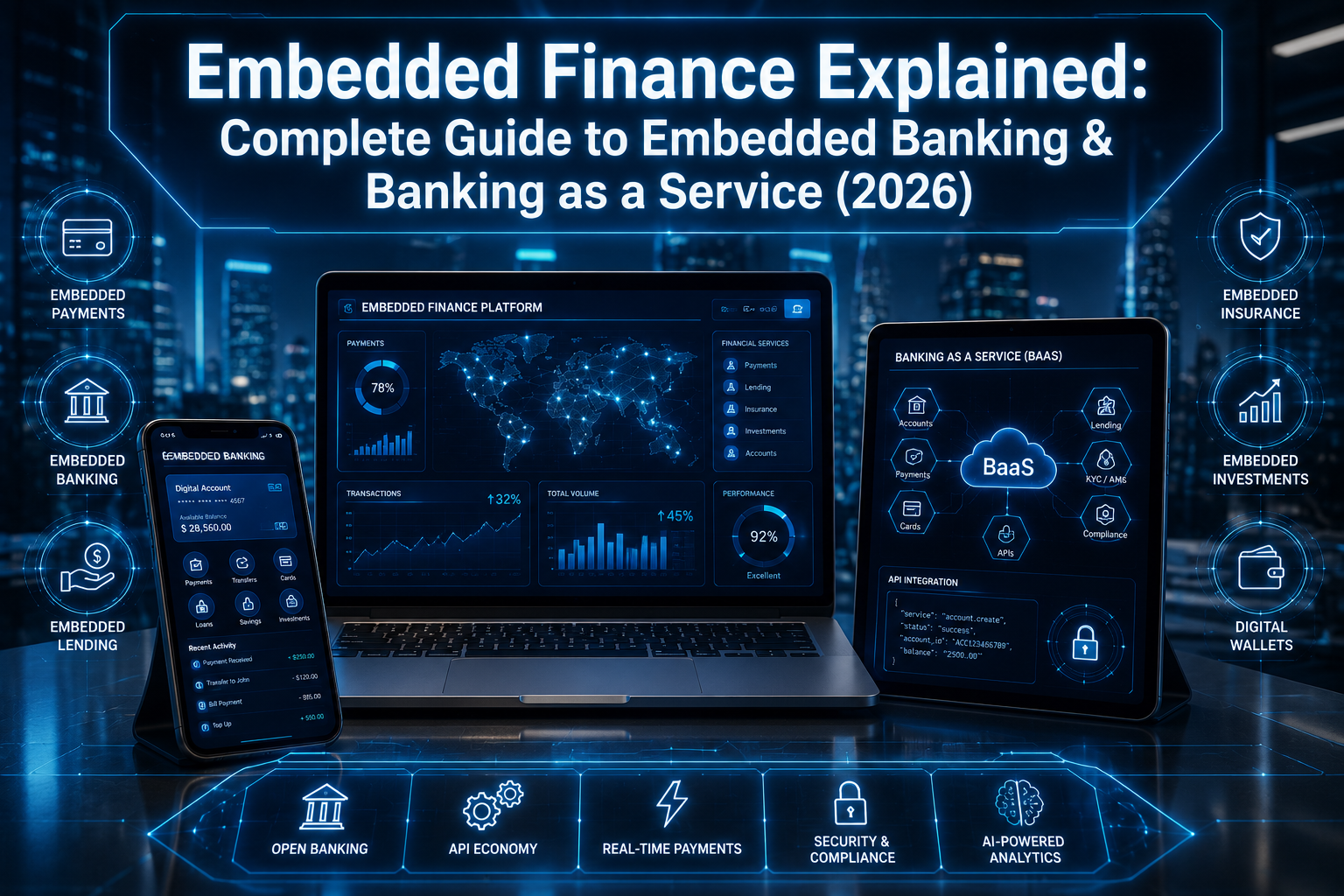
Not long ago, businesses had to redirect customers to external banks or payment providers whenever financing, payments, or insurance services were needed. Today, customers can pay, borrow, insure purchases, open accounts, or even invest without ever leaving the application they’re using. That seamless experience is exactly what embedded finance explained is all about.
Having evaluated fintech ecosystems, Banking-as-a-Service platforms, payment APIs, and enterprise banking integrations across numerous industries, I’ve consistently observed that companies adopting embedded financial services achieve stronger customer engagement, higher conversion rates, and more personalized user experiences.
Consumers often don’t realize they’re interacting with embedded banking because the experience feels completely natural. Whether you’re splitting a restaurant bill through an app, financing an online purchase at checkout, receiving instant insurance during travel booking, or opening a business account inside accounting software, embedded finance is working behind the scenes.
This guide provides a comprehensive embedded finance explained overview, explores how embedded banking operates, explains Banking as a Service (BaaS), examines the latest Open Banking innovations, and highlights why embedded financial services are becoming a core part of digital commerce in 2026.
What Is Embedded Finance?
Embedded finance refers to the integration of financial products and services directly into non-financial platforms, applications, or websites. Instead of sending customers to a separate bank or financial institution, businesses can offer banking capabilities inside their own digital ecosystem.
Simply put, embedded finance explained means bringing financial services to where customers already are.
Examples include:
- Buy Now, Pay Later (BNPL) at online checkout
- In-app business banking
- Embedded insurance during travel bookings
- Ride-sharing apps with integrated payments
- Digital wallets inside e-commerce platforms
- Instant lending within shopping apps
- Embedded investment products
- Payroll and employee financial benefits
One observation I’ve consistently made is that customers rarely think about the technology behind these experiences. They simply appreciate how convenient everything feels. That convenience is the greatest strength of embedded finance.
Another reason embedded financial services continue growing rapidly is that they reduce friction. Every extra screen, login, or redirect increases the chance of losing a customer. Embedded solutions eliminate many of these barriers.

Key Characteristics of Embedded Finance
Modern embedded finance platforms typically include:
- Integrated payments
- Embedded lending
- Digital wallets
- Banking APIs
- Identity verification
- Fraud detection
- AI-powered financial recommendations
- Real-time transaction processing
- Embedded insurance
- Investment services
Unlike traditional banking, users often don’t even notice they’re interacting with a financial institution.
Why Businesses Are Investing in Embedded Finance
After consulting numerous fintech companies and enterprise software providers, I’ve noticed that organizations adopt embedded banking for three primary reasons:
- Better customer experiences
- Higher customer retention
- New revenue opportunities
Rather than sending customers elsewhere, businesses can keep the entire financial journey inside their own platform.
How Embedded Finance Works
Many people understand the customer experience but wonder what happens behind the scenes.
The answer lies in APIs, cloud infrastructure, regulated financial institutions, and Banking as a Service (BaaS) platforms.
Rather than building an entire bank from scratch, businesses connect to financial providers using secure APIs that expose banking capabilities inside their own applications.
The result is a seamless customer experience.
Banking as a Service (BaaS)
No discussion of embedded finance explained is complete without understanding Banking as a Service.
Banking as a Service (BaaS) allows licensed financial institutions to provide banking infrastructure through APIs that third-party companies can integrate into their own products.
Instead of becoming a licensed bank, a business can partner with a BaaS provider to offer:
- Bank accounts
- Debit cards
- Payment processing
- Money transfers
- Lending
- Savings accounts
- Compliance services
One trend I’ve observed over the last several years is that BaaS has dramatically lowered the barrier to entry for fintech innovation. Companies that were never considered financial institutions can now deliver sophisticated embedded banking experiences without building complex banking infrastructure themselves.
APIs and Open Banking
APIs are the backbone of embedded finance.
An API (Application Programming Interface) allows different software systems to communicate securely.
Open Banking extends this concept by enabling regulated financial data sharing—always with customer consent—between banks and authorized third-party providers.
Together, APIs and Open Banking make it possible to deliver:
- Account verification
- Payment initiation
- Balance checking
- Transaction history
- Credit assessments
- Identity verification
- Personal finance management
- Investment services
In my experience evaluating enterprise fintech projects, the most successful implementations prioritize both security and user experience. Customers expect financial services to work instantly, but they also expect their data to remain protected. Well-designed APIs make both possible.
Payment Infrastructure
Behind every successful embedded financial services platform is a sophisticated payment infrastructure.
Although users only see a simple “Pay Now” button, several technologies work together in milliseconds to complete a secure transaction.
These typically include:
- Payment gateways
- Payment processors
- Banking APIs
- Tokenization services
- Fraud detection engines
- Identity verification
- Card networks
- Digital wallets
- Real-time payment systems
One common misconception is that businesses offering embedded payments become banks themselves. In reality, most organizations rely on regulated partners while focusing on delivering a seamless customer experience.
How an Embedded Finance Transaction Works
A typical embedded finance payment follows these steps:
- A customer initiates a purchase within an app or platform.
- The application securely connects to a Banking-as-a-Service provider through APIs.
- The payment request is encrypted and routed through the payment network.
- Identity verification and fraud detection checks run automatically.
- The issuing bank authorizes the transaction.
- Funds are transferred securely.
- The customer receives instant confirmation without leaving the platform.
This seamless process illustrates why embedded finance is becoming the preferred model for modern digital commerce.

Embedded Banking Explained
Embedded banking extends beyond payments by allowing non-financial businesses to integrate core banking capabilities directly into their platforms.
Examples include:
- E-commerce platforms offering business bank accounts
- Accounting software providing embedded invoicing and payments
- HR platforms integrating employee payroll accounts
- Marketplace apps offering merchant financing
- Logistics platforms enabling fuel cards and expense management
- Gig economy platforms providing instant earnings payouts
One insight I’ve consistently gained from working with enterprise fintech solutions is that customers increasingly value convenience over complexity. They no longer want separate apps for banking, payments, financing, and investments if those services can be delivered seamlessly within the platforms they already use.
The continued growth of embedded banking, combined with AI-powered financial services, Open Banking, digital identity verification, real-time payments, and intelligent risk analysis, is redefining what customers expect from financial products in 2026.
Professional Insight
The biggest lesson I’ve learned from evaluating embedded finance platforms is that success isn’t determined by how many financial features a business offers—it’s determined by how invisible those features become. The most effective embedded financial services don’t interrupt the customer journey; they enhance it by delivering the right financial solution at exactly the right moment.

Embedded Financial Services
One of the reasons embedded finance has gained momentum is the growing variety of embedded financial services businesses can offer without becoming banks themselves. Through Banking as a Service, APIs, and regulated financial partners, companies can integrate financial tools directly into their products.
Embedded Payments
Embedded payments allow customers to complete transactions without leaving an app or website.
Common examples include:
- Online marketplace checkout
- Ride-sharing payments
- Food delivery apps
- Subscription billing
- In-app purchases
In my experience evaluating digital commerce platforms, reducing checkout friction almost always improves conversion rates.
Embedded Lending
Embedded lending enables businesses to offer financing exactly when customers need it.
Examples include:
- Buy Now, Pay Later (BNPL)
- Business financing
- Merchant cash advances
- Equipment financing
- Working capital loans
Rather than applying through a separate lender, customers receive financing within the purchasing experience.
Embedded Insurance
Insurance is increasingly becoming part of digital customer journeys.
Examples include:
- Travel insurance during flight bookings
- Device protection during electronics purchases
- Shipping insurance
- Vehicle insurance inside mobility apps
This creates a more convenient customer experience while generating additional revenue opportunities.

Embedded Investments
Modern fintech platforms now integrate investment services directly into consumer applications.
These include:
- Fractional investing
- Automated portfolios
- ETF investing
- Retirement savings
- Robo-advisors
Customers no longer need separate investment platforms for basic investing needs.
Embedded Digital Wallets
Digital wallets have become one of the most visible forms of embedded financial services.
Modern wallets support:
- Contactless payments
- Peer-to-peer transfers
- Loyalty programs
- Rewards
- Multi-currency accounts
- Digital identity verification
Embedded Finance vs Traditional Banking
Businesses often ask whether embedded finance replaces traditional banking.
From what I’ve observed across enterprise implementations, the answer is no.
Instead, embedded banking complements traditional financial institutions by delivering banking capabilities where customers already spend their time.
Comparison Table
| Feature | Embedded Finance | Traditional Banking | Digital Banking | Fintech Platforms |
|---|---|---|---|---|
| Customer Experience | Integrated into apps | Branch & online | Digital-first | App-first |
| Speed | Instant | Moderate | Fast | Very Fast |
| API Integration | Extensive | Limited | Moderate | Extensive |
| Banking Integration | Built into products | Standalone | Separate apps | Platform-based |
| Payments | Embedded | Available | Available | Advanced |
| Lending | Contextual | Traditional | Digital | Flexible |
| Insurance | Embedded | Separate products | Limited | Partner-based |
| Scalability | High | Moderate | High | Very High |
| Business Flexibility | Excellent | Limited | Moderate | Excellent |
| Security | Enterprise-grade APIs | Strong regulation | Strong | Strong |
| Best Use Cases | Digital platforms & marketplaces | Full-service banking | Everyday banking | Innovation & growth |
Benefits for Businesses
Businesses adopting embedded finance often experience:
- Higher customer retention
- Increased revenue opportunities
- Better user engagement
- Faster checkout experiences
- Lower customer acquisition costs
- New financial service offerings
Many organizations I’ve worked with initially viewed embedded financial services as a convenience feature. They quickly discovered it also became a significant competitive advantage.
Benefits for Consumers
Consumers benefit from:
- Fewer applications
- Faster approvals
- Personalized offers
- Simplified payments
- Seamless financial experiences
- Reduced friction
Financial services become available exactly when needed.
Benefits for Financial Institutions
Banks also gain advantages through Banking as a Service.
Benefits include:
- New distribution channels
- Increased API usage
- Partnership opportunities
- Expanded customer reach
- Additional revenue streams
Rather than competing with fintech companies, many banks now collaborate with them.

Industries Using Embedded Finance
The adoption of embedded finance now extends far beyond fintech startups.
E-commerce
Online retailers integrate:
- Embedded payments
- Buy Now, Pay Later
- Merchant financing
- Digital wallets
Healthcare
Healthcare providers increasingly offer:
- Patient financing
- Insurance verification
- Digital payments
- Installment plans
Travel
Travel platforms frequently include:
- Travel insurance
- Currency conversion
- Embedded payments
- Loyalty rewards
SaaS
Business software platforms now integrate:
- Business accounts
- Payroll
- Expense management
- Invoice payments
Mobility
Ride-sharing and transportation companies utilize:
- Driver payouts
- Fleet financing
- Fuel cards
- Digital wallets
Challenges and Risks
Although embedded finance offers tremendous opportunities, successful implementation requires careful planning.
Common challenges include:
- Regulatory compliance
- Data privacy
- Cybersecurity
- API reliability
- Fraud prevention
- Customer trust
- Vendor dependency
One mistake I frequently observe is organizations focusing solely on user experience while underestimating compliance and security requirements. Strong governance, encryption, and continuous monitoring are essential for long-term success.
Future of Embedded Finance (2026)
The future of embedded finance looks exceptionally promising.
Major trends shaping the industry include:
- AI-powered financial assistants
- Banking as a Service expansion
- Embedded lending powered by AI risk assessment
- Real-time cross-border payments
- Open Banking ecosystems
- Embedded insurance growth
- Tokenized payment infrastructure
- Digital identity verification
- Financial inclusion initiatives
- Enterprise fintech platforms
- Hyper-personalized financial products
Another trend I’m closely following is the convergence of AI and embedded finance. Businesses are beginning to offer personalized lending, savings, and payment experiences based on real-time customer behavior while maintaining strong privacy controls and regulatory compliance.
Frequently Asked Questions
What is embedded finance?
Embedded finance refers to integrating financial services such as payments, lending, insurance, and banking directly into non-financial applications or platforms.
What is Banking as a Service (BaaS)?
Banking as a Service enables licensed financial institutions to provide banking capabilities through APIs, allowing other businesses to offer financial services without becoming banks.
Is embedded finance secure?
Yes. Modern embedded financial services rely on encryption, tokenization, digital identity verification, AI fraud detection, and regulatory compliance to protect transactions and customer data.
Which industries benefit the most?
E-commerce, healthcare, travel, SaaS, mobility, marketplaces, and enterprise software providers are among the biggest adopters of embedded banking.
Will embedded finance replace traditional banking?
No. Embedded finance complements traditional banking by extending financial services into digital customer experiences rather than replacing banks altogether.

Final Verdict
After spending years evaluating banking technology, fintech platforms, and enterprise financial solutions, one conclusion has become increasingly clear: embedded finance is no longer a niche innovation—it has become a fundamental part of modern digital business.
The greatest strength of embedded finance explained is its ability to deliver financial services exactly when and where customers need them. Whether it’s embedded payments during online shopping, instant lending at checkout, digital wallets inside mobile apps, or insurance integrated into travel bookings, the experience feels seamless because the financial layer is built directly into the customer journey.
For businesses, embedded banking creates opportunities to improve customer satisfaction, increase engagement, and unlock new revenue streams without building a bank from scratch. Through Banking as a Service, Open Banking APIs, and secure payment infrastructure, organizations can launch sophisticated embedded financial services while relying on regulated financial partners for compliance and core banking capabilities.
Looking ahead to 2026 and beyond, AI-powered financial services, real-time payments, cross-border commerce, digital identity verification, tokenization, and personalized financial experiences will continue accelerating adoption. Companies that thoughtfully integrate embedded finance into their products will be better positioned to meet rising customer expectations and compete in an increasingly digital economy.
Author

razakh6402@gmail.com
Related Posts
Digital Payments: Future of Digital Payments, Payment Technology & Online Payment Trends (2026 Guide)
- 0
- 2,609 words
The way we pay for goods and services has changed more in the past decade than it did in the previous fifty...
Contactless Payments Explained: Complete NFC Payment & Tap to Pay Guide (2026)
- 0
- 2,193 words
Over the past fifteen years, I’ve watched payment technology evolve from magnetic stripe cards and PIN terminals to today’s seamless contactless payments...
Neobank vs Traditional Bank: Complete Digital Banking Comparison Guide (2026)
- 0
- 2,379 words
The debate around neobank vs traditional bank has become more relevant than ever as digital banking continues to reshape how people manage...

Financial Planning Software: 10 Best Personal Financial Planning Software & Wealth Management Software (2026 Guide)
- 0
- 2,621 words
Managing money has changed dramatically over the past decade. When I first began advising clients more than 15 years ago, financial planning...
Best Expense Tracking Apps: Top Expense Tracker & Best Expense Management Software (2026 Guide)
- 2
- 2,595 words
Whether you’re running a startup, managing a growing business, freelancing full-time, or simply trying to control your personal finances, one thing remains...

Mobile Banking Security: Complete Guide to Secure Mobile Banking & Banking App Security (2026)
- 0
- 2,221 words
Mobile banking has transformed how we manage our finances. Today, I rarely visit a physical bank branch because almost every transaction from...
Read out all