
- 0
- 2,379 words
The debate around neobank vs traditional bank has become more relevant than ever as digital banking continues to reshape how people manage their money. Fifteen years ago, opening a bank account almost always meant visiting a physical branch, signing paperwork, and waiting days for approval. Today, many people can open an account on their smartphone in less than ten minutes.
Having evaluated banking technologies, fintech platforms, and digital payment systems over the past decade and a half, I’ve watched this transformation unfold from both the consumer and technology sides. Early digital banks focused mainly on convenience, but modern neobanks now compete with established financial institutions by offering intelligent budgeting tools, real-time spending alerts, AI-powered insights, low-cost international transfers, and seamless mobile experiences.
That doesn’t automatically make traditional banks obsolete. Large banks still lead in areas such as mortgage lending, commercial banking, wealth management, and extensive branch networks. The real question isn’t which option is universally better—it’s which one fits your financial needs.
Throughout this guide, we’ll explore the complete neobank vs traditional bank debate, perform a detailed digital bank vs traditional bank analysis, provide an expert neobank comparison, explain the differences between an online bank vs bank, and help you determine the best neobank for different financial situations.
By the end, you’ll have a practical understanding of which banking model aligns best with your lifestyle, business, or long-term financial goals.
What Is a Neobank?
A neobank is a digital-first financial institution that operates primarily through mobile apps and web platforms instead of physical branches. Many neobanks partner with licensed banks to provide regulated banking services, while others operate under their own banking licenses depending on the country.

What Is a Traditional Bank?
Traditional banks are licensed financial institutions that operate both physical branches and digital banking services. Their core strength lies in offering a comprehensive range of financial products beyond everyday banking.
These services typically include:
- Checking accounts
- Savings accounts
- Home mortgages
- Auto loans
- Personal loans
- Credit cards
- Wealth management
- Retirement planning
- Business banking
- Commercial lending
- Safe deposit boxes
While discussing digital bank vs traditional bank, it’s important to recognize that traditional banks have also invested heavily in technology over the last decade. Most major banks now provide robust mobile apps, contactless payments, online account management, and digital customer support.
However, many established banks continue to rely on legacy systems that can slow innovation. I’ve seen banks spend years modernizing infrastructure that newer fintech companies built from scratch in a fraction of the time.
That said, traditional banks remain the preferred choice for customers who value:
- In-person financial advice
- Large loan products
- Established trust
- Branch accessibility
- Comprehensive financial planning
For businesses and families with complex financial needs, these services often outweigh the convenience offered by digital-only providers.
Neobank vs Traditional Bank: Key Differences
When clients ask me whether they should choose a neobank vs traditional bank, I encourage them to evaluate how they actually use financial services instead of following trends.
The right decision depends on convenience, borrowing needs, travel habits, security expectations, and long-term financial goals.
Account Opening
This is where the neobank vs traditional bank comparison becomes immediately obvious.
Most neobanks allow customers to:
- Verify identity digitally
- Upload government ID
- Complete biometric verification
- Open an account within minutes
Traditional banks may still require branch visits or additional verification depending on local regulations.
For younger users, freelancers, and remote workers, this speed offers a significant advantage.
Mobile Banking Experience
A modern digital bank vs traditional bank comparison almost always favors neobanks in terms of user experience.
Neobanks usually provide:
- Faster apps
- Cleaner interfaces
- Spending analytics
- Automatic budgeting
- Subscription tracking
- Savings automation
Traditional banks have improved dramatically, but many still prioritize stability over rapid innovation.
Fees
One of the strongest reasons consumers consider the best neobank is cost savings.
Many neobanks eliminate:
- Monthly maintenance fees
- Foreign transaction fees
- ATM fees (selected networks)
- Currency conversion markups
Traditional banks may still charge fees depending on account type and usage.
Always review fee schedules before opening any account.
Customer Support
Support quality varies widely.
Neobanks commonly offer:
- Live chat
- AI assistants
- Email support
- In-app messaging
Traditional banks add:
- Branch appointments
- Phone support
- Relationship managers
- Face-to-face consultations
Customers managing mortgages or business financing often appreciate having local advisors available.

Physical Branch Access
This category clearly favors traditional banks.
If you frequently:
- Deposit cash
- Need certified checks
- Handle business cash transactions
- Require notarized banking documents
Traditional branches remain valuable.
For customers who rarely visit a bank, branch access may no longer be an important factor in the online bank vs bank decision.
Loans & Credit
Traditional banks generally offer:
- Mortgages
- Home equity loans
- Business financing
- Auto loans
- Credit cards
- Investment-backed lending
Many neobanks either partner with lenders or provide limited credit products.
Savings Accounts
Many digital-first institutions compete aggressively by offering attractive savings rates, automated savings tools, and round-up features that encourage consistent saving.
Traditional banks may provide broader savings products but sometimes with lower interest rates, depending on the institution and market conditions.
Investment Services
Traditional banks often provide integrated:
- Investment portfolios
- Retirement accounts
- Financial advisors
- Wealth management
Some neobanks now offer stocks, ETFs, and cryptocurrency investing, but the depth of services varies.
Security
One misconception I frequently encounter is that digital-only banks are inherently less secure.
In reality, reputable neobanks employ advanced protections such as:
- Biometric authentication
- Device recognition
- Instant fraud alerts
- AI-powered fraud detection
- Multi-factor authentication
- End-to-end encryption
Traditional banks also maintain rigorous security standards and benefit from decades of regulatory oversight. The safest choice depends on the institution’s practices rather than whether it has physical branches.
International Transfers
Travelers and remote professionals often notice one of the biggest differences in the neobank comparison.
Many neobanks provide:
- Lower foreign exchange fees
- Competitive exchange rates
- Faster international transfers
- Multi-currency accounts
Traditional banks can facilitate international payments as well, but fees and processing times may be higher.
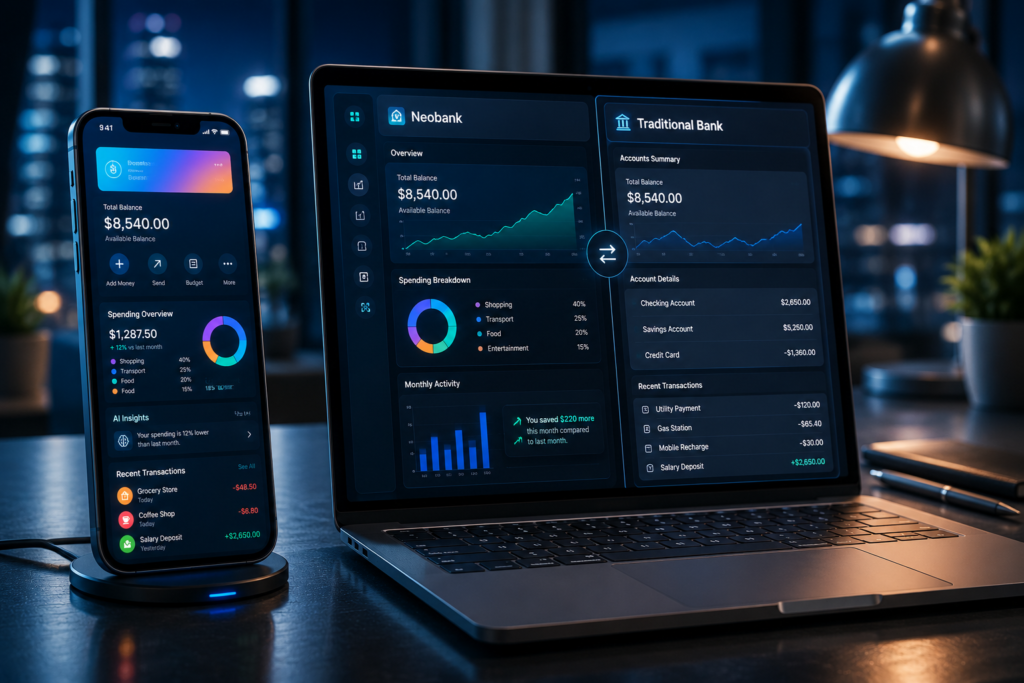
Neobank vs Traditional Bank Comparison Table
| Feature | Neobank | Traditional Bank |
|---|---|---|
| Account Opening | Fully digital, often within minutes | Online or in-branch, sometimes longer |
| Monthly Fees | Often low or none | Varies by account type |
| Branch Access | None or very limited | Extensive branch network |
| Debit Cards | Virtual and physical options | Physical cards with digital support |
| Credit Cards | Limited, depending on provider | Wide range of credit products |
| Loans | Basic personal loans or partner lending | Mortgages, auto, personal, and business loans |
| Savings | Competitive rates with automated tools | Broad range of savings accounts |
| Mobile App | Feature-rich, AI-driven, user-friendly | Robust but often more traditional |
| International Payments | Competitive exchange rates and multi-currency support | Available, sometimes with higher fees |
| Customer Support | In-app chat, email, AI assistants | Branches, phone, chat, relationship managers |
| Security | Biometrics, MFA, AI fraud detection, encryption | Strong regulatory oversight plus advanced security tools |
| Best For | Digital-first users, travelers, freelancers | Families, businesses, borrowers, long-term banking relationships |
Key Differences
- Digital banks often have full banking licenses.
- Neobanks may partner with licensed banks depending on regulations.
- Traditional banks offer broader financial services.
- Digital banks usually innovate faster.
- Neobanks focus heavily on mobile experiences.
When comparing digital bank vs traditional bank, ask yourself whether you value advanced mobile features or comprehensive financial products.
Neobank Comparison
No neobank comparison is complete without recognizing that different platforms excel in different areas. There is no single best neobank for everyone.
Popular Global Neobanks
Some of the most respected digital banking platforms include:
- Revolut
- Monzo
- Chime
- Starling Bank
- N26
- Wise Account
Each serves different customer needs. Some focus on travel, others on budgeting, while several specialize in international payments or everyday banking.
When I evaluate fintech products, I always look beyond marketing claims. The best digital banking experience depends on consistent app performance, transparent pricing, responsive customer support, and strong security rather than flashy features.
Features Comparison
When performing a neobank comparison, consider these factors:
- Mobile app usability
- Monthly fees
- ATM access
- International transfer costs
- Savings features
- Spending analytics
- Investment options
- Customer support quality
- Security controls
- Integration with digital wallets
Avoid choosing a platform solely because it is popular. Instead, select the best neobank based on your financial habits.
Online Bank vs Bank
Another common question is the difference between an online bank vs bank.
An online bank delivers most or all of its services digitally, while a traditional bank combines digital services with physical branches.
The decision depends largely on how you interact with your finances.
An online bank may be ideal if you:
- Rarely handle cash
- Prefer mobile banking
- Travel frequently
- Want lower banking fees
- Appreciate instant spending notifications
A traditional bank may be better if you:
- Need business banking
- Deposit cash regularly
- Require mortgage advice
- Prefer face-to-face financial planning
- Use multiple financial products under one institution
After years of reviewing consumer banking behavior, I’ve found that many people actually benefit from using both. A traditional bank can serve long-term financial needs, while a digital bank provides a smoother everyday banking experience.

Advantages of Neobanks
The neobank vs traditional bank discussion often highlights the strengths of digital-first banking.
Some of the biggest advantages include:
- Fast account opening
- Minimal paperwork
- Lower fees
- Excellent mobile apps
- AI-powered budgeting
- Instant spending alerts
- Virtual debit cards
- Competitive exchange rates
- Multi-currency accounts
- Easy international transfers
2026 Digital Banking Trends
Modern neobanks continue introducing innovative technologies, including:
- AI-powered financial assistants
- Personalized budgeting recommendations
- Embedded finance services
- Open Banking integrations
- Real-time payment networks
- Predictive fraud detection
- Carbon footprint tracking for spending
- Smart savings automation
These innovations continue to make the best neobank increasingly attractive for digital-first consumers.
Advantages of Traditional Banks
Traditional banks remain essential for millions of customers worldwide.
Key advantages include:
- Physical branch access
- Mortgage lending
- Business financing
- Wealth management
- Investment advisors
- Established brand trust
- Larger ATM networks
- Cash deposit services
- Financial planning
- Commercial banking
Large banks also continue investing heavily in:
- AI fraud detection
- Biometric authentication
- Digital identity verification
- Real-time payment systems
- Open Banking APIs
- Mobile wallet integration
The gap between traditional banks and digital banks continues to narrow every year.
Which Option Is Best for Different Users?
Choosing between neobank vs traditional bank depends on your financial priorities rather than current trends.
Students
Students generally benefit from a best neobank because they often prioritize:
- No monthly fees
- Instant notifications
- Budget tracking
- Easy online payments
- Mobile-first banking
Freelancers
Freelancers often appreciate:
- Fast international payments
- Multi-currency accounts
- Expense categorization
- Invoice tracking
- Lower foreign exchange costs
This makes many digital banks an excellent choice.
Travelers
Frequent travelers usually benefit from:
- Competitive currency exchange
- Global card acceptance
- Travel-friendly debit cards
- Lower international fees
- Real-time spending notifications
This is one area where many neobanks outperform traditional institutions.
Small Businesses
Business owners often require:
- Merchant services
- Business loans
- Payroll solutions
- Commercial credit
- Cash management
Traditional banks generally offer a wider range of business services, although fintech platforms are rapidly expanding.
Families
Families typically need:
- Joint accounts
- Mortgage services
- Children’s savings
- Insurance products
- Investment planning
Many households find that combining a traditional bank with a digital banking platform provides the best balance of convenience and comprehensive services.
Expert Tips Before Choosing a Bank
After evaluating banking platforms for many years, these are the factors I consistently recommend prioritizing:
- Compare total banking fees—not just monthly charges.
- Review international transfer costs if you travel or work globally.
- Verify deposit insurance in your country.
- Check customer support availability before opening an account.
- Test the mobile app by reading recent user reviews.
- Enable multi-factor authentication and biometric login.
- Use transaction alerts to detect fraud quickly.
- Consider whether you’ll need loans, mortgages, or investment services in the future.
- Avoid choosing a bank based solely on promotional offers.
- Select a provider whose features align with your everyday financial habits.
Frequently Asked Questions
Are neobanks safe?
Yes. Reputable neobanks use advanced encryption, biometric authentication, multi-factor authentication, and AI-powered fraud detection. Always verify that your deposits are protected under the applicable regulatory framework in your country.
Can a neobank replace a traditional bank?
For many users, yes. However, customers who frequently use mortgages, business banking, or in-person services may still benefit from maintaining a relationship with a traditional bank.
Which is better: digital bank vs traditional bank?
Neither is universally better. A digital bank vs traditional bank decision depends on your financial goals, lifestyle, and preferred banking experience.
What is the best neobank?
The best neobank varies based on your needs. Some excel at budgeting, others at international transfers, travel benefits, or everyday spending.
Should I use both?
In many cases, yes. Keeping a traditional bank for long-term financial products while using a neobank for daily spending and digital convenience can provide the best of both worlds.
Final Verdict
The neobank vs traditional bank debate isn’t about declaring one winner—it’s about matching the right banking model to your financial lifestyle.
If your priorities include convenience, mobile-first banking, lower fees, real-time spending insights, and seamless international payments, a neobank is likely to meet your expectations. The ongoing innovations in AI-powered financial management, Open Banking, embedded finance, biometric authentication, and real-time payments make digital banking more capable than ever in 2026.
On the other hand, traditional banks continue to provide unmatched value for customers who need mortgages, business financing, wealth management, investment advice, or face-to-face support. Their long-standing regulatory experience, extensive branch networks, and comprehensive financial services remain significant advantages.
After years of evaluating banking technology and observing how consumers interact with financial institutions, one conclusion stands out: the smartest choice often isn’t neobank vs traditional bank—it’s knowing when each serves a different purpose. Many consumers benefit from using a traditional bank for major financial products while relying on a neobank for everyday transactions and digital convenience.
As the line between digital bank vs traditional bank continues to blur, financial institutions on both sides are adopting AI, Open Banking, enhanced security, and customer-centric innovations. Rather than asking whether an online bank vs bank is better, focus on choosing the solution that aligns with your goals, spending habits, and long-term financial plans.
Author

razakh6402@gmail.com
Related Posts
Digital Payments: Future of Digital Payments, Payment Technology & Online Payment Trends (2026 Guide)
- 0
- 2,609 words
The way we pay for goods and services has changed more in the past decade than it did in the previous fifty...
Embedded Finance Explained: Complete Guide to Embedded Banking & Banking as a Service (2026)
- 0
- 2,288 words
Over the last fifteen years, I’ve watched financial services evolve from products that required customers to visit a bank into experiences seamlessly...
Contactless Payments Explained: Complete NFC Payment & Tap to Pay Guide (2026)
- 0
- 2,193 words
Over the past fifteen years, I’ve watched payment technology evolve from magnetic stripe cards and PIN terminals to today’s seamless contactless payments...

Financial Planning Software: 10 Best Personal Financial Planning Software & Wealth Management Software (2026 Guide)
- 0
- 2,621 words
Managing money has changed dramatically over the past decade. When I first began advising clients more than 15 years ago, financial planning...
Best Expense Tracking Apps: Top Expense Tracker & Best Expense Management Software (2026 Guide)
- 2
- 2,595 words
Whether you’re running a startup, managing a growing business, freelancing full-time, or simply trying to control your personal finances, one thing remains...
Mobile Banking Security: Complete Guide to Secure Mobile Banking & Banking App Security (2026)
- 0
- 2,221 words
Mobile banking has transformed how we manage our finances. Today, I rarely visit a physical bank branch because almost every transaction from...
Read out all