

- 0
- 2,752 words
Choosing the right CRM can transform how a business attracts leads, closes deals, and builds long-term customer relationships. Yet after working with startups, agencies, SaaS companies, manufacturers, healthcare providers, and enterprise organizations for more than 15 years, I’ve learned that many companies don’t fail because they choose a “bad” CRM they fail because they choose the wrong CRM for their business model.
That’s exactly why the HubSpot vs Salesforce debate remains one of the most important decisions businesses make in 2026.
I’ve implemented both platforms for organizations ranging from five-person startups to multinational enterprises with thousands of employees. I’ve seen companies migrate from spreadsheets to HubSpot in a weekend, and I’ve also led Salesforce implementations that took several months due to complex workflows, integrations, and compliance requirements.
One lesson has remained consistent: the best CRM isn’t necessarily the most powerful one. It’s the one your team actually adopts and uses every day.
In this detailed comparison, I’ll share practical insights from real implementations, discuss hidden costs many buyers overlook, explain the strengths and weaknesses of each platform, and help you determine which CRM aligns with your business goals. Whether you’re looking for the best CRM for small business, evaluating a CRM HubSpot review, or searching for an honest Salesforce CRM review, this guide is designed to help you make a confident decision.

My Experience After 15 Years Working With CRM Platforms
Over the years, I’ve noticed that businesses tend to focus on feature checklists instead of operational fit.
While those questions matter, they rarely determine long-term success.
The biggest predictor of CRM success is user adoption.
I’ve worked with businesses that invested heavily in enterprise software, only to discover that sales representatives continued tracking leads in Excel because the CRM felt too complicated.
Conversely, I’ve seen smaller organizations double their lead conversion rates within months after adopting HubSpot simply because the entire team embraced the platform from day one.
Another common mistake is underestimating implementation costs.
Many decision-makers compare subscription prices without considering migration, employee training, workflow redesign, third-party integrations, ongoing administration, and internal change management. These factors often cost more than the software itself.
HubSpot CRM Review
When clients ask me for a practical CRM HubSpot review, I usually describe HubSpot as the platform that removes friction.
Instead of overwhelming new users with endless configuration options, HubSpot emphasizes simplicity, intuitive navigation, and fast deployment. Sales teams can manage contacts, deals, meetings, emails, pipelines, and reporting from a clean interface that requires very little training.
This integrated approach dramatically reduces the need for multiple disconnected tools.
Pros
Exceptionally Easy to Learn
New employees often become productive within days instead of weeks.
Excellent Marketing Automation
HubSpot remains one of the strongest marketing-focused CRM platforms available. Lead nurturing, email workflows, landing pages, segmentation, and campaign analytics work seamlessly together.
Outstanding User Experience
The interface is modern, clean, and thoughtfully designed. Navigation feels intuitive even for non-technical users.
Fast Implementation
For many small and medium-sized businesses, deployment can happen within days rather than months.
Strong AI Capabilities
HubSpot has expanded its AI-powered tools considerably. Content generation, email drafting, conversation summaries, predictive insights, workflow recommendations, and sales assistance reduce repetitive work while improving productivity.
Excellent Educational Resources
HubSpot Academy remains one of the best free learning platforms available, making employee onboarding much easier.
Cons
Costs Increase as You Scale
HubSpot’s entry point is attractive, but businesses often underestimate how quickly costs rise as contact databases grow or additional premium features become necessary.
Limited Deep Customization
Although HubSpot offers solid flexibility, it doesn’t provide the same level of object customization, workflow complexity, or enterprise configuration found in Salesforce.
Advanced Reporting Requires Higher Plans
Many organizations eventually upgrade because they need more sophisticated reporting and attribution capabilities.
Best For
From my consulting experience, HubSpot is an excellent choice for:
- Startups
- Small businesses
- Growing SaaS companies
- Digital marketing agencies
- Professional service firms
- B2B businesses focused on inbound marketing
- Organizations seeking the best CRM for small business
- Teams that value simplicity and rapid adoption
Rather than overwhelming users with technical complexity, HubSpot helps teams become productive quickly while still offering enough room to grow over time.
For businesses evaluating HubSpot vs Salesforce, this ease of use is often HubSpot’s biggest competitive advantage.
Salesforce CRM Review
If someone asks me for an honest Salesforce CRM review, my answer is always the same: Salesforce is one of the most powerful CRM platforms available, but it’s not the right choice for every business.
Unlike HubSpot, Salesforce isn’t designed to be “plug and play.” Instead, it’s built as a highly customizable business platform that can adapt to virtually any sales, service, or operational workflow.
For organizations with complex sales cycles, multiple departments, international teams, or strict compliance requirements, that flexibility becomes a major competitive advantage.
Pros
Industry-Leading Customization
Salesforce allows businesses to customize almost every aspect of the CRM, including objects, workflows, automation, dashboards, reports, security permissions, approval processes, and integrations.
Enterprise Scalability
One of Salesforce’s greatest strengths is its ability to scale alongside business growth. Whether you’re managing 20 users or 20,000 users, the platform can support increasingly sophisticated processes without requiring a complete migration.
Powerful Sales Automation
Salesforce excels at automating repetitive tasks such as lead routing, opportunity management, approval workflows, task assignments, and customer lifecycle management.
Advanced AI Capabilities
Salesforce continues to invest heavily in AI through Einstein AI and the newer Agentforce platform. These tools assist sales teams with predictive lead scoring, opportunity insights, forecasting, automated email generation, conversation summaries, and intelligent recommendations that improve productivity and decision-making.
Extensive App Marketplace
Salesforce’s AppExchange remains one of the largest business software marketplaces available, offering thousands of certified applications that extend CRM functionality.
Cons
Steeper Learning Curve
The flexibility that makes Salesforce powerful also makes it more complex. New users often require structured onboarding and ongoing training before becoming fully productive.
Higher Implementation Costs
Many businesses underestimate the total investment required for Salesforce. Beyond licensing, costs often include consulting, customization, data migration, integration development, employee training, and ongoing administration.
Best For
Based on my consulting experience, Salesforce is best suited for:
- Large enterprises
- Rapidly scaling organizations
- Businesses with complex sales processes
- Companies requiring deep customization
- Multi-location organizations
- Businesses with dedicated CRM administrators
- Organizations integrating CRM with ERP, finance, customer service, and custom business applications
For companies comparing Salesforce vs HubSpot, Salesforce delivers unmatched flexibility—but only if the business is prepared to invest the necessary time, expertise, and resources.
HubSpot vs Salesforce Feature Comparison
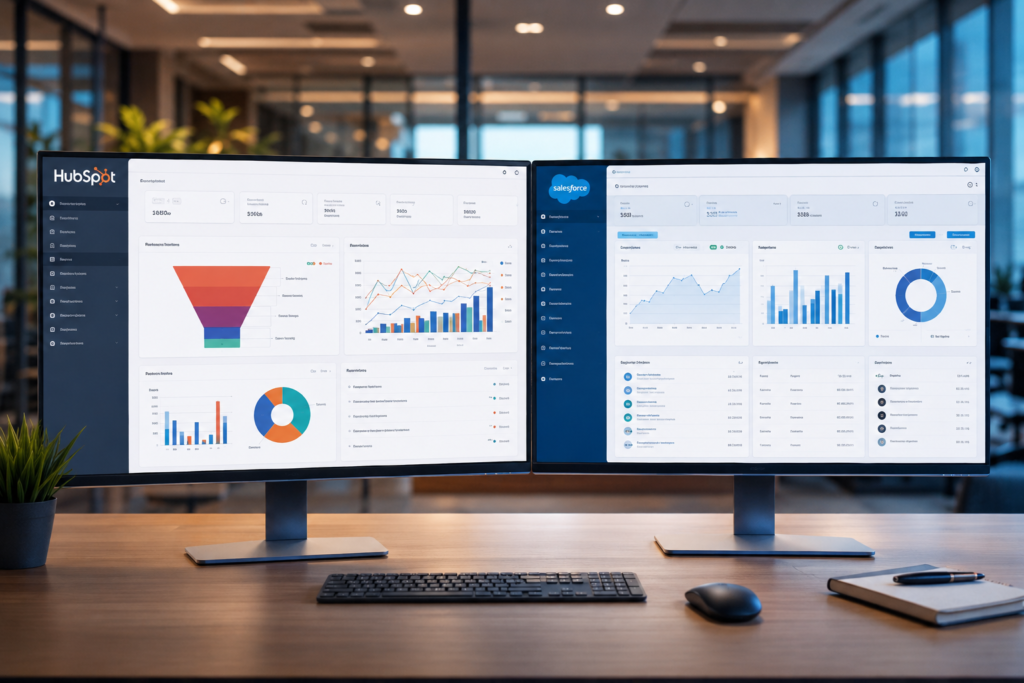
Choosing between HubSpot vs Salesforce becomes much easier when you compare the features that directly affect your team’s productivity.
Rather than asking which CRM has “more features,” ask which platform delivers the features your business will actually use. Over the years, I’ve seen businesses purchase enterprise-grade functionality they never adopted, while others achieved remarkable growth using a simpler CRM that their teams embraced wholeheartedly.
Here’s how the two platforms compare across the areas that matter most.
| Feature | HubSpot | Salesforce |
|---|---|---|
| Ease of Use | Excellent. Intuitive interface with minimal training required. | Good, but requires onboarding and user training. |
| Pricing Philosophy | Lower barrier to entry with scalable upgrades. Costs increase as contacts and premium features grow. | Premium pricing with enterprise-focused licensing and implementation investment. |
| CRM Features | Comprehensive contact, deal, pipeline, and customer management for most businesses. | Extremely powerful CRM with virtually unlimited customization. |
| Marketing Automation | Built-in email marketing, landing pages, workflows, lead nurturing, and campaign analytics. | Advanced automation available through Salesforce Marketing Cloud and related products. |
| Sales Automation | Easy-to-configure pipelines, sequences, meeting scheduling, and task automation. | Highly advanced automation, approvals, forecasting, and workflow orchestration. |
| AI Features | AI-powered content creation, sales assistance, workflow suggestions, predictive insights, and conversation summaries. | Einstein AI and Agentforce provide predictive analytics, lead scoring, forecasting, automation, and intelligent recommendations. |
| Reports & Dashboards | User-friendly dashboards with strong visualization. Advanced reporting available on higher plans. | Enterprise-grade reporting with extensive customization and advanced analytics. |
| Customization | Flexible but designed for simplicity. | Industry-leading customization across nearly every module. |
| Integrations | Thousands of integrations with popular business applications. | Massive AppExchange ecosystem supporting virtually every business need. |
| Mobile App | Clean, intuitive, and ideal for sales teams on the move. | Feature-rich mobile experience for enterprise users. |
| Customer Support | Strong knowledge base, academy, community, and premium support plans. | Multiple enterprise support tiers with global consulting ecosystem. |
| Learning Curve | Short. Most users become productive quickly. | Moderate to steep depending on customization. |
| Scalability | Excellent for startups, SMBs, and growing businesses. | Outstanding for mid-market and enterprise organizations. |
| Best Business Size | Small businesses, startups, agencies, and growing companies. | Mid-market businesses, enterprises, and highly customized organizations. |
From my experience, this comparison highlights the core difference in the HubSpot vs Salesforce debate. HubSpot focuses on usability and speed, while Salesforce prioritizes flexibility and enterprise-scale capabilities.
Pricing Comparison
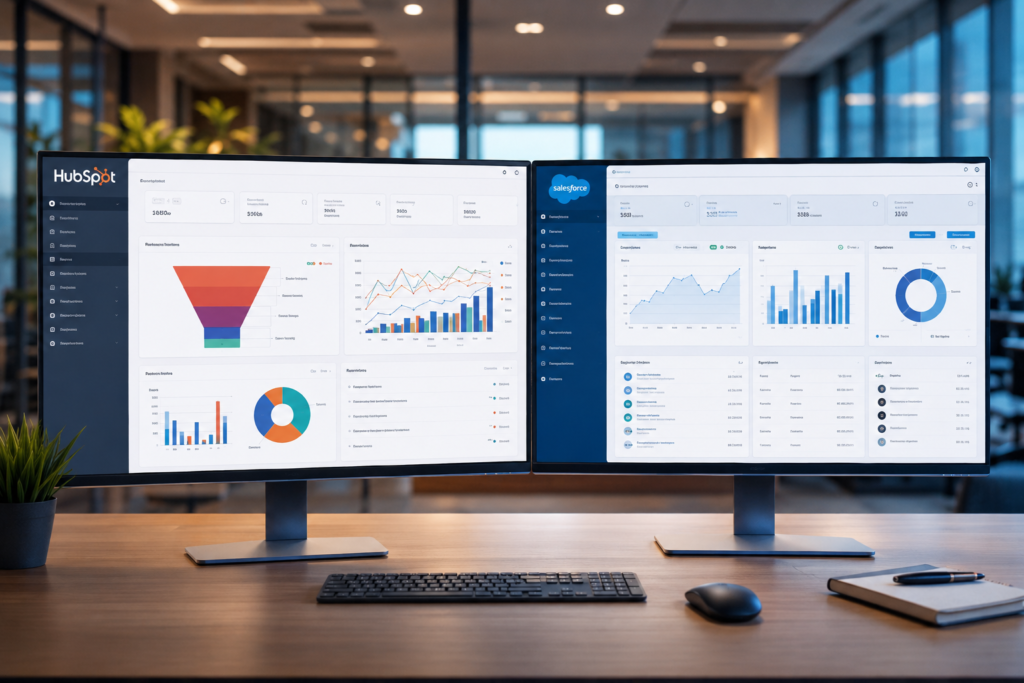
One of the biggest mistakes I see businesses make is comparing CRM pricing based solely on monthly subscription costs.
The reality is that the total cost of ownership extends far beyond the license fee.
HubSpot Pricing Philosophy
HubSpot follows a growth-oriented pricing model. Businesses can begin with free or entry-level tools and gradually unlock premium capabilities as their marketing, sales, and customer service operations become more sophisticated.
For many startups and small businesses, this incremental approach reduces upfront risk and allows teams to expand their CRM investment as revenue grows.
However, organizations should plan for increasing costs as contact databases expand or advanced automation, reporting, and multi-team collaboration become essential.
Salesforce Pricing Philosophy
Salesforce positions itself as an enterprise platform, and its pricing reflects that strategy.
Implementation services, administrator resources, consulting, integrations, and ongoing optimization often represent a significant portion of the overall investment.
My Practical Advice on CRM Costs
When evaluating Salesforce vs HubSpot, I encourage clients to calculate a three-year total cost of ownership instead of comparing monthly subscription prices.
Include:
- Software licensing
- Data migration
- Employee training
- CRM implementation
- Third-party integrations
- Internal administration
- Ongoing consulting
- Future scalability
This approach provides a far more accurate picture of the true investment and often changes the buying decision.
Which CRM Is Easier to Use?
This is one area where I rarely hesitate.
HubSpot is noticeably easier to learn.
Most sales representatives can begin using HubSpot with very little formal training. The interface feels modern, navigation is intuitive, and everyday tasks—such as managing contacts, updating deals, sending emails, and creating reports—are straightforward.
For organizations that prioritize rapid adoption and minimal training, HubSpot usually delivers faster time-to-value.
Marketing Automation Comparison
Marketing automation is one of HubSpot’s strongest competitive advantages.
Because HubSpot combines CRM, email marketing, forms, landing pages, blog management, lead nurturing, social media, and analytics into a single platform, marketers can create sophisticated customer journeys without relying on multiple disconnected tools.
For small and medium-sized businesses seeking simplicity, HubSpot often provides a more streamlined experience.
Sales Pipeline Management
Both platforms excel at sales pipeline management, but they cater to different business needs.
HubSpot emphasizes simplicity. Sales managers can quickly visualize opportunities, monitor deal progress, automate follow-ups, and generate pipeline reports with minimal setup.
Salesforce takes pipeline management much further by supporting highly customized sales stages, territory management, approval workflows, forecasting models, and multi-level reporting.
In my consulting projects, I typically recommend HubSpot for organizations with straightforward sales cycles and Salesforce for businesses managing multiple products, global sales teams, channel partners, or highly customized enterprise sales processes.

HubSpot AI
HubSpot has integrated AI throughout its platform, making it accessible even for smaller businesses. AI features include:
- AI-powered email and content generation
- Meeting and conversation summaries
- Workflow recommendations
- Predictive lead scoring
- Sales email suggestions
- AI-assisted reporting
- Customer service response drafting
- Breeze AI tools for content creation and CRM productivity
What I appreciate most is that HubSpot’s AI feels practical rather than overwhelming. Sales representatives can use AI without needing technical expertise, making it an excellent fit for growing teams.
Salesforce AI
Salesforce continues to lead enterprise AI innovation with Einstein AI and Agentforce, which provide:
- Predictive opportunity scoring
- Intelligent sales forecasting
- Automated customer insights
- AI-generated emails
- Next-best-action recommendations
- Conversation intelligence
- Customer service automation
- AI agents capable of assisting with business workflows
These tools are incredibly powerful, particularly for organizations handling large datasets and complex sales operations. However, maximizing their value often requires careful configuration and a well-managed CRM environment.
My Experience
If your business wants AI that works immediately with minimal setup, HubSpot offers a smoother experience.
If you’re managing enterprise-scale operations and need predictive analytics across multiple departments, Salesforce currently provides greater depth and flexibility.
Most integrations are easy to configure, making HubSpot attractive for businesses without dedicated IT teams.
Salesforce Integrations
Salesforce’s AppExchange is one of the largest enterprise software marketplaces in the world.
It includes thousands of certified applications for:
- ERP systems
- Finance platforms
- Healthcare
- Manufacturing
- Human Resources
- Marketing
- Customer Support
- Artificial Intelligence
- Industry-specific solutions
For enterprises requiring highly customized integrations, Salesforce remains difficult to match.
Reporting and Analytics
Reporting is another area where both platforms excel, but in different ways.
HubSpot focuses on clarity.
Managers can quickly monitor:
- Revenue
- Lead sources
- Conversion rates
- Marketing performance
- Sales pipelines
- Customer service metrics
Dashboards are visually appealing and require little technical knowledge.
Salesforce, meanwhile, delivers enterprise-grade analytics.
Businesses can build highly customized dashboards, combine multiple datasets, create executive reports, forecast revenue, monitor KPIs across departments, and integrate with advanced business intelligence platforms.
From my consulting experience:
- HubSpot wins for speed and ease of reporting.
- Salesforce wins for analytical depth and customization.
Which CRM Is Better for Small Businesses?
When clients ask for the best CRM for small business, I rarely answer with a single product without first understanding their goals.
However, if we’re comparing HubSpot vs Salesforce specifically, HubSpot is usually the stronger choice for most small businesses.
Why?
Because small businesses typically need:
- Fast implementation
- Easy onboarding
- Minimal administration
- Affordable entry costs
- Built-in marketing tools
- Simple reporting
- Quick sales adoption
HubSpot checks all of these boxes.
I’ve worked with startups that moved from spreadsheets to HubSpot in less than a week and immediately improved lead visibility, follow-up consistency, and marketing performance.
Salesforce can certainly serve small businesses, but unless they anticipate rapid growth or require advanced customization from the outset, its complexity may outweigh its benefits.
For most entrepreneurs, agencies, consultants, and growing SaaS companies, HubSpot offers the best balance of usability, scalability, and value.
Which CRM Is Better for Enterprises?
Enterprise organizations face a very different set of challenges.
Large sales teams.
Global operations.
Multiple business units.
Complex approval processes.
Regulatory compliance.
ERP integrations.
Advanced forecasting.
Territory management.
In these situations, Salesforce usually becomes the stronger long-term investment.
I’ve helped enterprise organizations migrate from legacy CRM systems to Salesforce because they required a level of customization that simpler platforms couldn’t provide.
That said, not every enterprise automatically needs Salesforce.
I’ve also worked with mid-sized companies generating millions in annual revenue that achieved outstanding results with HubSpot because their processes remained relatively straightforward.
The decision should always be based on operational complexity—not company size alone.

Conclusion
The HubSpot vs Salesforce comparison isn’t about identifying a single winner—it’s about choosing the platform that best aligns with your business goals, budget, technical expertise, and future growth plans.
If you’re looking for an intuitive platform with excellent marketing automation, quick implementation, and strong usability, HubSpot remains one of the best choices available. It consistently earns high marks in any CRM HubSpot review because it helps teams become productive quickly while offering enough flexibility to support long-term growth.
On the other hand, if your organization requires enterprise-grade customization, advanced automation, sophisticated reporting, and virtually unlimited scalability, Salesforce continues to set the industry benchmark. That’s why most Salesforce CRM reviews highlight its unmatched flexibility for larger and more complex organizations.
Ultimately, the best CRM for small business is often HubSpot due to its ease of use and lower barrier to entry, while Salesforce is generally the stronger fit for enterprises managing complex operations.
Author

razakh6402@gmail.com
Related Posts

Lead Generation Software: 12 Best Lead Generation Tools for B2B Sales (2026 Guide)
- 0
- 2,300 words
If someone had asked me 15 years ago what the biggest challenge in sales was, my answer would have been simple: finding...
Survey Software: 12 Best Online Survey Tools & Feedback Software for Businesses (2026 Guide)
- 0
- 1,871 word
Whether I was helping a SaaS startup validate a new feature, assisting an HR team with employee engagement, or optimizing customer experience...
Read out all
Online Course Platform: 12 Best LMS Software & eLearning Platforms for Course Creators (2026 Guide)
- 0
- 1,900 word
The online education industry has changed dramatically over the last 15 years. When I built my first digital training portal, simply uploading...

Team Communication Software: 12 Best Business Messaging Apps for Modern Workplaces in 2026 (Expert Tested)
- 0
- 2,305 words
I’ve personally tested dozens of team communication software platforms while consulting for marketing agencies, software companies, HR departments, remote development teams, and...
Invoice Software: 12 Best Invoicing Software for Small Business in 2026 (Expert Tested)
- 0
- 2,493 words
I’ve worked with freelancers chasing late payments, agencies managing hundreds of monthly invoices, startups scaling internationally, and established businesses struggling with outdated...
Generate one SEO-optimized title thatdigital asset management software
- 6
- 2,632 words
One of the most memorable projects I led involved migrating nearly half a million digital assets from a traditional file server into...