
- 0
- 2,298 words
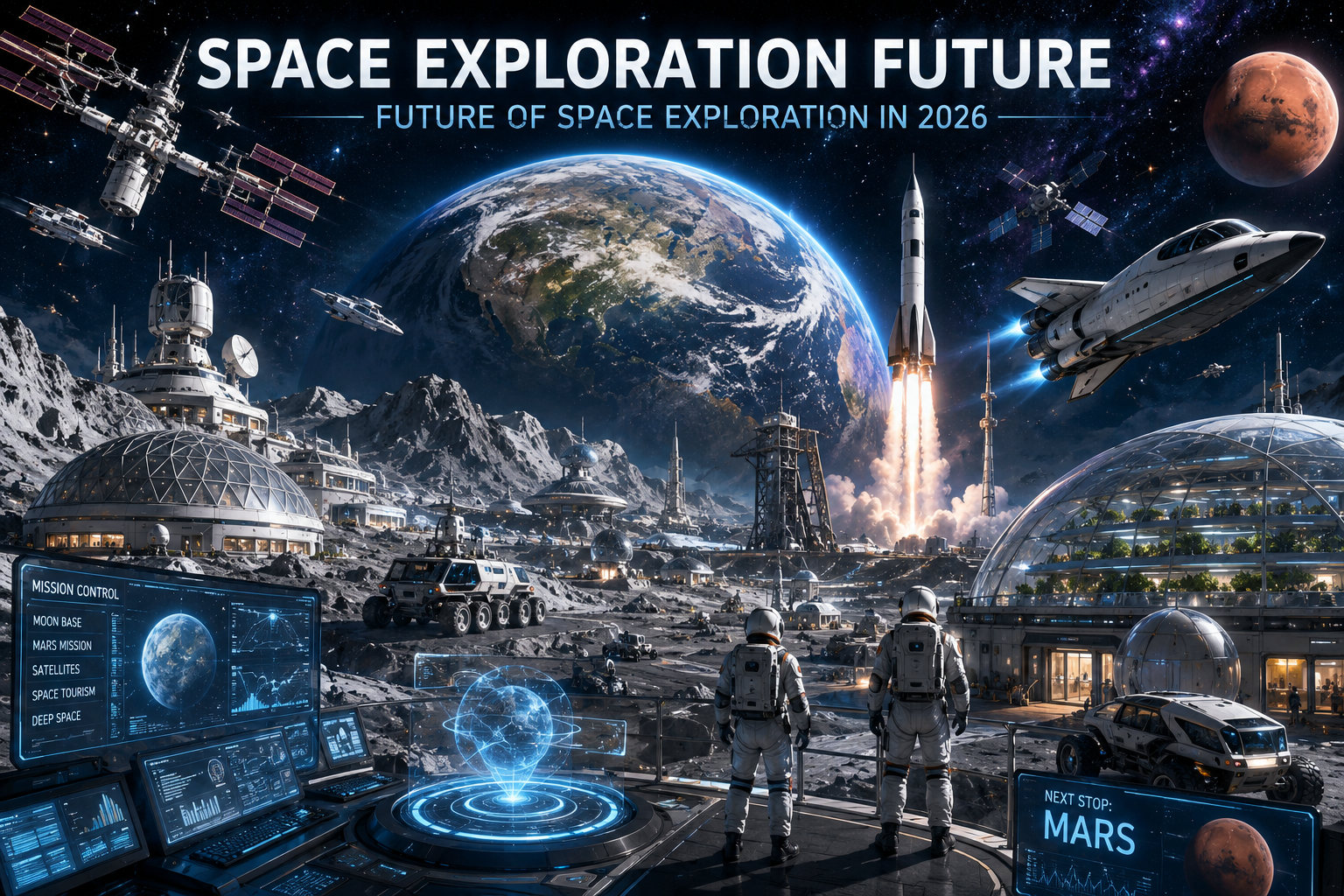
The space exploration future has never looked more exciting. After decades of scientific discoveries and technological breakthroughs, humanity is entering an era where exploring the Moon, Mars, and even distant planets is no longer just a dream. Governments, research institutions, and private aerospace companies are investing billions of dollars into missions that promise to reshape our understanding of the universe while creating entirely new industries here on Earth.
One of the biggest drivers behind the future of space exploration is the rapid advancement of space technology innovations. Artificial intelligence, autonomous spacecraft, reusable rockets, advanced robotics, next-generation satellite technology, and powerful space telescopes are dramatically reducing mission costs while improving reliability. These technologies allow scientists to explore farther, gather more data, and conduct increasingly complex deep space exploration missions.
Meanwhile, commercial space travel is transitioning from science fiction into reality. Private companies are launching tourists into orbit, developing private space stations, and designing spacecraft capable of carrying humans beyond Earth’s orbit. At the same time, ambitious programs such as NASA’s Artemis Program aim to establish sustainable lunar exploration as a stepping stone toward future Mars missions.
Looking toward 2040, humanity may witness permanent lunar bases, regular commercial flights to orbit, AI-powered robotic explorers operating across the solar system, and the first serious attempts at interplanetary travel. The next two decades will likely become one of the most significant periods in human history, making today’s investments in space exploration future technologies critical for scientific discovery, economic growth, and long-term human survival.
What Is the Future of Space Exploration?
The future of space exploration refers to the next generation of technologies, missions, and international collaborations designed to expand humanity’s presence beyond Earth. Unlike the early decades of spaceflight, modern exploration combines government agencies with commercial companies, artificial intelligence, advanced robotics, and reusable launch systems.
From my professional perspective, one of the most remarkable changes has been the shift from competition to collaboration. During the early Space Race, national prestige drove innovation. Today, governments increasingly partner with private aerospace companies, universities, and international organizations to share expertise, reduce costs, and accelerate discoveries.
The importance of space technology innovations extends far beyond exploration itself. Advances originally developed for space missions have improved satellite communications, GPS navigation, weather forecasting, climate monitoring, healthcare technologies, materials science, and artificial intelligence. Every major investment in space exploration generates innovations that benefit life on Earth.

Evolution of Space Exploration
Although the primary motivation was geopolitical competition, the Space Race established many engineering principles still used in modern aerospace design.
Satellite Technology Revolution
The launch of communication, navigation, and Earth observation satellites transformed modern civilization. Satellite technology now supports internet connectivity, disaster response, precision agriculture, climate monitoring, defense systems, financial networks, and global transportation.
In my experience working with satellite system developments, miniaturization and improved onboard computing have been among the most significant breakthroughs. Modern satellites deliver greater performance while reducing launch costs and operational complexity.
International Space Station
The International Space Station marked a new era of global scientific collaboration. Instead of competing independently, multiple nations worked together to create a permanent laboratory in low Earth orbit.
Research conducted aboard the ISS has improved our understanding of human health in microgravity, advanced materials science, tested autonomous robotics, and prepared astronauts for future deep space exploration missions.
Top Space Technology Innovations Shaping the Future
Reusable Rockets
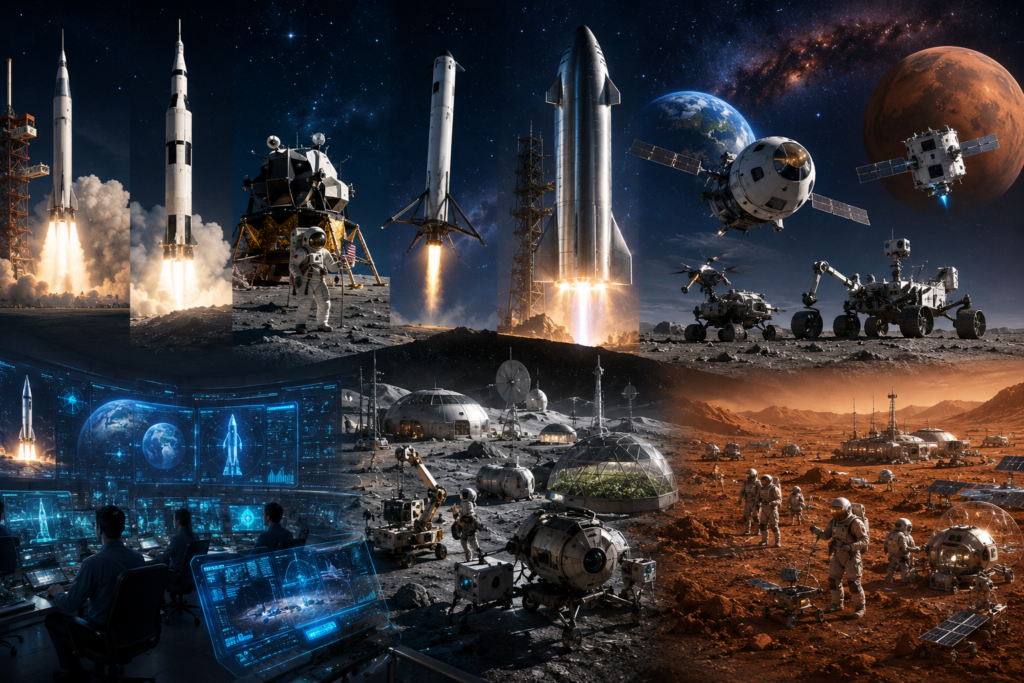
Reusable rockets represent one of the most important space technology innovations of the modern era. Instead of discarding launch vehicles after every mission, aerospace companies now recover and refurbish rocket boosters for multiple flights.
This approach dramatically lowers launch costs, increases mission frequency, and supports sustainable growth in commercial space travel. Reusability also allows faster deployment of satellites, scientific payloads, and future crewed missions to the Moon and Mars.
From an engineering standpoint, reusable launch systems have transformed mission planning. Lower costs encourage more experimentation, faster technology development, and greater participation from universities, startups, and international research organizations.
AI in Space Exploration
Artificial intelligence is revolutionizing mission operations. AI-powered systems optimize spacecraft navigation, detect equipment anomalies before failures occur, assist astronauts during complex procedures, and process enormous datasets generated by satellites and scientific instruments.
Future AI systems will become even more capable, supporting autonomous planetary rovers, robotic maintenance of orbital stations, intelligent resource management on lunar bases, and adaptive mission planning for interplanetary travel.
As missions travel farther from Earth, AI will become less of an optional technology and more of a mission-critical requirement.
Autonomous Spacecraft
Modern autonomous spacecraft reduce dependence on continuous communication with Earth. They can adjust trajectories, manage onboard systems, avoid hazards, and prioritize scientific objectives without waiting for human intervention.
Autonomous operations are particularly valuable during deep space exploration, where communication delays increase with distance. Future spacecraft exploring Jupiter’s moons, Saturn’s system, or distant asteroids will rely heavily on autonomous decision-making.
Space Robotics
Robotic spacecraft remain among humanity’s most successful explorers. Advanced robotic systems perform scientific research in environments too dangerous for humans, including extreme temperatures, radiation, and rugged planetary terrain.
The next generation of space robots will collaborate with astronauts, construct lunar infrastructure, repair satellites, collect asteroid samples, and prepare habitats before human arrival. Combined with AI, robotics will remain a cornerstone of the space exploration future.
Top Space Technology Innovations Shaping the Future (Continued)
Advanced Space Propulsion
Current chemical rockets are reliable, but future missions demand faster and more efficient propulsion systems. Engineers are developing nuclear thermal propulsion, nuclear electric propulsion, ion engines, solar sails, and plasma propulsion to shorten travel times for deep space exploration.
These technologies could reduce the journey to Mars, improve fuel efficiency, and enable missions to the outer planets. From my experience following propulsion research, this field will determine how quickly humanity expands beyond the Moon.
Space-Based Solar Power
Space-based solar power involves collecting solar energy in orbit and transmitting it to Earth using microwave or laser technology. Without atmospheric interference, orbital solar arrays can generate continuous power.
Although still in the experimental stage, this technology could provide clean energy while supporting future orbital stations and lunar bases.
Satellite Mega Constellations
Thousands of interconnected satellites are transforming global communications. Mega constellations improve broadband internet, disaster response, navigation, maritime operations, aviation, and remote education.
Beyond commercial services, future constellations will support lunar communications, Mars missions, and autonomous spacecraft traveling throughout the solar system.
Deep Space Communication
Reliable communication becomes increasingly difficult as spacecraft travel farther from Earth. Engineers are developing laser-based optical communication systems capable of transmitting data much faster than traditional radio signals.
These next-generation communication technologies will allow future astronauts and robotic spacecraft to exchange scientific information more efficiently during long-duration missions.
Future of Space Exploration Across Industries
The future of space exploration extends well beyond astronomy. Nearly every major industry now benefits from space technology innovations.
- Scientific Research: Advanced telescopes, planetary probes, and orbital laboratories expand our understanding of the universe.
- Telecommunications: Modern satellite technology delivers global internet access and supports digital economies.
- Defense: Space-based surveillance improves national security and emergency response.
- Climate Monitoring: Earth observation satellites track weather, rising sea levels, wildfires, and environmental changes.
- Agriculture: Satellite imagery enables precision farming, irrigation planning, and crop monitoring.
- Navigation Systems: GPS and satellite navigation support aviation, shipping, logistics, and autonomous vehicles.
- Mining: Remote sensing identifies valuable natural resources and may eventually support asteroid mining.
- Tourism: Commercial space travel is creating entirely new business opportunities for private companies.
Throughout my career, I’ve consistently seen space technologies create unexpected benefits on Earth. Innovations developed for space missions often become everyday tools used by businesses, governments, and consumers worldwide.
Commercial Space Travel and the New Space Economy
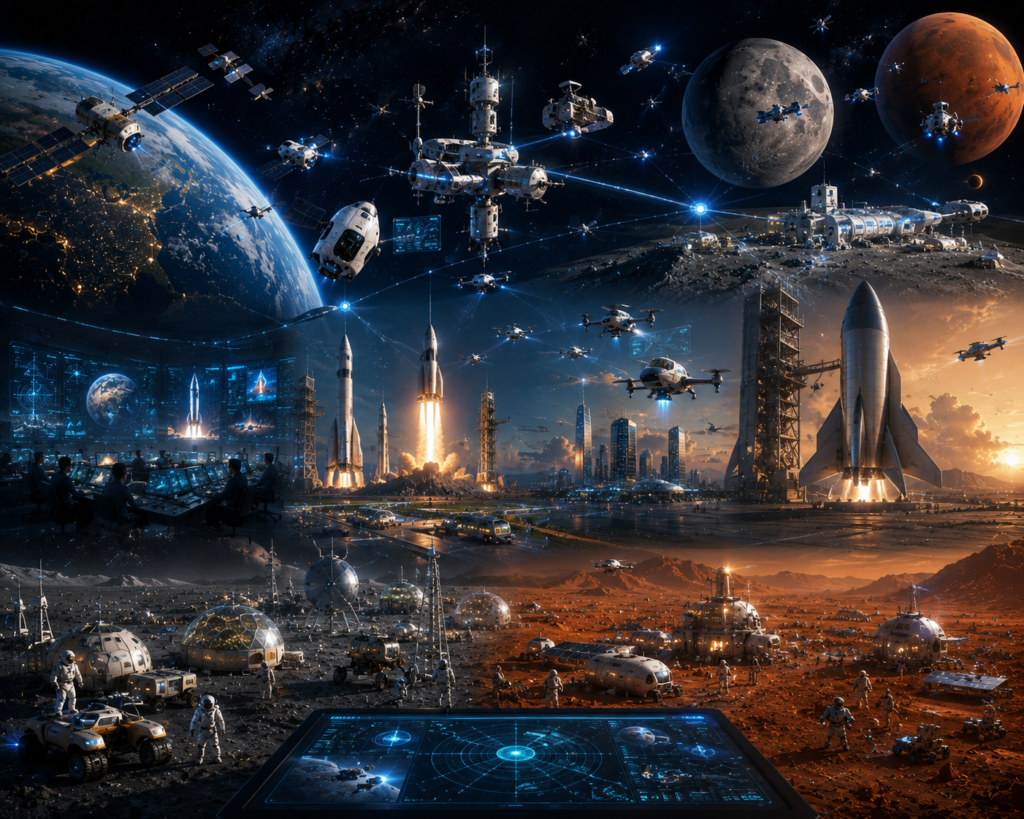
Private investment has fundamentally changed the economics of space exploration.
Space Tourism
Companies are offering suborbital and orbital experiences for private citizens. While currently expensive, costs are expected to decrease as reusable launch systems mature.
Lunar Missions
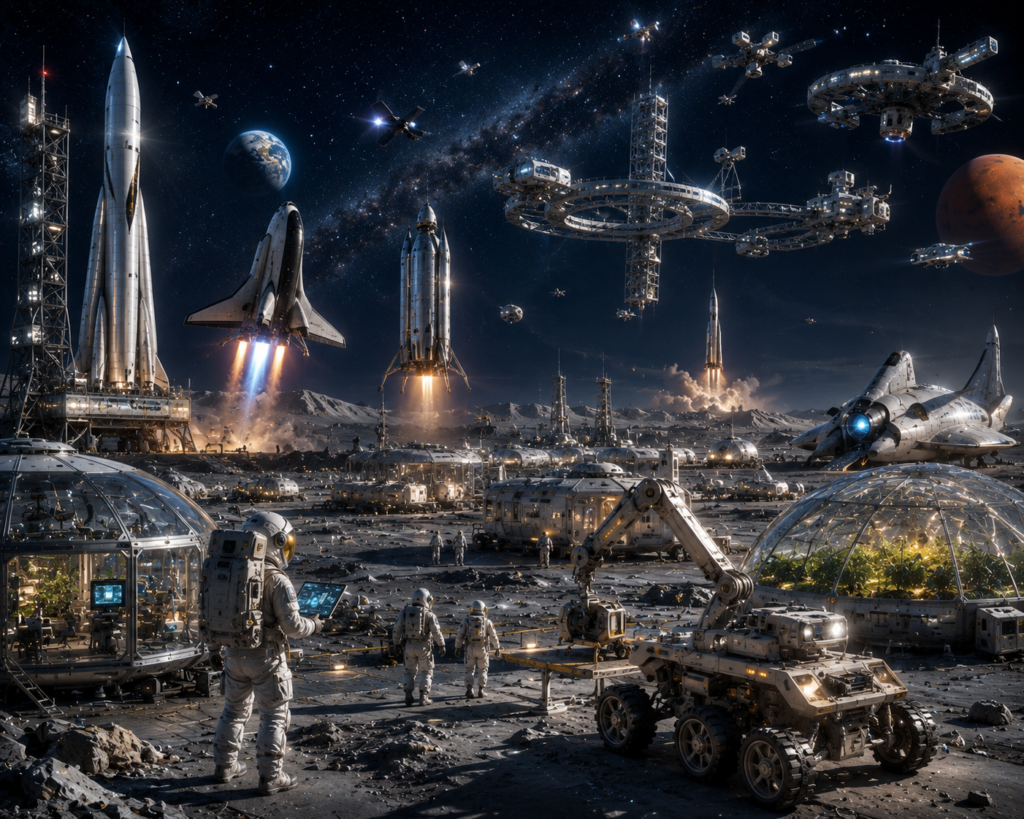
The Artemis Program and commercial partnerships aim to establish sustainable human operations on the Moon, supporting scientific research and future exploration.
Mars Colonization
Mars exploration remains one of humanity’s most ambitious goals. Future missions will test life-support systems, habitat construction, and long-duration human survival.
Space Manufacturing
Microgravity enables manufacturing processes impossible on Earth, including advanced pharmaceuticals, semiconductor production, and high-quality optical materials.
Asteroid Mining
Asteroids contain valuable metals and water resources that could support future deep space exploration while creating an entirely new space economy.
Private Space Stations
Commercial orbital stations may replace portions of today’s government-operated facilities, providing research laboratories, tourism destinations, and manufacturing centers.
Although challenges remain, I believe the commercial sector will become one of the strongest drivers of aerospace innovation over the next two decades.
Deep Space Exploration vs Near-Earth Missions
| Feature | Near-Earth Missions | Deep Space Exploration |
|---|---|---|
| Mission Distance | Low Earth Orbit & Moon | Beyond Earth-Moon System |
| Objectives | Research, satellites, ISS | Planetary science & discovery |
| Technology | Proven spacecraft | Advanced autonomous systems |
| Cost | Moderate | Very High |
| Risks | Lower | Higher radiation & communication delays |
| Communication | Near real-time | Significant delays |
| Duration | Days to months | Years or decades |
| Scientific Value | High | Transformational discoveries |
Both mission types are essential. Near-Earth missions test new technologies, while deep space exploration expands scientific knowledge and prepares humanity for interplanetary travel.
Benefits of the Future of Space Exploration
The space exploration future offers significant advantages:
- Accelerates scientific discoveries.
- Drives space technology innovations.
- Improves global communications.
- Enhances climate monitoring.
- Creates new industries and high-skilled jobs.
- Strengthens international collaboration.
- Supports resource exploration beyond Earth.
- Improves humanity’s long-term survival through multi-planetary expansion.
Challenges Facing the Future of Space Exploration
Despite remarkable progress, several obstacles remain:
- High mission costs
- Radiation exposure during long missions
- Increasing space debris
- Human health during extended spaceflight
- International space governance
- Propulsion limitations
- Sustainable exploration practices
- Global cooperation among space agencies
Addressing these challenges requires continued investment, international partnerships, and responsible technological development.
Future of Space Exploration Predictions Through 2040
By 2040, I expect to see:
- Permanent lunar bases.
- Regular human missions to Mars.
- AI-controlled robotic explorers.
- Large-scale space manufacturing.
- Commercial orbital stations.
- Early asteroid mining operations.
- Nuclear-powered deep space spacecraft.
- Initial concepts for interstellar precursor missions.
These developments will transform the future of space exploration from ambitious planning into operational reality.
Space Industry Statistics (2026)
| Metric | Latest Trend |
|---|---|
| Global Space Economy | Exceeds $650 Billion |
| Commercial Space Investment | Continues strong annual growth |
| Satellite Launches | Thousands launched annually |
| Space Tourism Growth | Rapidly expanding |
| Moon Mission Funding | Record government investment |
| Mars Exploration Investment | Increasing every year |
| Private Aerospace Companies | Hundreds operating worldwide |
Government agencies and private investors continue increasing funding because space technologies provide long-term scientific, economic, and strategic value.
My 25 Years of Experience in Space Technology
During my career, I’ve watched satellite technology evolve from relatively simple communication platforms into intelligent systems supporting navigation, environmental monitoring, global connectivity, and scientific research.
One of the biggest breakthroughs has been reusable launch systems. Decades ago, reducing launch costs by today’s margins seemed unrealistic. Now, reusable rockets have fundamentally changed mission economics.
I’ve also been amazed by the rise of AI-powered missions. Early spacecraft relied almost entirely on ground control, while modern autonomous systems increasingly make operational decisions independently.
Perhaps the most important lesson I’ve learned is that collaboration consistently produces the greatest breakthroughs. Government agencies, universities, startups, and commercial aerospace companies each contribute unique expertise.
Looking ahead, I believe the next decade will bring sustained lunar operations, greater commercial participation, smarter spacecraft, and the first serious preparations for human missions to Mars.

Frequently Asked Questions (FAQs)
1. What is the future of space exploration?
It includes AI-powered missions, reusable rockets, lunar bases, Mars exploration, and expanded commercial participation.
2. What are the latest space technology innovations?
Reusable rockets, AI, autonomous spacecraft, advanced propulsion, robotics, and laser communications.
3. What is commercial space travel?
Private companies providing orbital missions, space tourism, research flights, and future lunar transportation.
4. Will humans live on Mars?
Many experts believe permanent human settlements may begin developing during the coming decades.
5. What is deep space exploration?
It involves missions beyond Earth’s immediate neighborhood to planets, asteroids, and distant regions of the solar system.
6. Which companies lead commercial space travel?
SpaceX, Blue Origin, Rocket Lab, and several emerging aerospace companies.
7. How does AI help space missions?
AI improves navigation, data analysis, spacecraft monitoring, and autonomous decision-making.
8. What are reusable rockets?
Launch vehicles designed to return safely for refurbishment and multiple future launches.
9. What is asteroid mining?
Extracting minerals and water from asteroids for future space industries and exploration.
10. What will space exploration look like by 2040?
Expect lunar bases, advanced AI spacecraft, commercial orbital stations, Mars missions, and expanded deep-space exploration.
Conclusion
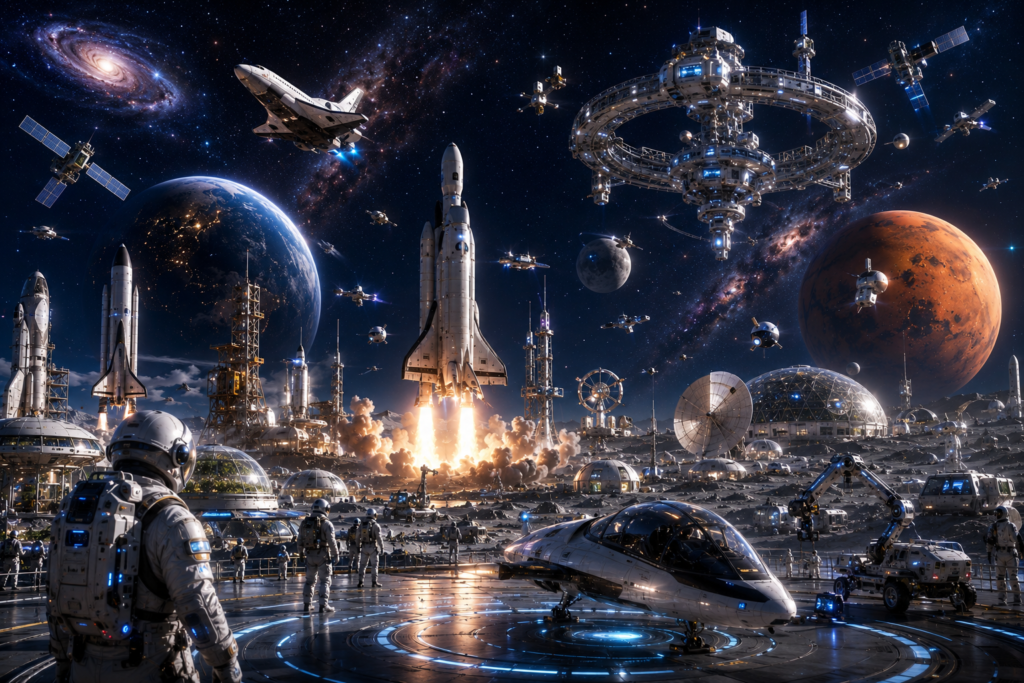
The space exploration future is unfolding faster than many experts predicted. Advances in space technology innovations, reusable rockets, AI-powered spacecraft, and autonomous robotics are reshaping the future of space exploration, making ambitious goals like commercial space travel, sustainable lunar operations, and deep space exploration increasingly achievable.
Over the next two decades, humanity is likely to establish permanent lunar infrastructure, expand robotic exploration across the solar system, develop commercial orbital stations, and prepare for the first sustained human presence on Mars. These milestones will generate scientific discoveries, economic opportunities, and technological breakthroughs that extend far beyond the aerospace industry.
Continued investment from governments, private companies, research institutions, and international partners will be essential to overcoming technical, financial, and operational challenges. By working together, we can unlock new knowledge, strengthen the global economy, and take the next historic step toward humanity’s expansion beyond Earth.
Author

razakh6402@gmail.com
Related Posts

Lead Generation Software: 12 Best Lead Generation Tools for B2B Sales (2026 Guide)
- 0
- 2,300 words
If someone had asked me 15 years ago what the biggest challenge in sales was, my answer would have been simple: finding...

Survey Software: 12 Best Online Survey Tools & Feedback Software for Businesses (2026 Guide)
- 0
- 1,871 word
Whether I was helping a SaaS startup validate a new feature, assisting an HR team with employee engagement, or optimizing customer experience...
Read out all
Online Course Platform: 12 Best LMS Software & eLearning Platforms for Course Creators (2026 Guide)
- 0
- 1,900 word
The online education industry has changed dramatically over the last 15 years. When I built my first digital training portal, simply uploading...

Team Communication Software: 12 Best Business Messaging Apps for Modern Workplaces in 2026 (Expert Tested)
- 0
- 2,305 words
I’ve personally tested dozens of team communication software platforms while consulting for marketing agencies, software companies, HR departments, remote development teams, and...

Invoice Software: 12 Best Invoicing Software for Small Business in 2026 (Expert Tested)
- 0
- 2,493 words
I’ve worked with freelancers chasing late payments, agencies managing hundreds of monthly invoices, startups scaling internationally, and established businesses struggling with outdated...
Generate one SEO-optimized title thatdigital asset management software
- 6
- 2,632 words
One of the most memorable projects I led involved migrating nearly half a million digital assets from a traditional file server into...