
- 0
- 2,449 words
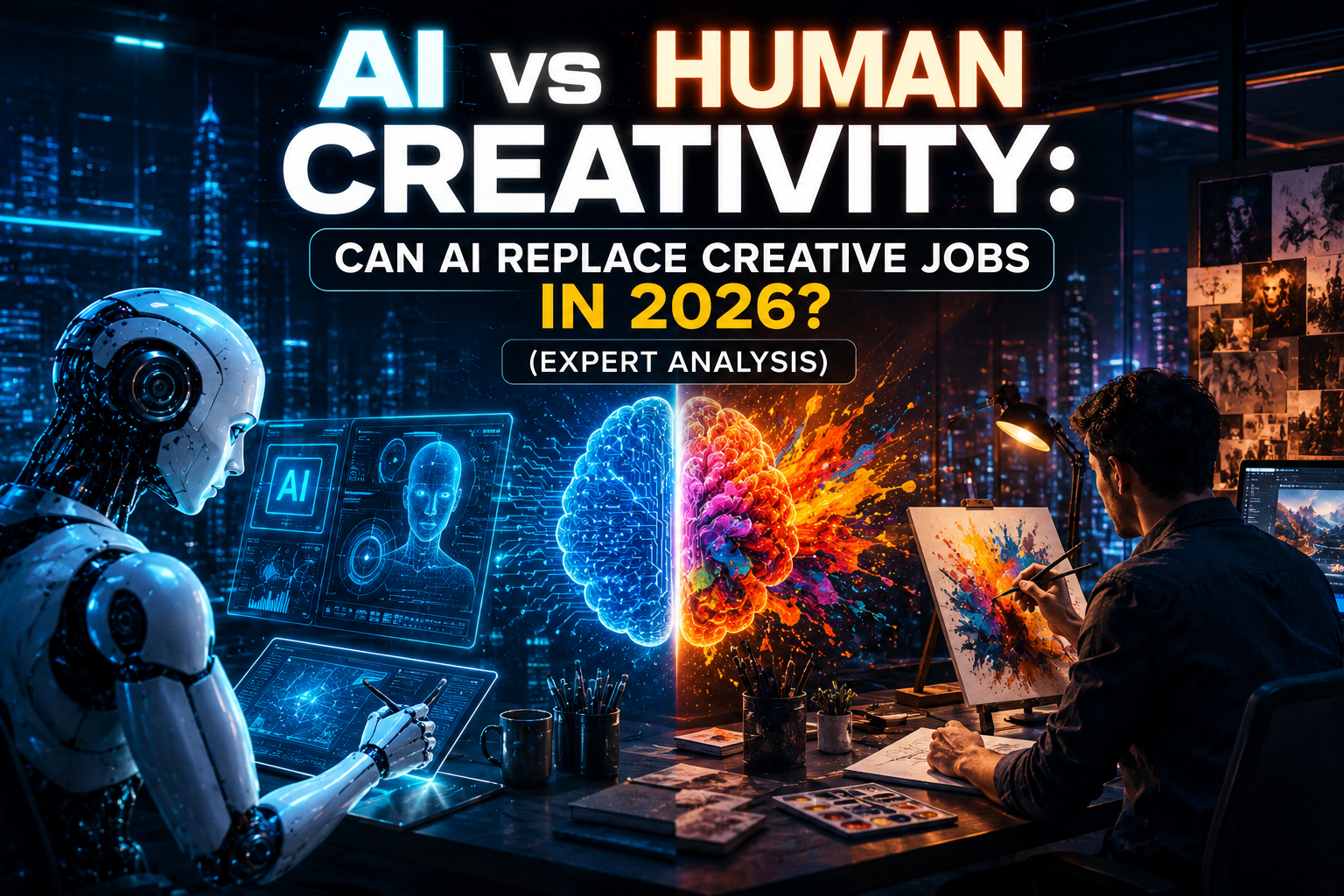
The conversation around AI vs human creativity has become one of the most fascinating and controversial topics in technology. Every week, new AI models generate artwork, write articles, edit videos, compose music, and even create marketing campaigns in minutes. This rapid progress naturally raises an important question: can AI replace creative jobs, or is human imagination still irreplaceable?
After closely following the evolution of AI-powered creative workflows over the past decade and analyzing how businesses, agencies, educators, and creators use these technologies, one thing has become clear: artificial intelligence is transforming creative work—but it’s not replacing creativity itself.
Today’s AI creative tools have become incredibly effective at accelerating repetitive tasks. They help designers generate concepts, assist writers with brainstorming, simplify video production, automate image editing, and improve productivity across creative industries.

However, there’s a significant difference between producing content and creating something genuinely meaningful.
This article explores the reality behind AI vs human creativity, examines whether AI generated content can compete with original human ideas, discusses the strengths and weaknesses of modern AI for designers, writers, marketers, and developers, and explains how creative professionals can thrive in the AI era rather than compete against it.
What AI Means for Creativity in 2026
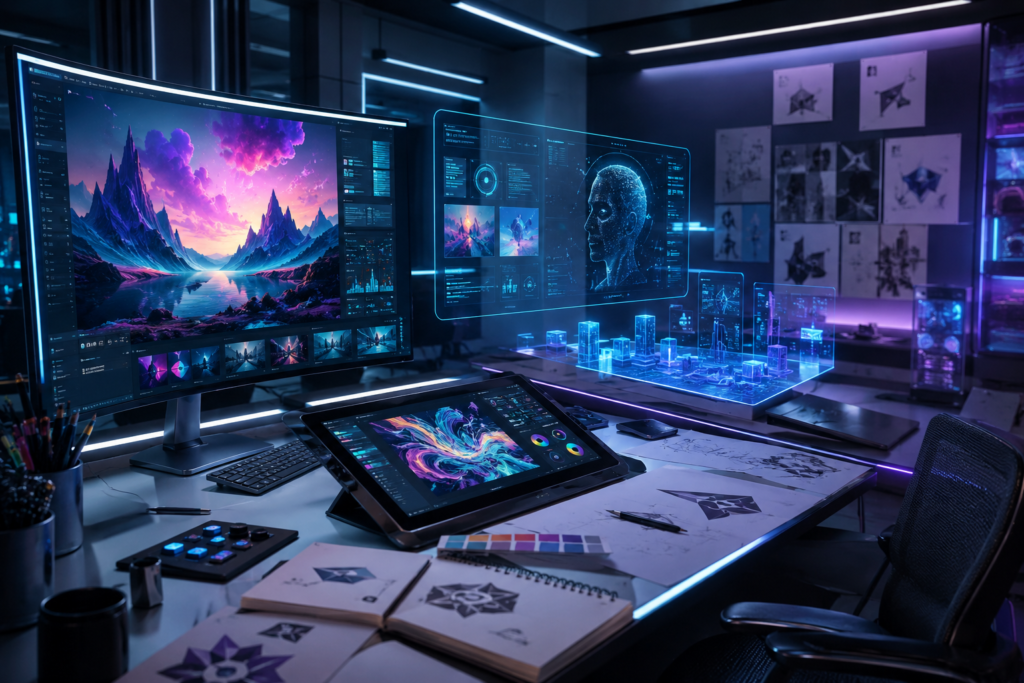
Artificial intelligence has moved well beyond simple automation. Modern AI systems can now generate illustrations, presentations, marketing copy, software code, product concepts, videos, voiceovers, and even complete advertising campaigns.
This doesn’t mean creativity has become automated.
Instead, AI has become a creative assistant.
The biggest shift I’ve observed across agencies and businesses is that professionals are spending less time on repetitive production work and more time refining ideas, improving storytelling, and making strategic decisions.
For example:
- Graphic designers use AI to generate multiple concept variations before refining the strongest one.
- Writers use AI to brainstorm outlines instead of starting with a blank page.
- Video creators use AI for subtitles, voiceovers, and editing rather than replacing the entire production process.
- Marketing teams use AI to create first drafts of campaigns before adapting them to match their brand voice.
best email marketing softwareThis collaborative approach explains why discussions about AI vs human creativity have become more nuanced. The question is no longer whether AI can create—it clearly can. The real question is whether AI can create with genuine intent, emotional depth, and cultural understanding.
Why Businesses Are Investing in AI Creative Tools
Companies adopt AI creative tools for several practical reasons:
- Faster content production
- Lower production costs
- Improved workflow automation
- Increased marketing efficiency
- Faster idea generation
- Better multilingual content creation
- More personalized customer experiences
These advantages explain why businesses across design, media, education, software, and marketing continue investing in AI technologies.
Understanding Human Creativity
Before comparing AI with people, it’s important to define creativity itself.
Human creativity isn’t simply producing something new.
It combines:
- Experience
- Emotion
- Observation
- Curiosity
- Imagination
- Cultural awareness
- Personal values
- Storytelling
- Critical thinking
When a designer creates a logo, they don’t simply arrange shapes.
They consider:
- Brand identity
- Customer psychology
- Industry trends
- Business objectives
- Emotional response
- Long-term recognition
Similarly, an author writing a novel isn’t just predicting the next word. They’re drawing on memories, relationships, emotions, and lived experiences to craft meaningful stories.
These human qualities remain difficult for AI to replicate.
The Psychology Behind Creativity
Creative thinking often emerges from experiences that machines cannot genuinely possess.
Humans connect ideas through:
- Childhood memories
- Personal struggles
- Cultural traditions
- Humor
- Empathy
- Intuition
- Unexpected inspiration
Artificial intelligence can imitate these patterns based on training data, but it doesn’t experience them firsthand.
That’s one of the biggest distinctions in the ongoing discussion about AI vs human creativity.
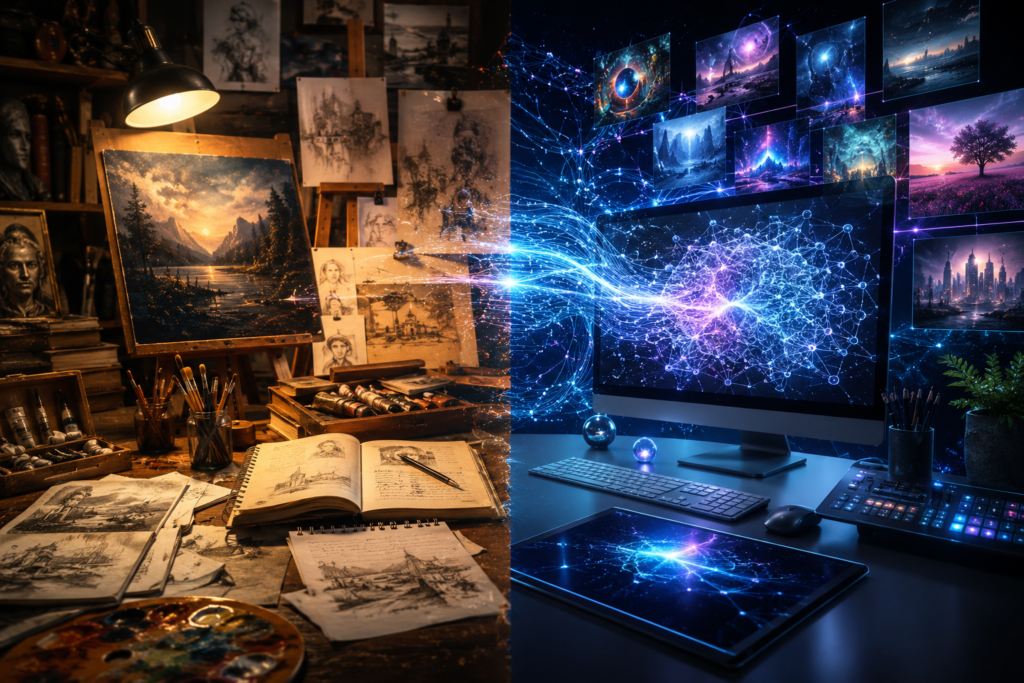
How AI Generates Creative Content
One of the biggest misconceptions surrounding AI generated content is that AI “thinks” like people.
It doesn’t.
Modern AI models learn statistical relationships between billions of words, images, sounds, and patterns.
When prompted, they predict what content is most likely to satisfy the request.
This allows AI to generate:
- Articles
- Marketing copy
- Logos
- Images
- Music
- Videos
- Code
- Presentations
- Product descriptions
- Social media posts
The results can be remarkably convincing.
However, AI doesn’t understand creativity the way humans do.
It predicts.
Humans imagine.
Strengths of AI Generated Content
Modern AI systems excel at:
Speed
Tasks that once required several hours often take only minutes.
Consistency
AI maintains consistent tone, formatting, and style across large projects.
Brainstorming
Many creators use AI as an idea generator before beginning the creative process.
Productivity
One of the biggest benefits of AI for designers and writers is eliminating repetitive production work.
Examples include:
- Background removal
- Image resizing
- Caption writing
- Outline creation
- Presentation formatting
- Video transcription
Where AI Still Struggles
Despite impressive capabilities, AI continues to face important limitations.
These include:
- Genuine originality
- Emotional storytelling
- Cultural nuance
- Ethical judgment
- Long-term strategy
- Personal experience
- Humor with deep context
- Abstract conceptual thinking
Because of these limitations, human review remains essential for high-value creative work.
AI vs Human Creativity: Key Differences
The debate surrounding AI vs human creativity often assumes one side must replace the other.
Reality is far more collaborative.
AI excels at processing information rapidly.
Humans excel at assigning meaning.
Consider a branding project.
AI can quickly generate:
- Logo ideas
- Color palettes
- Marketing headlines
- Mood boards
A creative director then evaluates whether those concepts truly represent the company’s mission, values, audience, and long-term strategy.
Likewise, AI can draft an article in minutes.
A skilled writer transforms that draft into something persuasive, engaging, and memorable through storytelling, expertise, and editorial judgment.
The most successful creative professionals today are those who combine AI efficiency with uniquely human insight rather than relying exclusively on either one.
Can AI Replace Creative Jobs?
This is perhaps the most frequently asked question in discussions about AI vs human creativity.
The short answer is:
AI will replace certain creative tasks—but it’s far less likely to replace creative professionals who continuously adapt.
Routine work is already becoming automated.
Examples include:
- Image resizing
- Basic logo variations
- Caption generation
- Product descriptions
- Subtitle creation
- Background removal
- Audio transcription
- Initial content drafts
However, strategic creative work still depends heavily on human expertise.
Businesses continue to rely on experienced professionals for:
- Brand strategy
- Creative direction
- Campaign planning
- Storytelling
- Emotional marketing
- User experience design
- Innovation
- Client collaboration
Instead of eliminating creative careers, AI is reshaping them.
Professionals who learn to integrate AI into their workflow are often becoming more productive, allowing them to focus on higher-value work that requires originality, judgment, and human connection.
Top AI Creative Tools in 2026
Artificial intelligence has become an essential part of many creative workflows. Rather than replacing professionals, today’s AI creative tools help generate ideas faster, automate repetitive tasks, and improve productivity. Here are some of the most influential tools shaping creative work in 2026.
ChatGPT
Best For
- Content writing
- Brainstorming
- Script writing
- Marketing copy
- Creative ideation
ChatGPT is one of the most versatile AI assistants available today. It excels at generating article outlines, refining marketing campaigns, developing creative concepts, and helping writers overcome creative blocks.
Where it shines: Fast idea generation and structured writing.
Claude
Best For
- Long-form writing
- Editing
- Research summaries
- Strategy documents
Claude performs exceptionally well when working with lengthy creative projects. It produces coherent drafts and helps improve clarity without drastically changing the author’s original voice.
Google Gemini
Best For
- Research
- Google Workspace integration
- Presentations
- Educational content
Gemini integrates naturally with Google’s ecosystem, making it valuable for teams already using Google Docs, Slides, and Drive.
Midjourney
Best For
- Concept art
- Digital illustration
- Product visualization
- Creative inspiration
Midjourney has become one of the most impressive image-generation platforms for designers and artists looking to rapidly visualize concepts.
Adobe Firefly
Best For
- Commercial graphics
- Image editing
- Generative Fill
- Professional design
Adobe Firefly integrates directly into Adobe Creative Cloud, making it especially attractive for professional designers already using Photoshop and Illustrator.
Canva Magic Studio
Best For
- Social media graphics
- Presentations
- Marketing assets
- Educational visuals
Canva continues to simplify graphic design while adding AI-powered image generation, presentation creation, and writing assistance.
Runway
Best For
- AI video editing
- Background removal
- Motion graphics
- Visual effects
Runway dramatically speeds up video production workflows with AI-powered editing capabilities.
Synthesia
Best For
- AI avatars
- Corporate training
- Educational videos
- Product demonstrations
Synthesia allows businesses and educators to create professional training videos without cameras or filming studios.
ElevenLabs
Best For
- Voiceovers
- AI narration
- Podcasts
- Educational content
ElevenLabs produces remarkably natural AI voices, making it a favorite for course creators, YouTubers, and businesses.
Descript
Best For
- Podcast editing
- Video editing
- AI transcription
- Screen recordings
Descript makes editing audio and video as simple as editing text, dramatically reducing production time.
Figma AI
Best For
- UX/UI design
- Wireframes
- Prototyping
- Interface generation
Figma AI accelerates the design process by helping teams generate layouts, components, and design suggestions.
Notion AI
Best For
- Knowledge management
- Documentation
- Brainstorming
- Project planning
Notion AI streamlines content organization, meeting notes, and creative collaboration.
Gamma AI
Best For
- AI presentations
- Pitch decks
- Reports
- Interactive documents
Gamma enables creators to transform ideas into polished presentations within minutes.
How Different Creative Professionals Use AI
AI for Designers
Modern AI for designers has become an everyday productivity companion.
Designers now use AI to:
- Generate mood boards
- Create concept sketches
- Remove backgrounds
- Produce color palettes
- Generate typography ideas
- Expand images
- Create mockups
AI speeds up exploration, but successful branding still depends on human judgment, market understanding, and visual storytelling.
AI for Writers
Writers increasingly use AI for:
- Research
- Outlines
- Editing
- Headline generation
- SEO optimization
- Grammar improvement
The strongest articles still require human expertise, originality, and fact-checking. AI generated content works best as a starting point rather than a finished product.
AI for Video Creators
Video professionals use AI to:
- Generate subtitles
- Remove noise
- Edit clips
- Produce voiceovers
- Translate videos
- Create AI avatars
This dramatically shortens production time while allowing creators to focus on storytelling.
AI for Marketers
Marketing teams use AI to:
- Generate ad copy
- Analyze customer behavior
- Create social media content
- Build presentations
- Personalize campaigns
- Brainstorm creative concepts
AI for Developers
Developers leverage AI for:
- Code suggestions
- Documentation
- Debugging
- UI generation
- API explanations
- Workflow automation
AI increases productivity without replacing software engineering expertise.
Industries Most Affected by AI Creativity
Several industries have experienced significant changes:
- Graphic Design
- Advertising
- Marketing
- Publishing
- Journalism
- Software Development
- Video Production
- Photography
- Education
- Architecture
- Product Design
- Music Production
Rather than eliminating jobs entirely, AI is reshaping workflows and increasing productivity across these sectors.
Advantages of AI Creative Tools
Modern AI creative tools offer several benefits:
- Faster production
- Reduced repetitive work
- Cost savings
- Rapid brainstorming
- Better accessibility
- Scalable content creation
- Multilingual support
- Workflow automation
- Improved collaboration
Limitations of AI Generated Content
Despite impressive progress, AI generated content still has important limitations:
- Limited emotional understanding
- Occasional factual inaccuracies
- Lack of genuine lived experience
- Risk of generic outputs
- Copyright and licensing considerations
- Potential bias inherited from training data
- Dependence on high-quality prompts
These limitations reinforce the need for human oversight, especially in high-value creative projects.
Comparison Table
| Category | Human Creativity | Artificial Intelligence |
|---|---|---|
| Original Thinking | High | Pattern-based generation |
| Emotional Intelligence | Excellent | Limited simulation |
| Speed | Moderate | Extremely fast |
| Consistency | Variable | Very consistent |
| Innovation | Driven by imagination | Driven by learned patterns |
| Adaptability | Excellent in unfamiliar contexts | Depends on training and prompts |
| Problem Solving | Strategic and contextual | Analytical and data-driven |
| Learning Ability | Experience and reflection | Model training and updates |
| Cost | Higher for skilled professionals | Lower for repetitive tasks |
| Best Use Cases | Strategy, storytelling, branding, innovation | Automation, ideation, drafting, production support |
Future of Creative Careers
Creative careers are evolving rather than disappearing.
Professionals who embrace AI as a collaborative tool are likely to gain a competitive advantage by delivering work more efficiently while focusing on areas where human creativity remains strongest:
- Strategic thinking
- Brand development
- Storytelling
- Emotional design
- Innovation
- Leadership
- Client relationships
The demand for these uniquely human skills is expected to remain strong.
How to Use AI Without Losing Creativity
To maintain originality while benefiting from AI:
- Use AI for research and first drafts.
- Add your own perspective and expertise.
- Verify facts and sources.
- Develop a consistent creative voice.
- Treat AI as a collaborator, not a replacement.
- Continue practicing core creative skills.
- Experiment with different prompts and workflows.
This balanced approach allows creators to increase efficiency without sacrificing authenticity.
Expert Insights
Across creative industries, the most successful professionals are not those who avoid AI or rely on it completely. They understand where automation adds value and where human judgment, empathy, and originality remain essential.
Organizations increasingly look for people who can combine creative thinking with AI literacy, making adaptability one of the most valuable skills in the years ahead.
Frequently Asked Questions
Can AI replace creative jobs?
AI can automate repetitive creative tasks, but it is unlikely to replace professionals whose work depends on strategy, originality, storytelling, and emotional understanding.
Which AI creative tools are best in 2026?
Popular choices include ChatGPT, Claude, Google Gemini, Midjourney, Adobe Firefly, Canva Magic Studio, Runway, Synthesia, ElevenLabs, Descript, Figma AI, Notion AI, and Gamma AI.
Is AI generated content good for SEO?
AI-generated content can support SEO when it is accurate, original, and enhanced with expert insights. Human editing remains essential for quality and credibility.
Is AI useful for designers?
Yes. AI for designers helps with ideation, image editing, mockups, and repetitive design tasks, allowing designers to focus on creative direction and user experience.
Conclusion
The discussion around AI vs human creativity will continue as technology evolves, but one conclusion is already clear: AI is changing how creative work gets done, not eliminating the need for creative professionals. While questions such as can AI replace creative jobs remain relevant, the strongest outcomes come from combining human imagination with modern AI creative tools.
Whether you’re exploring AI for designers, experimenting with AI generated content, or building creative workflows for your business, the goal shouldn’t be to replace creativity—it should be to amplify it. The future belongs to creators who understand both the possibilities and the limitations of AI and use it thoughtfully to deliver work that is efficient, authentic, and meaningful.
Author

razakh6402@gmail.com
Related Posts
Document Management Software: Top Document Management Software Compared (2026 Guide)
- 0
- 1,895 word
Not long ago, managing business documents meant overflowing filing cabinets, misplaced contracts, and countless hours spent searching for the right file. Even...
Read out all
AI Website Builder: Best AI Website Builders Compared (2026 Guide)
- 0
- 2,412 words
A decade ago, building a professional website meant writing HTML, CSS, JavaScript, and often PHP from scratch. Later, drag-and-drop builders like WordPress...
Read out all
AI Course Creator: Top AI Tools for Online Courses in 2026 (Expert-Tested Guide)
- 0
- 1,935 word
I’ve spent years researching instructional design, evaluating learning platforms, and following the evolution of educational technology. One trend has become impossible to...
Read out all
AI Browser Extensions: Best AI Chrome Extensions for Productivity in 2026 (Expert-Tested Guide)
- 0
- 2,414 words
Artificial intelligence has quietly become one of the biggest productivity upgrades I’ve experienced during my career. Over the past 15 years of...
Read out all
AI Agents in 2026: How AI Agents for Work Are Transforming Everyday Productivity
- 2
- 2,405 words
A few years ago, most businesses viewed artificial intelligence as a helpful assistant for answering questions or generating content. Today, the conversation...
Read out all
Best AI Search Engines in 2026: 10 AI Search Engine Alternatives That Can Replace Google
- 2
- 2,337 words
Google has dominated online search for more than two decades, and for many people, typing a query into Google has become second...
Read out all