
- 10
- 2,685 words
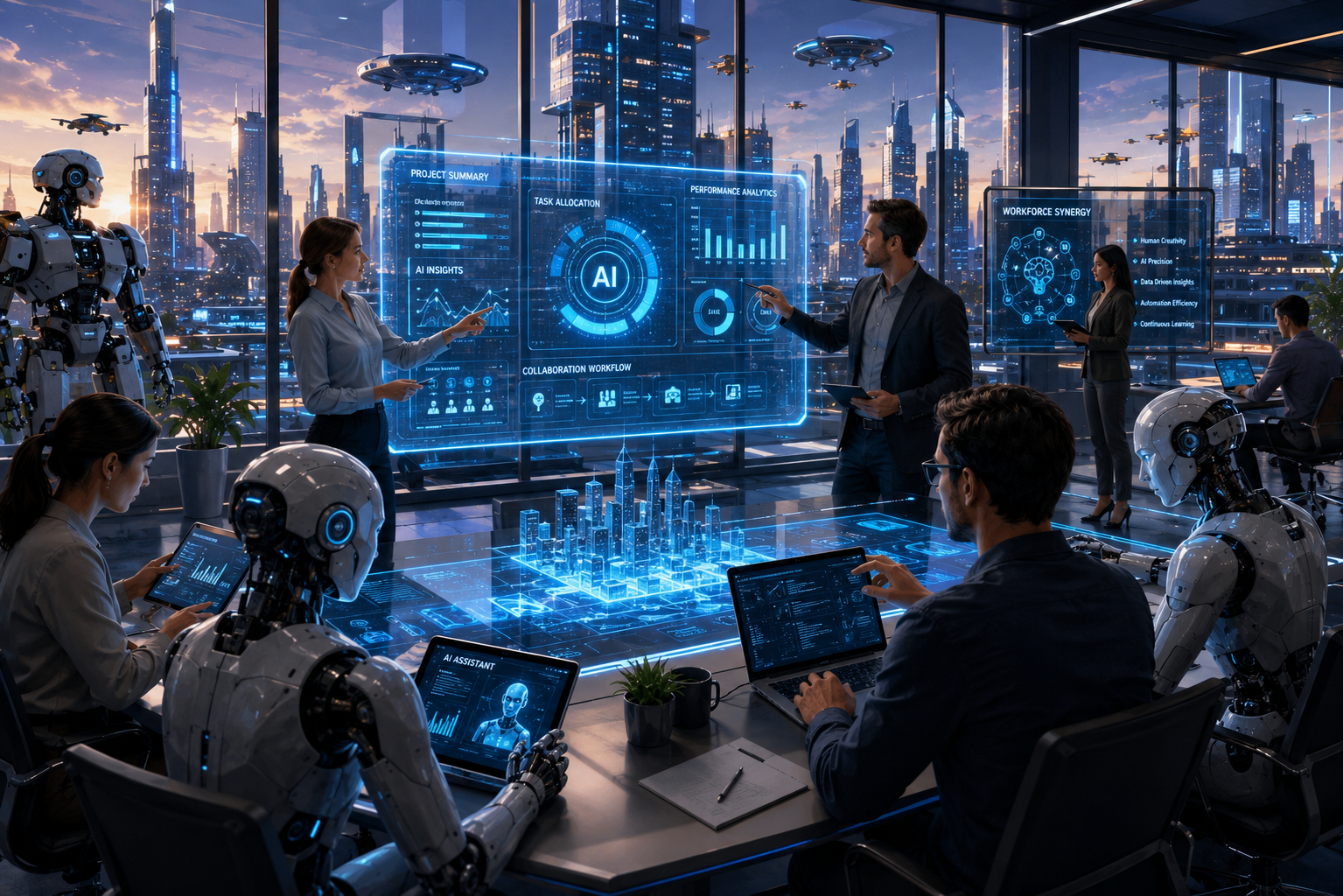
Artificial Intelligence has moved far beyond being a futuristic concept. Today, it helps developers write code, assists doctors in diagnosing diseases, supports marketers with content creation, enables manufacturers to optimize production lines, and empowers business leaders to make faster, data-driven decisions. The conversation is no longer about whether AI will become part of our lives—it already has. The real question is how humans and AI can work together to achieve better outcomes.
This is where human AI collaboration becomes one of the most important technology trends of this decade. Rather than replacing people, modern AI is increasingly designed to enhance human creativity, improve productivity, and support smarter decision-making. Across industries, AI and human collaboration is transforming the way organizations innovate, communicate, and solve complex challenges.
From analyzing enterprise AI adoption over recent years, one trend has become clear: companies that treat AI as a collaborative partner consistently achieve better results than those attempting to automate everything. Successful organizations focus on human centered AI, ensuring technology complements human expertise instead of replacing it.
As businesses continue investing in digital transformation, the future of AI workforce will depend on balancing technological capabilities with uniquely human skills such as creativity, emotional intelligence, ethical judgment, and strategic thinking. This balanced approach is shaping a new era of AI assisted work, where humans and intelligent systems collaborate to create greater value than either could achieve alone.
Human AI Collaboration: Why It Matters More Than Ever
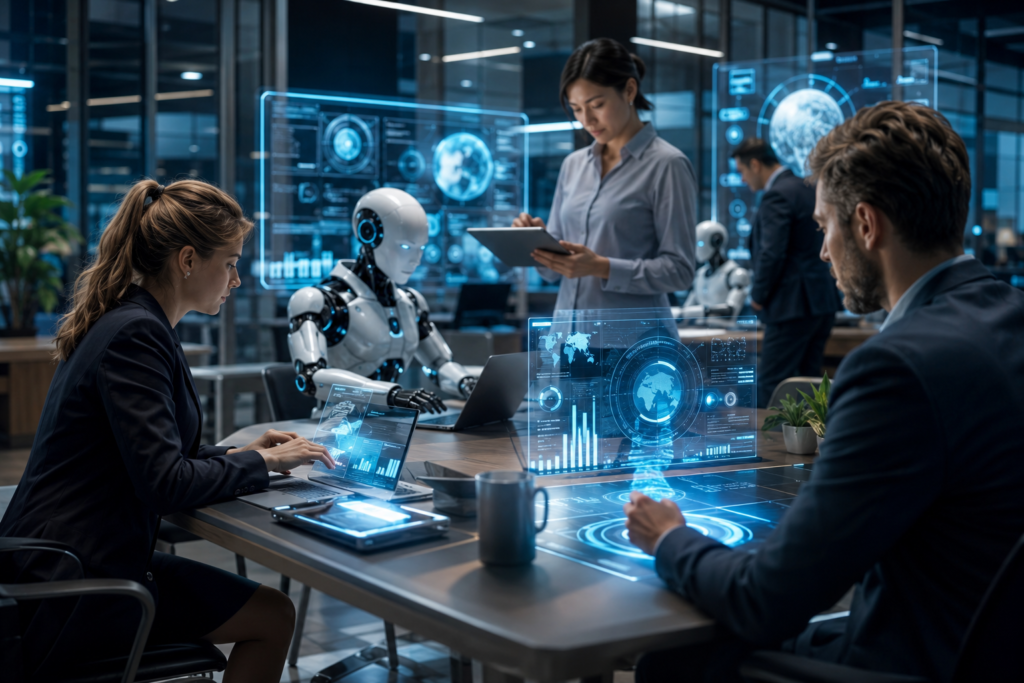
The rapid advancement of Artificial Intelligence has fundamentally changed how organizations operate. Only a few years ago, AI adoption was largely limited to automation and data analysis. Today, intelligent systems actively assist with research, software development, customer service, content creation, cybersecurity, financial forecasting, and healthcare.
The growing importance of human AI collaboration stems from the realization that AI performs best when combined with human expertise. While AI excels at processing massive datasets, identifying patterns, and automating repetitive tasks, humans remain superior in creativity, empathy, leadership, negotiation, and ethical decision-making.

The future of AI workforce is therefore not about replacing employees but empowering them with intelligent digital tools. Organizations that embrace this philosophy are seeing measurable improvements in productivity, innovation, and customer satisfaction.
Understanding AI and Human Collaboration
At its core, AI and human collaboration means combining artificial intelligence with human judgment to achieve better outcomes. Instead of competing with people, AI acts as an intelligent assistant capable of accelerating work, improving accuracy, and providing valuable insights.
Whether it’s an architect using AI to generate multiple building concepts, a physician receiving AI-assisted diagnostic recommendations, or a software engineer working alongside an AI coding assistant, the principle remains the same: AI enhances human capabilities rather than replacing them.
This approach reflects the broader philosophy of human centered AI, where technology is designed to serve people, respect ethical standards, and improve decision-making without removing human oversight.
How Human-AI Collaboration Has Evolved
The evolution of human AI collaboration has been remarkable. Early AI systems focused primarily on automating repetitive tasks such as data entry and manufacturing processes. Modern AI platforms, however, are capable of understanding natural language, generating content, recognizing images, writing software, translating conversations, and assisting with complex problem-solving.
Why Businesses Are Investing in AI Assisted Work
Organizations are rapidly investing in AI assisted work because the benefits extend far beyond cost savings. AI helps employees make faster decisions, reduce repetitive workloads, improve accuracy, and deliver better customer experiences.
For example, customer support teams use AI to answer routine inquiries, enabling human agents to focus on complex cases. Marketing teams leverage AI for campaign analysis while relying on human creativity to develop compelling brand strategies. Healthcare professionals use AI to analyze medical images but continue making final clinical decisions based on expertise and patient needs.
This balanced approach highlights why human centered AI has become a guiding principle for responsible innovation. Businesses increasingly recognize that sustainable AI adoption depends on maintaining human oversight, transparency, and accountability.
Core Technologies Powering Human AI Collaboration
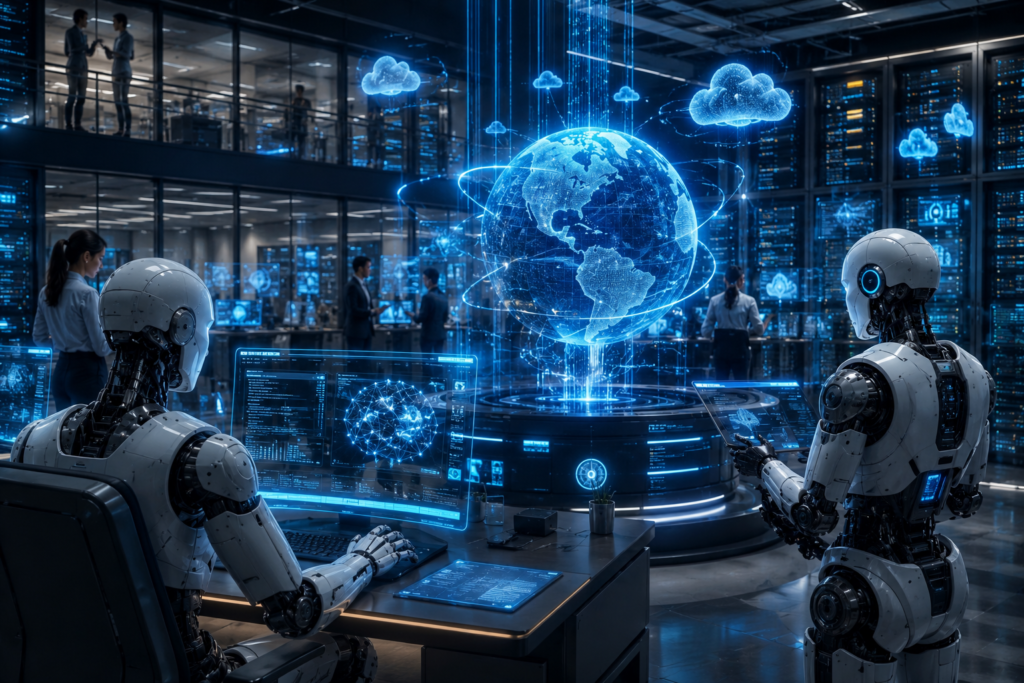
The rapid growth of human AI collaboration is made possible by several breakthrough technologies working together. Artificial Intelligence is no longer a single technology—it is a connected ecosystem that combines machine learning, generative AI, robotics, cloud computing, automation, and advanced analytics.
These technologies are redefining the future of AI workforce by enabling organizations to build intelligent systems that augment human capabilities instead of replacing them. In the next section, we’ll explore the key technologies—including Generative AI, Machine Learning, Large Language Models, Computer Vision, Automation, Robotics, and AI Copilots—and examine how they are transforming AI and human collaboration across industries.
Core Technologies Powering Human AI Collaboration
The rapid evolution of human AI collaboration is driven by a combination of advanced technologies that complement human intelligence rather than compete with it. Individually, these innovations are powerful. Together, they are redefining the future of AI workforce and creating smarter, faster, and more collaborative workplaces.
Machine Learning
Machine Learning enables AI systems to learn from historical data and improve over time without being explicitly programmed for every situation.
Within human AI collaboration, machine learning provides valuable insights while human experts validate results, interpret context, and make final decisions.
Large Language Models (LLMs)
Large Language Models have transformed communication and knowledge work.
These models understand context, summarize documents, answer questions, translate languages, generate code, and assist with research.
Organizations increasingly deploy LLM-powered assistants to improve AI and human collaboration, helping employees access information faster and reduce administrative workloads.
Instead of replacing expertise, these assistants enable professionals to work more efficiently.
Computer Vision
Computer Vision allows AI to understand images and videos much like humans do.
Healthcare providers analyze medical scans, manufacturers inspect product quality, retailers monitor inventory, and security teams detect unusual activity.
When combined with human judgment, computer vision significantly improves accuracy while reducing manual effort.
This practical partnership reflects the growing importance of human centered AI.
Intelligent Automation
Automation has evolved beyond repetitive workflows.
Modern intelligent automation combines robotic process automation (RPA), AI, and analytics to streamline complex business operations.
Finance teams automate invoice processing.
HR departments simplify recruitment.
Customer support centers handle routine inquiries automatically.
Meanwhile, employees focus on creativity, relationship building, and strategic planning.
Robotics
Collaborative robots, often called cobots, work safely alongside humans instead of replacing them.
Factories increasingly use robots for lifting heavy materials, assembling products, and performing hazardous tasks.
Human workers supervise operations, solve unexpected problems, and improve production processes.
This partnership represents one of the strongest examples of AI and human collaboration in modern manufacturing.
AI Copilots
AI Copilots are becoming essential workplace assistants.
Whether writing emails, analyzing spreadsheets, generating software code, summarizing meetings, or preparing presentations, AI copilots help professionals complete tasks more efficiently.
Rather than making independent decisions, they provide intelligent recommendations while humans remain responsible for final approval.
This collaborative approach reflects the future vision of human centered AI.
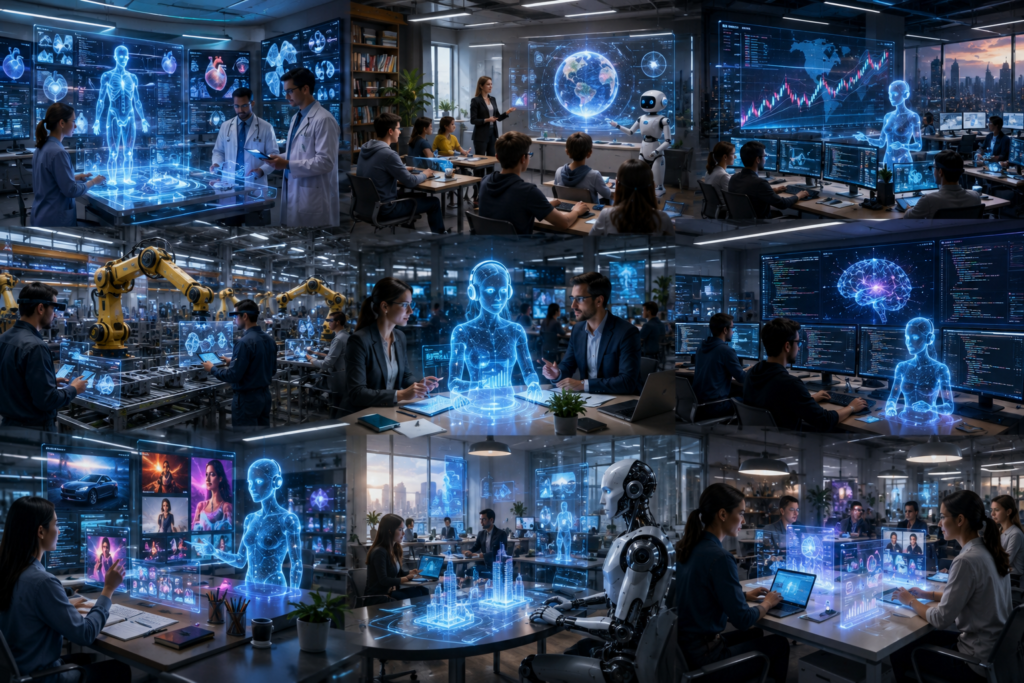
Top Human AI Collaboration Trends
The next phase of human AI collaboration is being shaped by practical innovation rather than hype. Organizations are focusing on technologies that improve productivity, reduce costs, and support employees instead of replacing them.
AI Copilots Everywhere
AI copilots are becoming standard productivity tools.
Professionals use them to draft reports, generate presentations, summarize meetings, analyze data, and automate repetitive tasks.
This trend is accelerating the adoption of AI assisted work across every major industry.
AI Agents
Unlike traditional chatbots, AI agents can complete multi-step tasks with minimal supervision.
Businesses are beginning to use AI agents for scheduling meetings, processing documents, customer support, software testing, and workflow automation.
These systems expand the possibilities of AI and human collaboration while keeping humans in control of strategic decisions.
Human Centered AI
Responsible AI development is becoming a business priority.
Organizations increasingly design AI systems that are transparent, explainable, fair, and accountable.
This focus on human centered AI helps build trust among employees, customers, and regulators.
Smart Offices and Hybrid Work
Modern workplaces combine cloud computing, AI assistants, intelligent meeting rooms, and digital collaboration platforms.
Employees receive real-time recommendations, automated scheduling, meeting summaries, and productivity insights, making hybrid work more effective than ever before.
Education
Teachers increasingly use AI to personalize learning experiences, create lesson plans, and monitor student progress.
Students benefit from interactive tutoring while educators continue providing mentorship, emotional support, and critical thinking guidance.
Manufacturing
Factories are embracing predictive maintenance, intelligent robots, quality inspection systems, and digital twins.
Workers collaborate with AI-powered equipment to improve safety, efficiency, and production quality.
Marketing
Marketing teams use AI to analyze consumer behavior, generate campaign ideas, optimize advertising performance, and personalize customer experiences.
Human creativity remains essential for storytelling, branding, and emotional connection.
Software Development
Developers now work alongside AI coding assistants that suggest code, identify bugs, generate documentation, and improve software quality.
This significantly increases productivity while allowing engineers to focus on architecture, innovation, and complex problem-solving.
Finance
Banks and financial institutions use AI for fraud detection, risk assessment, customer support, and investment analysis.
Financial professionals validate AI recommendations before making critical business decisions, reinforcing the value of human AI collaboration.
Benefits of Human AI Collaboration
Organizations adopting human AI collaboration are already experiencing measurable benefits.
Some of the most significant advantages include:
- Increased employee productivity through AI assisted work
- Better decision-making supported by real-time analytics
- Faster innovation and product development
- Improved customer experiences through personalized services
- Reduced repetitive administrative tasks
- Greater workplace creativity by combining AI efficiency with human imagination
- Enhanced collaboration between global teams
- Higher employee satisfaction by allowing people to focus on meaningful work
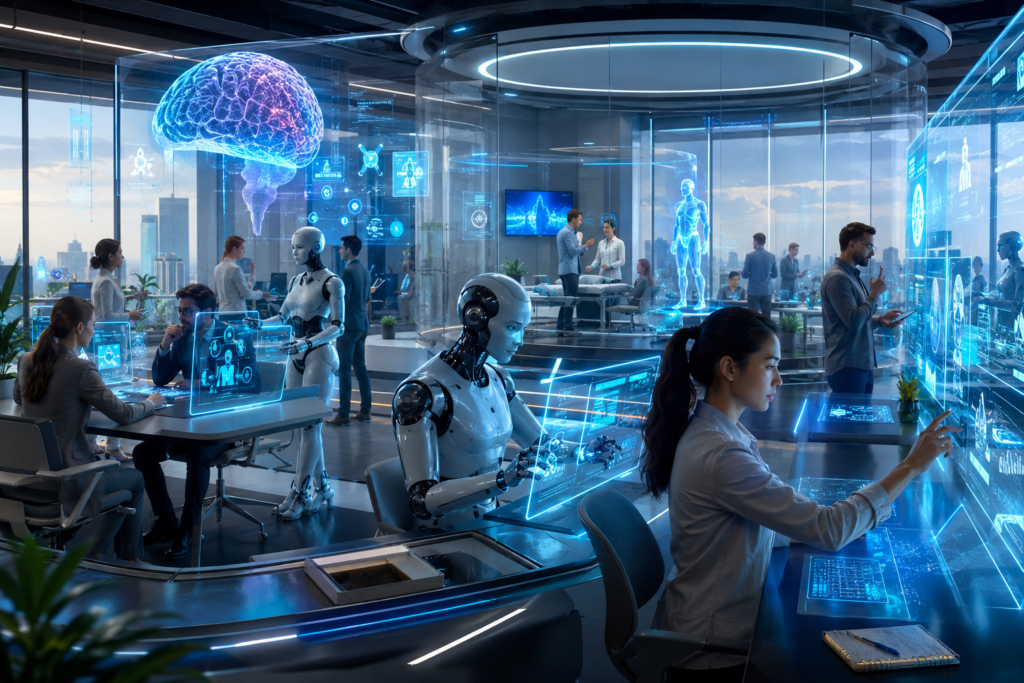
Challenges of Human AI Collaboration
Although human AI collaboration is transforming industries, successful adoption requires more than implementing advanced technology. Organizations must address ethical, technical, legal, and workforce challenges to build sustainable and trustworthy AI ecosystems.
AI Bias and Fairness
Artificial Intelligence learns from data, and if that data contains bias, AI systems can produce unfair outcomes. Businesses must regularly audit AI models, diversify training datasets, and involve human experts in reviewing AI-generated decisions. A human centered AI approach ensures fairness, transparency, and accountability.
Privacy and Data Security
Modern AI assisted work relies on vast amounts of business and customer data. Protecting sensitive information has become a critical responsibility.
Organizations should implement:
- End-to-end encryption
- Multi-factor authentication
- Zero-trust security architecture
- Regular security audits
- Compliance with privacy regulations
Without strong security, even the most advanced AI and human collaboration strategy can lose stakeholder trust.
Successful organizations treat AI as a decision-support system rather than allowing it to make high-impact decisions without human oversight.
Workforce Transformation
The future of AI workforce is changing job roles rather than eliminating work altogether. Employees will increasingly transition from repetitive operational tasks to analytical, creative, and strategic responsibilities.
Continuous learning and reskilling will be essential for adapting to this new workplace.
Building Trust
Employees are more likely to embrace human AI collaboration when organizations communicate openly about AI’s role. Training, transparency, and employee involvement help build confidence while reducing fear and resistance to change.
Traditional Workforce vs AI Assisted Workforce
| Feature | Traditional Workforce | AI Assisted Workforce |
|---|---|---|
| Decision Making | Human intuition only | Human expertise supported by AI insights |
| Productivity | Manual workflows | Automated repetitive tasks |
| Customer Support | Human agents only | AI + human collaboration |
| Data Analysis | Time-consuming | Real-time AI analytics |
| Software Development | Manual coding | AI coding assistants |
| Employee Training | Classroom-based | Personalized AI learning |
| Collaboration | Email & meetings | Intelligent digital collaboration |
| Innovation | Limited by available resources | AI-powered idea generation and faster experimentation |
Real Industry Examples
The rapid growth of human AI collaboration is being driven by leading technology companies that are integrating AI into everyday business operations.
Microsoft Copilot
Microsoft Copilot enhances productivity across Word, Excel, Outlook, Teams, and PowerPoint. It assists employees with writing, data analysis, meeting summaries, and workflow automation, making AI assisted work accessible to millions of professionals.
Google Gemini
Google Gemini combines multimodal AI capabilities with productivity tools, enabling users to analyze documents, generate ideas, summarize information, and collaborate more efficiently.
OpenAI ChatGPT
ChatGPT has transformed knowledge work by helping professionals write, research, brainstorm, code, and solve problems. It represents one of the strongest examples of practical AI and human collaboration.
Anthropic Claude
Claude focuses on responsible AI development with an emphasis on safety, long-context reasoning, and enterprise applications, supporting organizations that prioritize human centered AI.
NVIDIA
NVIDIA provides the GPUs and AI infrastructure powering many of today’s most advanced AI systems. Its technologies accelerate research, robotics, healthcare, autonomous vehicles, and enterprise AI.
IBM Watson
IBM Watson continues supporting healthcare, finance, customer service, and enterprise analytics through AI-powered decision support systems.
Expert Insights
One lesson consistently observed across enterprise AI adoption is that technology alone does not create transformation—people do.
The most successful implementations also prioritize governance, transparency, and ethics. Businesses that establish clear AI policies build greater trust among employees, customers, and stakeholders.
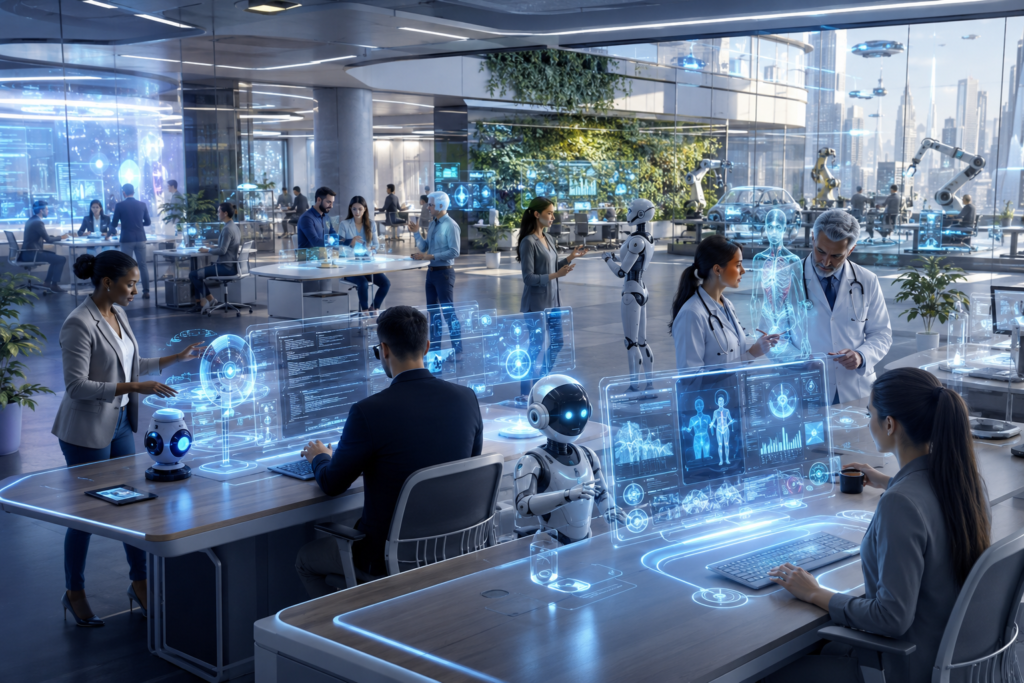
Frequently Asked Questions
1. What is human AI collaboration?
Human AI collaboration is the partnership between people and Artificial Intelligence where AI assists with analysis, automation, and repetitive tasks while humans provide creativity, judgment, ethics, and decision-making.
2. Why is AI and human collaboration important?
AI and human collaboration improves productivity, enhances decision-making, reduces repetitive work, and enables employees to focus on innovation, customer relationships, and strategic thinking.
3. What industries benefit most from AI assisted work?
Healthcare, finance, manufacturing, education, software development, marketing, customer service, logistics, and retail are among the industries benefiting most from AI assisted work.
4. Will AI replace human workers?
AI is expected to transform jobs rather than replace all workers. The future of AI workforce will emphasize collaboration, where AI augments human skills instead of replacing human expertise.
5. What is human centered AI?
Human centered AI focuses on developing Artificial Intelligence systems that are transparent, ethical, fair, secure, and designed to support human well-being and decision-making.
6. How can businesses prepare for AI collaboration?
Organizations should invest in employee training, establish AI governance policies, prioritize cybersecurity, encourage responsible AI adoption, and integrate AI into existing workflows gradually.
7. What skills will become more valuable in the AI era?
Critical thinking, creativity, emotional intelligence, leadership, communication, adaptability, and ethical decision-making will remain essential as human AI collaboration becomes increasingly common.
8. What does the future of AI workforce look like?
The future of AI workforce will feature intelligent digital assistants, AI copilots, collaborative robots, and automated workflows working alongside skilled professionals to improve productivity and innovation.
Final Thoughts
The future of Human AI collaboration is not about choosing between humans and machines—it is about combining the strengths of both. Artificial Intelligence can analyze vast amounts of information, automate repetitive tasks, and generate valuable insights, while humans contribute creativity, empathy, ethical judgment, and strategic thinking.
Businesses that embrace AI and human collaboration thoughtfully will be better positioned to innovate, adapt, and compete in an increasingly digital economy. The goal should not be to replace employees but to empower them through AI assisted work, enabling teams to focus on higher-value activities that drive long-term success.
As AI technologies continue to evolve, organizations should prioritize human centered AI by ensuring transparency, accountability, security, and continuous learning. Companies that invest in both technology and people will shape the future of AI workforce and create workplaces that are more productive, inclusive, and resilient.
Ultimately, human AI collaboration represents one of the most significant opportunities of the coming decade. Those who learn to work alongside intelligent systems today will be better prepared for the future of work tomorrow.
Author

razakh6402@gmail.com
Related Posts
Lead Generation Software: 12 Best Lead Generation Tools for B2B Sales (2026 Guide)
- 0
- 2,300 words
If someone had asked me 15 years ago what the biggest challenge in sales was, my answer would have been simple: finding...
Survey Software: 12 Best Online Survey Tools & Feedback Software for Businesses (2026 Guide)
- 0
- 1,871 word
Whether I was helping a SaaS startup validate a new feature, assisting an HR team with employee engagement, or optimizing customer experience...
Read out all
Online Course Platform: 12 Best LMS Software & eLearning Platforms for Course Creators (2026 Guide)
- 0
- 1,900 word
The online education industry has changed dramatically over the last 15 years. When I built my first digital training portal, simply uploading...
Team Communication Software: 12 Best Business Messaging Apps for Modern Workplaces in 2026 (Expert Tested)
- 0
- 2,305 words
I’ve personally tested dozens of team communication software platforms while consulting for marketing agencies, software companies, HR departments, remote development teams, and...

Invoice Software: 12 Best Invoicing Software for Small Business in 2026 (Expert Tested)
- 0
- 2,493 words
I’ve worked with freelancers chasing late payments, agencies managing hundreds of monthly invoices, startups scaling internationally, and established businesses struggling with outdated...

Generate one SEO-optimized title thatdigital asset management software
- 6
- 2,632 words
One of the most memorable projects I led involved migrating nearly half a million digital assets from a traditional file server into...
10 comments