
- 2
- 2,337 words
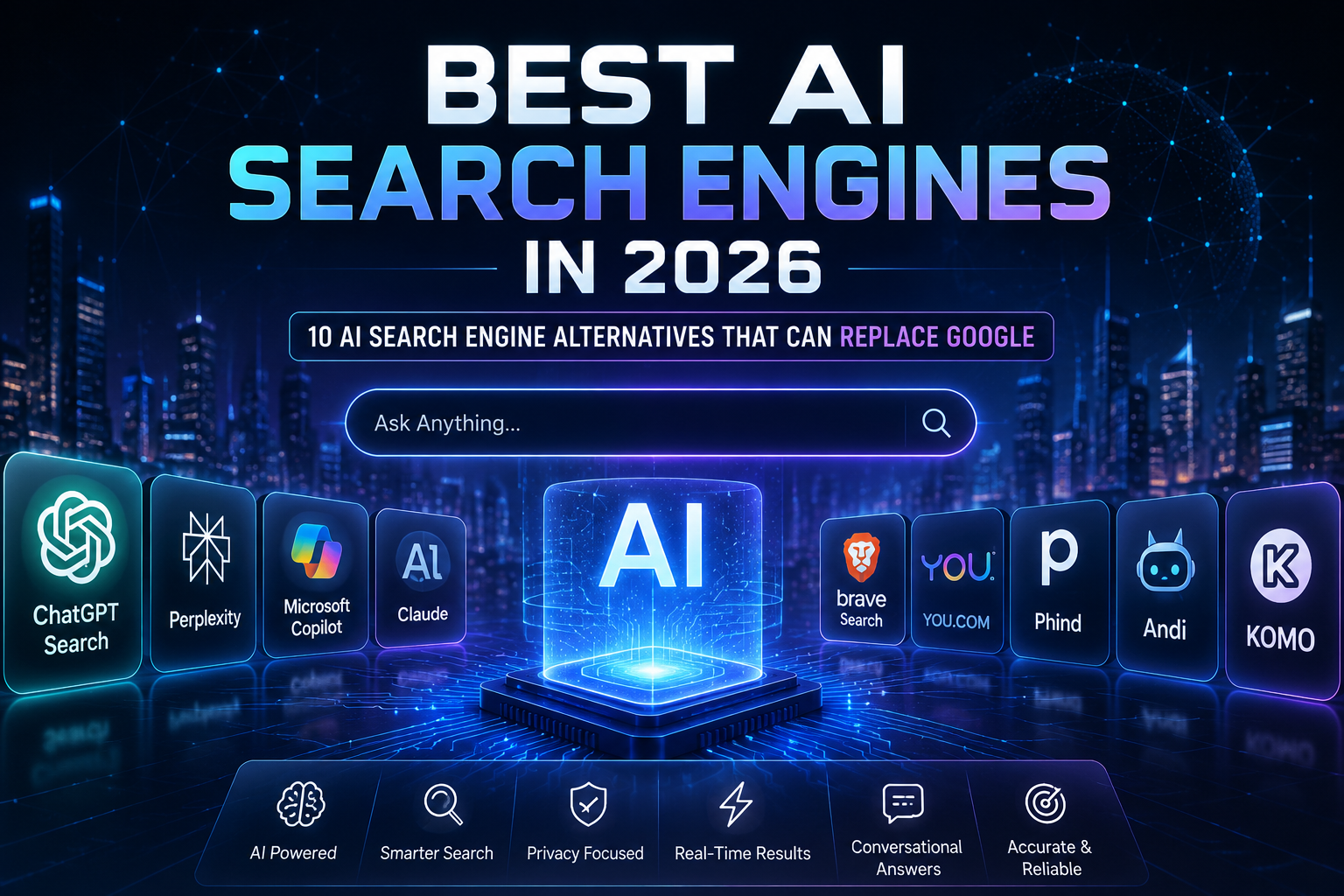
Google has dominated online search for more than two decades, and for many people, typing a query into Google has become second nature. However, 2026 feels very different. Artificial intelligence has fundamentally changed how we discover information. Instead of scrolling through ten blue links, users now expect direct answers, contextual conversations, cited sources, and personalized recommendations within seconds.
Over the last 15 years working in SEO, content strategy, and search technology, I’ve watched search evolve from keyword matching to semantic understanding and now to conversational AI. In my daily workflow, I no longer rely on a single search platform. Instead, I combine several best AI search engines depending on the task. Some excel at academic research, others summarize lengthy reports, while a few are exceptional for coding, marketing research, or fact-checking.
This shift doesn’t necessarily mean Google is disappearing. Instead, it means users finally have genuine choices. Today’s AI search engine platforms don’t simply search the web—they understand context, compare sources, summarize complex topics, and often save hours of manual research.
If you’ve been searching for reliable Google alternatives AI users actually enjoy using, this guide shares my hands-on experience with the leading platforms available in 2026. I’ll explain where each AI powered search engine excels, where it falls short, and which one deserves a place in your daily workflow.

What Is an AI Search Engine?
An AI search engine combines traditional web indexing with advanced artificial intelligence to understand user intent rather than simply matching keywords.
Instead of returning hundreds of webpages, an AI powered search engine analyzes multiple trusted sources, identifies the most relevant information, summarizes it in natural language, and frequently provides citations for verification.

Unlike traditional search, today’s best search engine with AI can:
- Understand follow-up questions
- Remember conversation context
- Summarize long documents
- Compare products instantly
- Generate research reports
- Explain complex concepts simply
- Help with coding and debugging
- Provide cited answers instead of only links
From my own testing across dozens of SEO projects, AI search has reduced research time by nearly half. Tasks that previously required opening fifteen browser tabs can often be completed with two or three AI-assisted searches.
That efficiency is exactly why many professionals are now exploring Google alternatives AI for everyday research.
H2: Why AI Search Is Growing So Fast in 2026
Artificial intelligence is no longer an experimental technology. It has become the default expectation for modern search.
Several major trends are driving this transformation.
H3: Faster Answers
Users no longer want to click through multiple websites.
The best AI search engines summarize information instantly while still providing links for deeper reading.
For professionals, this saves an enormous amount of time.
H3: Better Understanding of Context
Traditional search often requires users to rewrite queries several times.
A modern AI search engine understands conversational language.
For example, instead of searching:
“Best laptops under $1,200 for video editing with long battery life.”
You can simply ask:
“I’m a freelance video editor. Which laptop should I buy?”
The AI understands your intent.
H3: Improved Productivity
As someone who spends several hours every day researching SEO trends, software tools, and AI technologies, I’ve noticed that an AI powered search engine dramatically reduces repetitive work.
Instead of manually comparing multiple reviews, I receive concise summaries with references, allowing me to focus more on analysis than information gathering.
H3: Better Research Quality
One feature I particularly appreciate is source citation.
Platforms like Perplexity and ChatGPT Search allow me to verify where information comes from before including it in client reports.
That level of transparency wasn’t common just a few years ago.

H2: Best AI Search Engines That Can Replace Google in 2026
After testing nearly every major AI search engine over the past year, these are the platforms I consistently recommend.
Each serves a different audience, so there isn’t a single winner for everyone.
H3: 1. ChatGPT Search
ChatGPT Search has quickly become one of the best AI search engines available today.
Unlike traditional search, it doesn’t simply list webpages. Instead, it provides detailed explanations while retrieving current information from the web when needed.
Best For
- Content creators
- SEO professionals
- Students
- Researchers
- Business owners
Pros
- Natural conversational experience
- Excellent summaries
- Strong reasoning
- Helpful follow-up questions
- Supports images, documents, and coding
Cons
- Occasionally simplifies highly technical subjects
- Some advanced capabilities require a paid plan
My Experience
ChatGPT Search has become my primary research assistant.
When writing SEO content, I use it to brainstorm ideas, compare software, organize outlines, and validate trends before manually reviewing authoritative sources.
It consistently saves me hours every week.
H3: 2. Perplexity AI
Perplexity remains one of my favorite Google alternatives AI because of its outstanding citation system.
Instead of asking users to trust the AI blindly, it clearly shows where each answer originated.
That transparency makes it one of the best AI search engines for professionals.
Best For
- Academic research
- Journalists
- Analysts
- Technical writers
Pros
- Excellent citations
- Fast responses
- Supports follow-up conversations
- Multiple AI models
- Reliable research summaries
Cons
- Interface is research-focused
- Less creative than ChatGPT
My Experience
Whenever I’m fact-checking statistics or preparing long-form SEO articles, Perplexity is usually my second browser tab.
The ability to verify sources immediately makes it one of the most trustworthy AI research tools available.
H3: 3. Google AI Mode
Although many people are looking for Google alternatives AI, Google itself has embraced artificial intelligence through AI Mode.
Instead of replacing Google Search entirely, AI Mode enhances it by generating conversational answers while still leveraging Google’s massive search index.
Best For
- Everyday users
- Shopping
- Maps
- Local businesses
- Breaking news
Pros
- Massive search index
- Excellent local results
- Shopping integration
- Strong image search
- Reliable navigation
Cons
- AI answers still vary in quality
- More advertisements than competitors
My Experience
For local SEO projects, Google AI Mode remains difficult to beat.
Business listings, maps, reviews, and nearby services are still areas where Google’s ecosystem performs exceptionally well.
H3: 4. Microsoft Copilot Search
Microsoft has integrated Copilot deeply into Windows, Microsoft 365, Edge Browser, and Bing Search.
This integration makes it one of the most practical AI powered search engine experiences for office productivity.
Best For
- Microsoft Office users
- Enterprise teams
- Business research
- Productivity
Pros
- Strong Office integration
- Excellent document summaries
- Coding assistance
- Fast web search
- Business-friendly features
Cons
- Best experience inside Microsoft’s ecosystem
- Some enterprise tools require subscriptions
My Experience
Many of my SEO reports begin as Copilot-generated summaries before I refine them with my own analysis.
For business users already using Microsoft products, it’s an incredibly efficient assistant.

H3: 5. Claude Search
Claude has earned a reputation for thoughtful, well-structured answers and exceptional long-context understanding.
Rather than producing rushed responses, Claude often delivers balanced explanations that feel closer to reading an expert analyst’s report.
Best For
- Writers
- Researchers
- Legal professionals
- Business strategy
- Long-form analysis
Pros
- Excellent reasoning
- Strong document analysis
- Handles lengthy conversations
- Natural writing style
- High-quality summaries
Cons
- Web search features continue to expand but vary by region
- Less focused on shopping or local search
My Experience
When reviewing long technical reports or white papers, Claude consistently stands out. It does an excellent job preserving context across large documents, making it one of the best AI search engines for professionals who work with detailed information.
H6. Brave Search AI
Brave Search AI has become one of the strongest privacy-focused Google alternatives AI available today. Unlike many search platforms that rely heavily on user tracking, Brave emphasizes independent indexing and privacy while still delivering AI-powered summaries.
Best For
- Privacy-conscious users
- Security professionals
- Anonymous browsing
- Independent web search
Pros
- Excellent privacy protection
- Independent search index
- AI-generated summaries
- Minimal tracking
- Fast performance
Cons
- Smaller search index than Google
- Local search results can occasionally be less comprehensive
My Experience
For cybersecurity research and competitor analysis, I frequently use Brave Search AI. Its independent index often surfaces websites that don’t appear prominently on Google, making it one of the best AI search engines for discovering diverse sources.
7. You.com
You.com has evolved from an experimental platform into a highly capable AI powered search engine that blends search, productivity, coding, writing, and AI assistants in one workspace.
Best For
- Productivity
- Developers
- Content creators
- Students
Pros
- Multiple AI assistants
- Coding support
- Document analysis
- Productivity apps integration
- Custom AI agents
Cons
- Interface has many features, which may overwhelm beginners
- Premium features require a subscription
My Experience
When I need to switch between research, writing, coding, and brainstorming without opening multiple applications, You.com is often my preferred choice. Its all-in-one workflow saves valuable time during busy projects.
H3: 8. Phind
Phind is widely recognized as one of the best AI search engine platforms for developers.
Unlike general-purpose AI search tools, Phind specializes in programming, debugging, documentation, APIs, and software engineering.
Best For
- Developers
- Software engineers
- Students learning programming
Pros
- Excellent code explanations
- API references
- Fast technical answers
- High-quality documentation search
Cons
- Limited usefulness for general consumers
- Less effective for shopping or lifestyle searches
My Experience
Whenever I’m working on React, SEO automation, or JavaScript projects, Phind frequently provides clearer technical explanations than traditional search engines. It dramatically reduces the time spent digging through developer forums.

9. Andi Search
Andi Search approaches web search differently by focusing on a conversational, chat-like interface instead of traditional search result pages.
Best For
- Casual users
- Quick answers
- Students
- Everyday research
Pros
- Clean interface
- Easy conversations
- Fast summaries
- Beginner friendly
Cons
- Smaller ecosystem
- Limited advanced research capabilities
My Experience
I recommend Andi to users who are completely new to AI search because it feels approachable and requires almost no learning curve.
10. Komo AI
Komo AI continues to improve as a conversational search platform focused on asking questions naturally rather than relying on keyword searches.
Best For
- Brainstorming
- Market research
- Product discovery
Pros
- Simple interface
- Fast conversational search
- Helpful recommendations
- Modern AI experience
Cons
- Smaller knowledge ecosystem
- Not as feature-rich as larger competitors
My Experience
For brainstorming blog topics, business ideas, and marketing campaigns, Komo AI performs surprisingly well. While it isn’t yet my primary best search engine with AI, it has become a valuable secondary research tool.
Advantages of AI Search Engines
The rise of the best AI search engines isn’t just about convenience—it represents a fundamental shift in how we interact with information.
H3: Faster Research
An AI powered search engine summarizes multiple sources in seconds, reducing hours of manual reading.
H3: Better Context
Instead of isolated keywords, every AI search engine understands conversational questions and follow-up prompts.
H3: Improved Productivity
As an SEO consultant, I’ve reduced research time by nearly 40–50% by integrating AI search into my daily workflow.
H3: Better Learning Experience
Students, professionals, marketers, and business owners can understand complex topics much faster through conversational explanations.
Limitations of AI Search
Despite their impressive capabilities, the best AI search engines are not perfect.
- AI can occasionally hallucinate facts.
- Not every answer includes reliable citations.
- Some tools depend on premium subscriptions.
- Local search is still stronger on Google.
- Breaking news may require verification from trusted news sources.
- Human judgment remains essential for important decisions.
My advice after years of SEO work is simple: use AI search to accelerate research, but always verify critical information before publishing or making business decisions.
Which AI Search Engine Is Best?
The answer depends entirely on your needs.
- Best overall AI search engine: ChatGPT Search
- Best for verified citations: Perplexity AI
- Best Google alternative: Brave Search AI
- Best for developers: Phind
- Best for writers: Claude Search
- Best for Microsoft users: Microsoft Copilot
- Best for productivity: You.com
- Best for beginners: Andi Search
- Best for brainstorming: Komo AI
- Best for local businesses and maps: Google AI Mode
From my own experience, no single platform replaces every use case. My daily workflow typically combines ChatGPT Search for ideation, Perplexity AI for source verification, Google AI Mode for local and shopping queries, and Phind for technical development work. This combination consistently delivers the best balance of speed, accuracy, and productivity.

Conclusion
The search landscape in 2026 looks very different from just a few years ago. The emergence of the best AI search engines has transformed how professionals, students, developers, marketers, and businesses discover information. Instead of spending hours opening dozens of browser tabs, users can now rely on an AI powered search engine to understand context, summarize reliable sources, and provide actionable insights in seconds.
After years of working in SEO, digital marketing, and search technology, my biggest takeaway is that AI search isn’t replacing critical thinking—it is enhancing it. The most effective professionals combine AI-generated insights with their own expertise and always verify important information before making decisions.
If I had to recommend a starting point, ChatGPT Search remains my top choice for everyday productivity, Perplexity AI stands out for research and citations, Brave Search AI is ideal for privacy-focused users, and Phind is exceptional for developers. Google AI Mode still deserves a place in your toolkit, especially for local search and real-time information.
Rather than asking whether AI search engines will completely replace Google, the better question is how they will reshape the future of search. Based on everything I’ve observed, the future belongs to users who know how to combine traditional search with the strengths of modern AI. Those who adapt early will research faster, make better-informed decisions, and stay ahead in an increasingly AI-driven digital world.
Author

razakh6402@gmail.com
Related Posts
Document Management Software: Top Document Management Software Compared (2026 Guide)
- 0
- 1,895 word
Not long ago, managing business documents meant overflowing filing cabinets, misplaced contracts, and countless hours spent searching for the right file. Even...
Read out all
AI Website Builder: Best AI Website Builders Compared (2026 Guide)
- 0
- 2,412 words
A decade ago, building a professional website meant writing HTML, CSS, JavaScript, and often PHP from scratch. Later, drag-and-drop builders like WordPress...
Read out all
AI vs Human Creativity: Can AI Replace Creative Jobs in 2026? (Expert Analysis)
- 0
- 2,449 words
The conversation around AI vs human creativity has become one of the most fascinating and controversial topics in technology. Every week, new...
AI Course Creator: Top AI Tools for Online Courses in 2026 (Expert-Tested Guide)
- 0
- 1,935 word
I’ve spent years researching instructional design, evaluating learning platforms, and following the evolution of educational technology. One trend has become impossible to...
Read out all
AI Browser Extensions: Best AI Chrome Extensions for Productivity in 2026 (Expert-Tested Guide)
- 0
- 2,414 words
Artificial intelligence has quietly become one of the biggest productivity upgrades I’ve experienced during my career. Over the past 15 years of...
Read out all
AI Agents in 2026: How AI Agents for Work Are Transforming Everyday Productivity
- 2
- 2,405 words
A few years ago, most businesses viewed artificial intelligence as a helpful assistant for answering questions or generating content. Today, the conversation...
Read out all
2 comments