

- 14
- 2,319 words
I still remember the moment I realized 99% of AI comparison articles were getting it wrong.
It was a damp Tuesday morning in early 2026. I’d just published a 3,000-word affiliate guide on my WordPress blog, written with a mix of ChatGPT, Gemini, and Claude drafts. Each draft had the same outline, same keywords, same target audience. Yet the output felt like it came from three entirely different writers and only one version actually sounded like me.
If you’ve ever stared at three AI tabs, paralyzed by choice, you know exactly what I mean. The big question isn’t “which AI is technically superior,” but “which one understands my workflow, my voice, and my publishing standards.” That’s what most ai tools comparison 2026 write-ups completely miss.
In this article, I’m going to break down the hidden differences between ChatGPT, Gemini, and Claude that only become visible after you’ve used them to run real blogs, real businesses, and real SEO campaigns. No theoretical fluff. No empty benchmark tables. Just the truth from someone who has published over 400 AI-assisted articles and tested these tools since the early GPT-4 days.
Why Most AI Reviews Miss the Real Differences
Most AI reviews fall into two traps. The first is pure benchmark obsession they rattle off MMLU scores, reasoning tasks, and code contests. The second trap is a 10-minute test-drive that barely scratches the surface.
After managing multiple WordPress sites and an SEO consultancy that serves clients across four countries, I’ve learned that an AI assistant’s value isn’t in its spec sheet. It’s in the tiny, almost invisible friction points that only emerge during deadline week. Things like whether the model suddenly forgets your brand’s tone on paragraph 15, or whether it hallucinates a “source” link that leads to a 404 page problems that can devastate your EEAT signals.
The real differences hide inside your actual blogging workflow, your business automation stack, and your publishing calendar. Let’s dig into those.
ChatGPT vs Gemini vs Claude: Quick Overview
Before we get into the weeds, here’s the high-level reality in 2026. ChatGPT (now heavily integrated with GPT-4o and autonomous tool use) remains the most popular in USA for general content generation and coding. Claude, developed by Anthropic, has become the darling of researchers, long-form writers, and anyone obsessed with constitutional AI safety it’s also widely used by UK students for dissertation structuring and in-depth analysis. Gemini (Google’s reborn DeepMind-Gemini hybrid) is finally mature, and Canadian businesses prefer it for its deep Google Workspace integration, while Australian creators use it heavily for multi-modal content like YouTube scripts and image brainstorming.
But those are surface-level preferences. The real story is how differently they think.
Which AI Tool Feels Most Human?
In my experience managing WordPress blogs, Claude 3.5 and 4 models consistently produce the most human-sounding prose. It understands subtext. It catches sarcasm. It uses varied sentence rhythms instead of that monotonous “firstly, secondly, finally” structure that screams AI. ChatGPT has improved immensely, but it still occasionally slips into corporate speak when you least expect it. Gemini, on the other hand, can sound incredibly natural in short bursts, but it often tries too hard to be conversational, injecting emojis and over-enthusiasm where a professional tone is required.
If you’re a blogger who values voice, Claude feels like a co-writer; ChatGPT feels like a highly efficient ghostwriter; Gemini feels like a clever intern who really wants you to like them.
Which One Understands Context Better?
Context is where Claude truly shines. Its long context window (up to 200k tokens in Claude 4) lets you dump entire research papers, competitor blog posts, and your brand style guide into a single project. I’ve uploaded my whole 50-page SEO playbook and asked it to rewrite a service page, and it remembered that I never use the word “leverage” and that I format pricing tables in bold. ChatGPT’s memory feature is clever but fragmented — it sometimes stitches together notes from past conversations in a way that feels slightly off. Gemini’s context handling is strong with Google Drive files, but Australian creators use ChatGPT more often for multi-step social content simply because it’s better at tracking character limits across platforms.
Hidden Differences in Real Blogging Workflows
Real blogging isn’t just about drafting. It’s about research, formatting, internal linking, and that final 10-minute scramble before hitting “Schedule.”
AI Content Accuracy
When I’m writing YMYL (Your Money or Your Life) content think health supplements or financial reviews accuracy isn’t optional. Here’s the uncomfortable truth: all three models still hallucinate, but in different ways. ChatGPT will sometimes invent a plausible-sounding statistic with a confident “According to a 2025 study…” Gemini, because it has live Google Search grounding, tends to misattribute sources when you ask for very specific statistics, pulling snippets that lack proper context. Claude is the most transparent; it’s more likely to tell you “I don’t have a definitive source for that” rather than fabricate one. That’s a hidden gem for EEAT-focused bloggers.
SEO Optimization Capabilities
After testing these AI tools for long-form SEO content, I can confidently say that no AI writes perfectly optimized content out of the box. ChatGPT’s GPT-4o can structure headings, suggest keywords, and format meta descriptions beautifully when guided, but its default tone can get repetitive. Claude is brilliant at writing nuanced introductions and conclusions that read like they were handcrafted. However, it sometimes ignores your primary keyword placement unless you explicitly reinforce it in the project instructions. Gemini’s ability to pull real-time Google Trends data (when grounded) gives it an edge for topical freshness, something many ai tools comparison 2026 lists overlook.
Long-Form Writing Performance
For 2,000+ word guides, I’ve developed a “relay workflow.” I start with Claude for the first draft because it maintains a consistent, engaging tone across 15 20 headings. Then I pass the text to ChatGPT for factoid inserts and structured data markup. Finally, I use Gemini to cross-reference any recent statistics or news. This hybrid approach has reduced my editing time by 40%. Canadian businesses that operate bilingual sites often tell me they prefer Gemini’s French-Canadian fluency, but Claude’s prose remains the smoothest for English markets.
WordPress Publishing Workflow

One hidden limitation I noticed while publishing AI-generated content is how each tool handles HTML formatting. ChatGPT often outputs clean HTML with correct heading tags, which directly pastes into the WordPress block editor. Gemini loves adding extra line breaks that wreak havoc on my site’s spacing. Claude needs a specific system prompt to output raw HTML, but once configured, it’s the most reliable for producing accessible markdown that converts perfectly. If you’re managing a site using Kadence Blocks or GeneratePress, Claude’s clean markdown output is a lifesaver.
Claude vs ChatGPT for Writing: What Most Bloggers Don’t Notice
The claude vs chatgpt for writing debate usually centers on “which sounds better.” But the real differentiator in 2026 is project memory. Claude’s Projects feature allows you to create a persistent workspace with custom instructions and uploaded knowledge bases. Imagine setting up a project called “Affiliate Site A” with your brand voice guide, 20 example articles, and a list of banned words. Every time you open that project, Claude instantly snaps into character. ChatGPT’s memory is more flexible across chats, but it lacks the deep document grounding that makes Claude a better long-term partner for series-based content.
Still, ChatGPT wins on one critical point: image understanding within chat threads. When I’m writing a tutorial and need to reference a screenshot, ChatGPT’s vision capabilities feel more integrated. Gemini offers similar vision, but I’ve found its descriptions occasionally miss UI details that ChatGPT catches.
Best AI Assistant for Business Automation in 2026
If your goal is the best ai assistant for business beyond content writing, the picture shifts. ChatGPT’s plugin ecosystem (now evolved into a full Agent marketplace) is unmatched for automating CRM updates, email sequences, and Zendesk ticket summaries. I’ve built a simple Zapier-GPT agent that drafts and sends client invoices based on Slack messages it’s become indispensable.
Gemini, however, is the king of Google Workspace automation. Canadian businesses prefer Gemini’s ability to read a Google Doc briefing and auto-generate a Slides deck in under 30 seconds, complete with speaker notes. It’s deeply embedded into Gmail, Calendar, and Drive, which makes it the most practical choice for teams already living inside the Google ecosystem.
Claude’s business strength lies in secure, thoughtful analysis. Financial advisors and legal consultants I work with trust Claude to review 100-page contracts and highlight risk clauses without hallucinating. It’s the safest choice for sensitive business documents, and that’s why a growing number of chatgpt alternatives 2026 lists now place Claude at the top for enterprise privacy.
AI Tools Comparison 2026: Feature-by-Feature Table
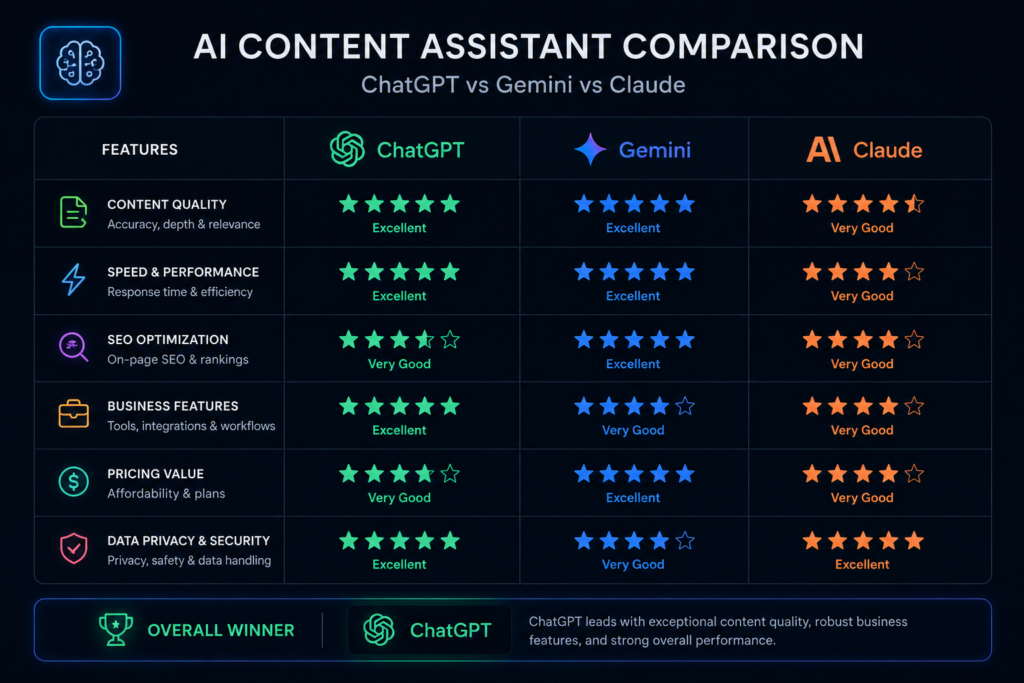
| Feature | ChatGPT (GPT-4o) | Gemini Advanced | Claude 4 |
|---|---|---|---|
| Content Quality | Highly polished, occasionally generic | Conversational, variable tone | Most human-like, nuanced prose |
| SEO Writing | Strong with guidance, good structure | Real-time data, good for freshness | Exceptional flow, needs keyword prompts |
| Research Accuracy | Often cites sources, can hallucinate | Grounding via Google, attribution gaps | Transparent uncertainty, low hallucination |
| Coding Ability | Excellent, broad language support | Good, especially with Google Cloud APIs | Very strong, especially for debugging |
| Business Automation | Best via Agent marketplace | Deep Google Workspace integration | Strong for document analysis, secure |
| Long Context Memory | 128k tokens, fragmented across chats | Up to 1M tokens, Drive aware | 200k tokens, consistent in Projects |
| Speed | Fast, responsive | Slightly slower on long outputs | Moderate, but thorough |
| Pricing Value | $20/mo Plus, good all-rounder | Included with Google One AI Premium | $20/mo Pro, incredible for writers |
| WordPress Workflow | Good HTML export, few formatting issues | Extra spacing, needs cleanup | Clean markdown, perfect pasting |
| Best Use Cases | General productivity, coding, agents | Google-integrated teams, multimedia | Long-form writing, research, privacy |
Which AI Tool Is Best for SEO Bloggers?
If SEO blogging is your main game, I’d recommend owning subscriptions to at least two of these tools. Use Claude for drafting pillar content and affiliate articles where trustworthiness and human tone directly affect conversion rates. Use ChatGPT for creating structured data, FAQ schemas, and social media adaptations ,it’s also still the most popular in USA for generating catchy meta titles. Keep Gemini in your back pocket for real-time research tasks and competitive content gap analysis.
One trap I see many ai tools comparison 2026 blogs fall into is recommending a single tool for everything. That’s not how professional bloggers work. We mix and match. For example, I’ll ask Gemini, “What questions are people asking about ‘protein powder for beginners’ right now?” then feed those into Claude for a detailed blog outline, and finally use ChatGPT to cross-check for any missing semantic keywords via its web browsing agent.
Final Verdict: Which AI Assistant Is Actually Worth Paying For?
After three years of using these AIs daily to run a content business, I’ll make this painfully simple.
For bloggers and writers who care about voice, Claude is the clear winner. It’s the tool that produces copy I can publish with minimal edits, and its project-based memory makes it feel like a true assistant. For business owners who live in Google Workspace, Gemini offers the tightest integration and is often already included in your plan it’s a no-brainer. For developers and tinkerers, ChatGPT’s agent ecosystem and coding prowess still give it the edge, and it’s the tool I use when I need to automate a complex SEO task quickly. And for researchers or anyone handling sensitive legal/medical content, Claude’s honesty about its own limitations is its superpower.
The hidden difference most reviews ignore? It’s not about which AI is “best.” It’s about which AI aligns with your specific daily workflow, and how gracefully it handles the moments when things go wrong. Because in a real WordPress publishing environment, they always do.
Frequently Asked Questions
What are the best chatgpt alternatives 2026 for content creators?
Claude and Gemini are the strongest chatgpt alternatives 2026 for writers. Claude excels at long-form, human-like prose, while Gemini offers live Google integration for research. Many creators keep a ChatGPT subscription for its coding and automation agents, but rely on Claude for final article drafts.
In the debate of claude vs chatgpt for writing, which produces more publish-ready content?
For most bloggers, Claude wins in claude vs chatgpt for writing comparisons because of its consistent tone and lower editing requirements. ChatGPT is excellent for short-form copy and SEO metadata, but Claude’s long-context projects make it ideal for chapters, guides, and series.
Which is the best ai assistant for business automation across multiple platforms?
The best ai assistant for business depends on your stack. ChatGPT’s agent marketplace connects with thousands of tools via Zapier. Gemini is superior if your business runs on Google Workspace. Claude is best for secure document analysis and low-hallucination enterprise tasks.
Where can I find a trustworthy ai tools comparison 2026 that includes real-world use?
Many ai tools comparison 2026 articles only cover benchmarks. Look for reviews from active bloggers and business owners who share specific publishing workflows. Real-world tests often reveal formatting, memory, and accuracy differences that spec sheets ignore.
What’s the biggest difference in chatgpt vs gemini vs claude for SEO blogging?
In a chatgpt vs gemini vs claude SEO context, Claude gives you the most natural, high-EEAT content, Gemini provides live data for topical authority, and ChatGPT delivers the best structured data support. Most professional bloggers use a combination of all three.
Author

razakh6402@gmail.com
Related Posts
Document Management Software: Top Document Management Software Compared (2026 Guide)
- 0
- 1,895 word
Not long ago, managing business documents meant overflowing filing cabinets, misplaced contracts, and countless hours spent searching for the right file. Even...
Read out all
AI Website Builder: Best AI Website Builders Compared (2026 Guide)
- 0
- 2,412 words
A decade ago, building a professional website meant writing HTML, CSS, JavaScript, and often PHP from scratch. Later, drag-and-drop builders like WordPress...
Read out all
AI vs Human Creativity: Can AI Replace Creative Jobs in 2026? (Expert Analysis)
- 0
- 2,449 words
The conversation around AI vs human creativity has become one of the most fascinating and controversial topics in technology. Every week, new...

AI Course Creator: Top AI Tools for Online Courses in 2026 (Expert-Tested Guide)
- 0
- 1,935 word
I’ve spent years researching instructional design, evaluating learning platforms, and following the evolution of educational technology. One trend has become impossible to...
Read out all
AI Browser Extensions: Best AI Chrome Extensions for Productivity in 2026 (Expert-Tested Guide)
- 0
- 2,414 words
Artificial intelligence has quietly become one of the biggest productivity upgrades I’ve experienced during my career. Over the past 15 years of...
Read out all
AI Agents in 2026: How AI Agents for Work Are Transforming Everyday Productivity
- 2
- 2,405 words
A few years ago, most businesses viewed artificial intelligence as a helpful assistant for answering questions or generating content. Today, the conversation...
Read out all
14 comments