
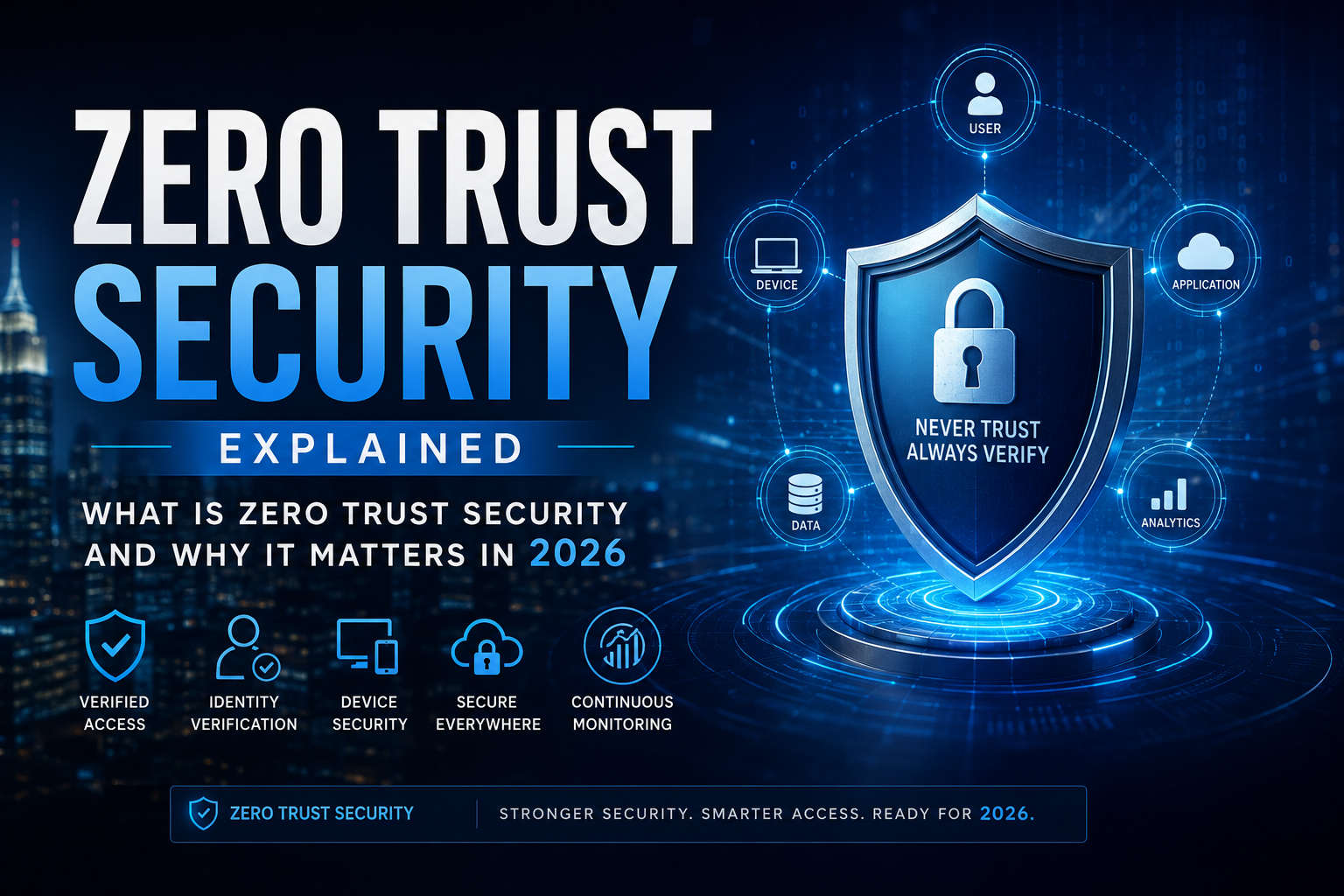
- 1
- 1,974 word
Cybersecurity has changed dramatically over the last decade.
When I started working in enterprise security more than 25 years ago, most organizations operated inside clearly defined network boundaries. Employees worked in offices, applications lived in on-premises data centers, and security teams focused heavily on protecting the network perimeter.
That approach worked reasonably well at the time.
Today, it doesn’t.
Organizations now operate across multiple clouds, employees work from anywhere, applications run in hybrid environments, and attackers routinely bypass traditional perimeter defenses through phishing, credential theft, and supply chain attacks.
I’ve seen organizations invest millions in firewalls and intrusion prevention systems only to suffer breaches because attackers compromised a single user account.
The reality is simple: the network perimeter no longer exists.
This shift has accelerated the adoption of zero trust security, a modern security framework designed for today’s distributed digital environments.
So, what is zero trust security?
At its core, zero trust security assumes that no user, device, application, or network connection should be trusted automatically. Every access request must be verified continuously before access is granted.
That philosophy has become one of the most important cybersecurity principles of the modern era.
What Is Zero Trust Security?
Simple Definition
Zero trust security is a cybersecurity framework that requires continuous verification of users, devices, and applications before granting access to resources, regardless of whether they are inside or outside the network.
This definition aligns closely with guidance from organizations such as the National Institute of Standards and Technology (NIST) and Cybersecurity and Infrastructure Security Agency.
The Core Philosophy
The foundation of zero trust security can be summarized in three words:
Never Trust, Always Verify
In traditional environments, users inside the network often received broad access privileges.
In a zero trust architecture, trust is never assumed.
Every request must prove:
- Who the user is
- What device they are using
- Their location
- Their security posture
- Whether access is justified
Why Traditional Security Models No Longer Work
Over the years, I have investigated numerous incidents where attackers gained access through legitimate credentials.
Traditional “castle-and-moat” security models assume that everything inside the network perimeter is trustworthy.
Unfortunately, attackers know this.
Common weaknesses include:
- Compromised credentials
- Insider threats
- Unmanaged devices
- Excessive user permissions
- Cloud application exposure
- VPN misuse
Once attackers enter a trusted network, they often move laterally with little resistance.
Zero trust security eliminates that assumption.

Zero Trust Model Explained
How Zero Trust Works
A zero trust model explained in simple terms focuses on validating every interaction.
Organizations continuously:
- Verify every user
- Verify every device
- Monitor activity
- Analyze behavior
- Apply access policies dynamically
Access becomes conditional rather than permanent.
The Three Core Principles
Verify Explicitly
Every access request must be authenticated and authorized.
Example:
An employee logging into a finance application from a managed corporate laptop may gain access immediately.
The same employee attempting access from an unknown device may trigger additional verification.
Least Privilege Access
Users receive only the access required for their roles.
One of the biggest mistakes I’ve observed during security audits is excessive permissions.
Limiting access dramatically reduces attack opportunities.
Assume Breach
Organizations must operate as though attackers already exist somewhere in the environment.
This mindset drives:
- Segmentation
- Monitoring
- Logging
- Threat hunting
- Rapid incident response
Key Components of Zero Trust Architecture
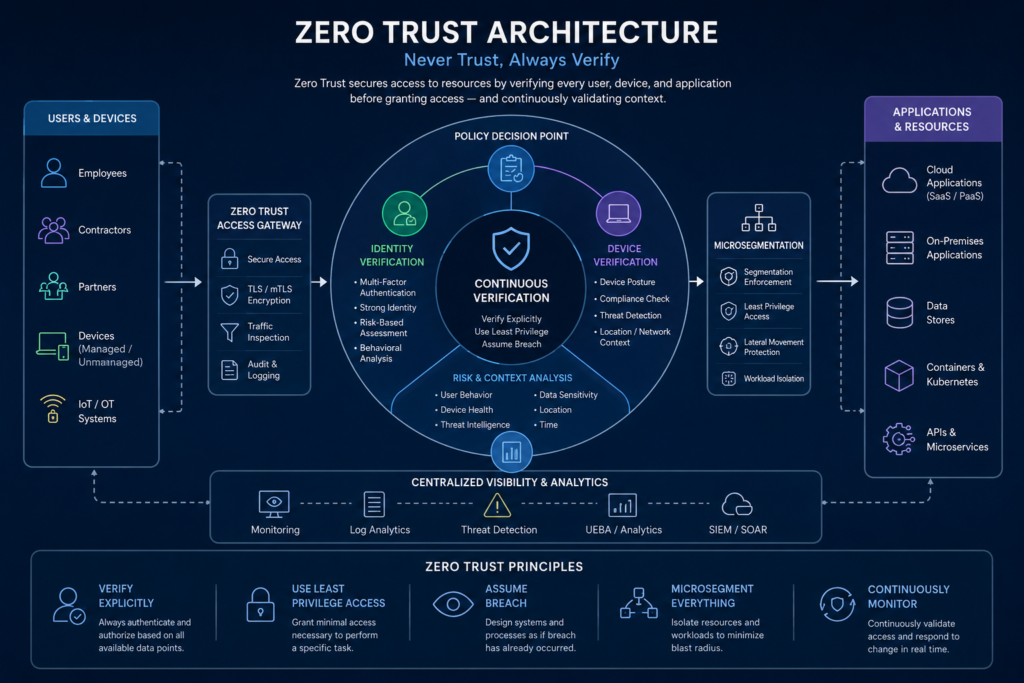
A successful zero trust architecture combines multiple security technologies and controls.
Identity and Access Management (IAM)
Identity becomes the primary security perimeter.
IAM solutions validate:
- User identity
- Roles
- Permissions
- Access policies
Multi-Factor Authentication (MFA)
MFA remains one of the most effective security controls available.
In my consulting work, MFA deployments consistently reduced account compromise incidents.
Device Security
Access decisions should consider device health.
Organizations should verify:
- Operating system status
- Security patches
- Endpoint protection
- Device ownership
Microsegmentation
Microsegmentation divides networks into smaller security zones.
If attackers compromise one segment, they cannot move freely across the environment.
Continuous Monitoring
Zero trust security depends on real-time visibility.
Organizations monitor:
- User activity
- Device behavior
- Authentication events
- Network traffic
Security Analytics
Advanced analytics identify anomalies that humans might miss.
Behavioral baselines help detect suspicious activity quickly.
Endpoint Detection and Response (EDR)
EDR platforms provide:
- Threat detection
- Investigation capabilities
- Automated response
- Endpoint visibility
Cloud Security Controls
Modern environments require cloud-native protections.
Organizations secure:
- SaaS applications
- Cloud workloads
- Containers
- APIs
From my experience, cloud visibility remains one of the most challenging aspects of large-scale zero trust architecture deployments.
Traditional Security vs Zero Trust Security
| Feature | Traditional Security | Zero Trust Security |
|---|---|---|
| Trust Model | Implicit Trust | Verify Every Request |
| Network Access | Broad Access | Least Privilege |
| Insider Threat Protection | Limited | Strong |
| Cloud Security | Weak | Strong |
| Monitoring | Periodic | Continuous |
| Authentication | One-Time Login | Continuous Verification |
| Security Visibility | Moderate | High |
The biggest difference lies in trust assumptions.
Traditional security grants trust first.
Zero trust security requires proof first.
That single change fundamentally transforms an organization’s security posture.
Benefits of Zero Trust Security
Reduced Attack Surface
Users only access necessary resources.
This dramatically limits exposure.
Better Protection Against Insider Threats
Insider threats remain a major concern.
Zero trust architecture restricts unauthorized movement and access.
Improved Cloud Security
Cloud environments benefit significantly from identity-based controls.
Enhanced Regulatory Compliance
Many compliance frameworks require:
- Strong authentication
- Access control
- Monitoring
- Audit trails
Zero trust security supports these requirements naturally.
Stronger Remote Work Security
Remote work has expanded attack surfaces dramatically.
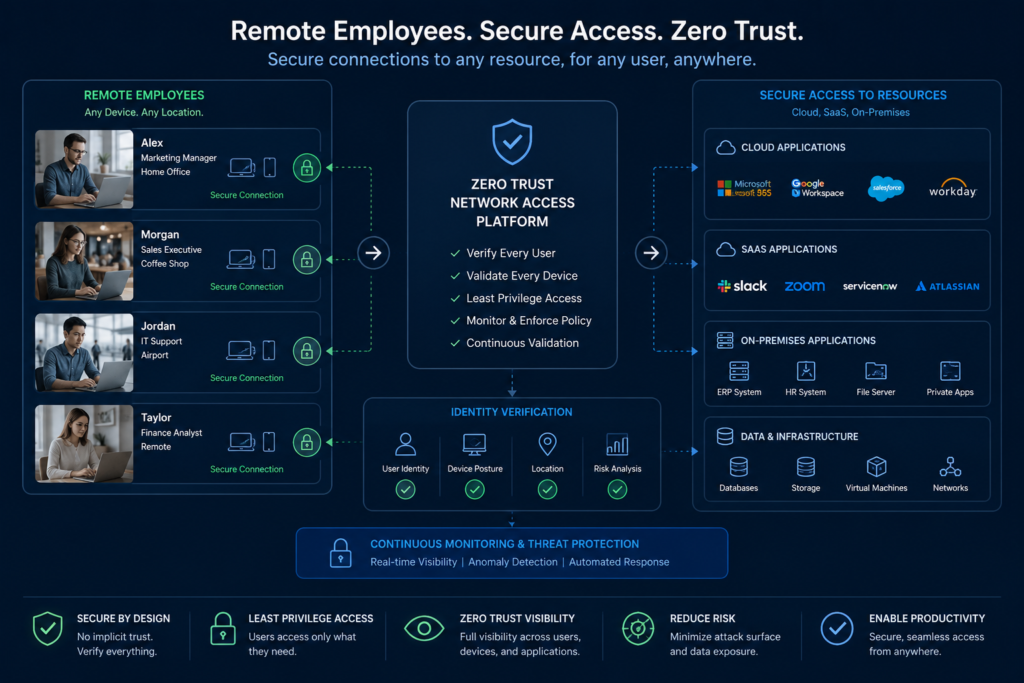
Zero trust network access provides secure access without exposing entire networks.
Better Visibility and Monitoring
Organizations gain deeper insights into:
- User behavior
- Device health
- Access patterns
- Security risks
I’ve seen security teams reduce incident investigation times significantly after implementing comprehensive visibility controls.
Understanding Zero Trust Network Access (ZTNA)
What Is Zero Trust Network Access?
Zero trust network access (ZTNA) is a security approach that grants users access to specific applications rather than entire networks.
ZTNA verifies identity and context before establishing connections.
ZTNA vs VPN
| Feature | VPN | Zero Trust Network Access |
|---|---|---|
| Access Model | Network Access | Application Access |
| Security | Moderate | High |
| Visibility | Limited | Excellent |
| Scalability | Moderate | High |
| Remote Work Support | Good | Excellent |
Why Organizations Are Replacing VPNs
Traditional VPNs often provide broad network connectivity.
ZTNA limits exposure by:
- Restricting access
- Verifying users continuously
- Reducing lateral movement risks
- Improving visibility
Many enterprise clients I’ve worked with now prioritize zero trust network access as part of broader modernization initiatives.
How Organizations Implement Zero Trust Architecture
Assess Existing Infrastructure
Identify security gaps and existing controls.
Identify Critical Assets
Focus on protecting:
- Sensitive data
- Critical applications
- Intellectual property
Implement Strong Identity Controls
Identity serves as the foundation of zero trust architecture.
Deploy MFA Everywhere
Organizations should require MFA across all critical systems.
Segment Networks
Microsegmentation limits attacker movement.
Enable Continuous Monitoring
Visibility remains essential.
Automate Security Policies
Automation improves consistency and response times.
One lesson I’ve learned repeatedly: organizations that attempt massive zero trust deployments all at once often struggle. Successful projects typically begin with identity security and expand gradually.
Challenges and Limitations of Zero Trust Security
Legacy Systems
Older applications may not support modern authentication methods.
Implementation Complexity
Zero trust architecture requires careful planning.
Cost Considerations
Technology investments can be significant.
User Adoption Challenges
Additional verification steps sometimes create resistance.
Skills Gap
Organizations often need specialized expertise.
Continuous Management Requirements
Zero trust security is not a one-time project.
It requires ongoing management and optimization.
Despite these challenges, the long-term security benefits usually outweigh the implementation difficulties.

Zero Trust Security Trends for 2026
AI-Powered Security Decisions
AI increasingly evaluates risk in real time.
Behavioral Analytics
Behavior-based access decisions continue to expand.
Passwordless Authentication
Passkeys and biometrics reduce credential risks.
Continuous Authentication
Verification occurs throughout user sessions.
Cloud-Native Security Platforms
Cloud-first security platforms simplify deployment.
Unified Identity Security
Identity protection becomes increasingly centralized.
AI-Driven Threat Detection
Advanced detection engines identify attacks faster than traditional approaches.
I expect identity-centric security and AI-assisted decision-making to become the defining characteristics of next-generation zero trust security programs.
Zero Trust Security Statistics
| Metric | Recent Trend |
|---|---|
| Enterprise Adoption Rate | Rapid Growth |
| Remote Workforce Protection | Increasing Priority |
| Cloud Security Investments | Strong Growth |
| Insider Threat Reduction | Significant Improvement |
| Identity-Based Attacks | Rising |
| Security Incident Reduction | Improving |
Organizations increasingly recognize identity as the new security perimeter.
As cloud adoption expands and hybrid work becomes permanent, zero trust security adoption will likely continue accelerating through 2026 and beyond.
Best Practices for Successful Zero Trust Adoption
Start with Identity
Identity security provides the strongest foundation.
Prioritize High-Risk Assets
Protect critical systems first.
Use Least Privilege Access
Reduce unnecessary permissions.
Monitor Continuously
Visibility enables rapid threat detection.
Educate Employees
Security awareness remains essential.
Review Policies Regularly
Threats evolve constantly.
Policies should evolve as well.
Frequently Asked Questions
What is Zero Trust Security?
Zero trust security is a cybersecurity framework that continuously verifies users, devices, and applications before granting access to resources.
How does Zero Trust Architecture work?
Zero trust architecture validates identity, device health, context, and risk before allowing access while continuously monitoring activity.
What is Zero Trust Network Access?
Zero trust network access provides secure application-level access without exposing entire networks.
Is Zero Trust better than VPN?
For most modern environments, yes. ZTNA provides more granular access controls, better visibility, and stronger security than traditional VPNs.
What are the benefits of Zero Trust Security?
Benefits include reduced attack surfaces, stronger insider threat protection, improved cloud security, enhanced compliance, and better visibility.
Is Zero Trust suitable for small businesses?
Yes. Small businesses can implement core zero trust principles such as MFA, least privilege access, and identity verification.
Does Zero Trust eliminate cyberattacks completely?
No.
No security framework can eliminate cyberattacks entirely. Zero trust security reduces risk significantly but does not guarantee complete protection.
How long does Zero Trust implementation take?
Implementation timelines vary widely.
Smaller projects may take several months, while enterprise-wide zero trust architecture initiatives often require multiple years.
Conclusion
Understanding what is zero trust security has become essential for every organization operating in today’s digital environment.
Traditional perimeter-based security models no longer provide adequate protection against modern cyber threats. Cloud computing, remote work, sophisticated phishing campaigns, and identity-based attacks have fundamentally changed the security landscape.
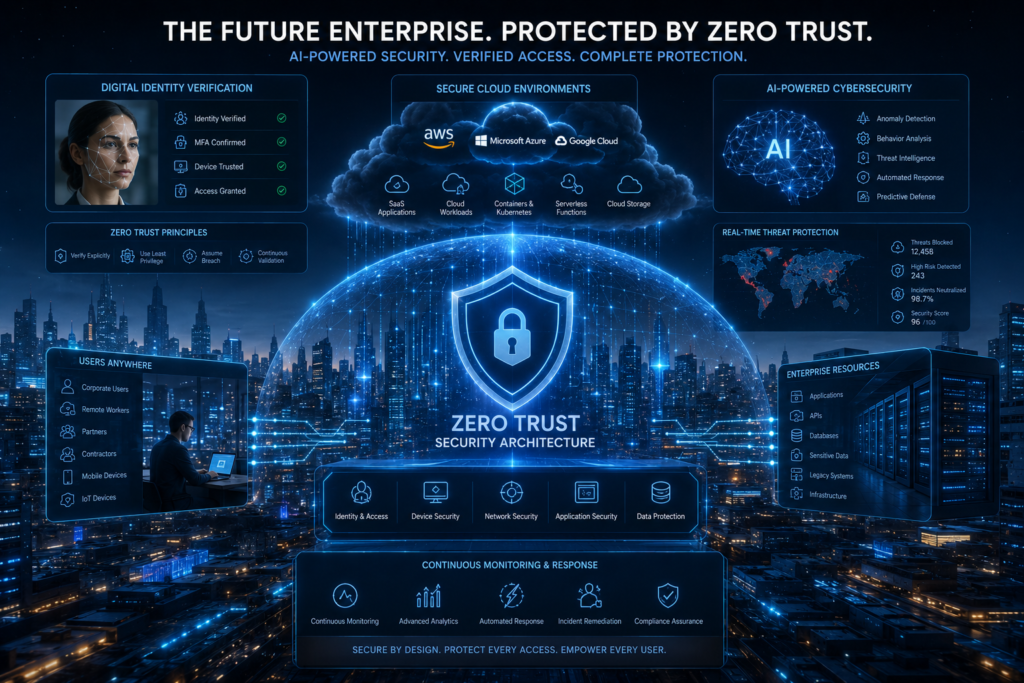
A well-designed zero trust architecture addresses these challenges by embracing continuous verification, least privilege access, and the assumption that breaches can occur at any time.
Combined with zero trust network access, strong identity controls, microsegmentation, monitoring, and advanced analytics, organizations can significantly improve their security posture while supporting modern business operations.
After more than 25 years working in cybersecurity, auditing enterprise environments, and helping organizations recover from security incidents, I’ve reached one consistent conclusion:
Organizations that adopt zero trust principles proactively almost always find the transition easier and less expensive than those forced into change after a major breach.
The future of cybersecurity belongs to continuous verification, identity-centric security, and intelligent access control.
Start your zero trust journey now, strengthen your defenses gradually, and build a security strategy designed for the realities of 2026 and beyond.
Author

razakh6402@gmail.com
Related Posts
Browser Security Extensions: Top Chrome Security Extensions & Privacy Browser Extensions You Need in 2026
- 0
- 2,358 words
best budgeting appsEvery year, browsers become smarter, websites become faster, and online services become more convenient. Unfortunately, cybercriminals evolve just as quickly....
Read out all
Passkeys: How Passwordless Authentication Is Replacing Passwords in 2026
- 0
- 2,452 words
If you’ve ever forgotten a password, reset the same account multiple times, or worried that your login credentials were exposed in a...
Read out all
Cybersecurity Checklist: Essential Small Business Cybersecurity Guide (2026)
- 0
- 2,462 words
Cyberattacks are no longer a problem reserved for large enterprises. Over the last 15 years, I’ve worked with startups, retail stores, healthcare...
Secure Cloud Storage: Best Secure Cloud Storage Services for Business & Personal Use (2026 Guide)
- 0
- 2,443 words
Whether you’re backing up family photos, sharing confidential client documents, or managing sensitive business files, choosing the right secure cloud storage service...

AI Scams: How to Protect Yourself from AI-Powered Scams in 2026 (Expert Guide)
- 0
- 1,918 word
Artificial intelligence has transformed the way we work, communicate, and manage our finances. Unfortunately, cybercriminals have embraced the same technology to create...
Read out all
Future of Cybersecurity: Top Cybersecurity Trends 2026, AI Innovations, and Predictions for the Next Decade
- 1
- 2,173 words
Twenty-five years ago, cybersecurity focused primarily on protecting desktop computers, on-premises servers, and corporate networks. Firewalls, antivirus software, and perimeter defenses formed...
1 comment