
- 1
- 2,173 words
Twenty-five years ago, cybersecurity focused primarily on protecting desktop computers, on-premises servers, and corporate networks. Firewalls, antivirus software, and perimeter defenses formed the backbone of most security programs.
Today, that world no longer exists.
Organizations operate across cloud environments, remote work infrastructures, mobile ecosystems, IoT networks, AI-powered applications, and globally distributed digital platforms. The attack surface has expanded exponentially, while cybercriminals have evolved into sophisticated enterprises generating billions of dollars through ransomware, fraud, espionage, and cyber extortion.
Having worked across incident response, threat hunting, cloud security, ransomware investigations, digital forensics, and enterprise risk management for more than two decades, I have witnessed multiple transformational shifts in the industry. However, none compare to the pace of change occurring today.
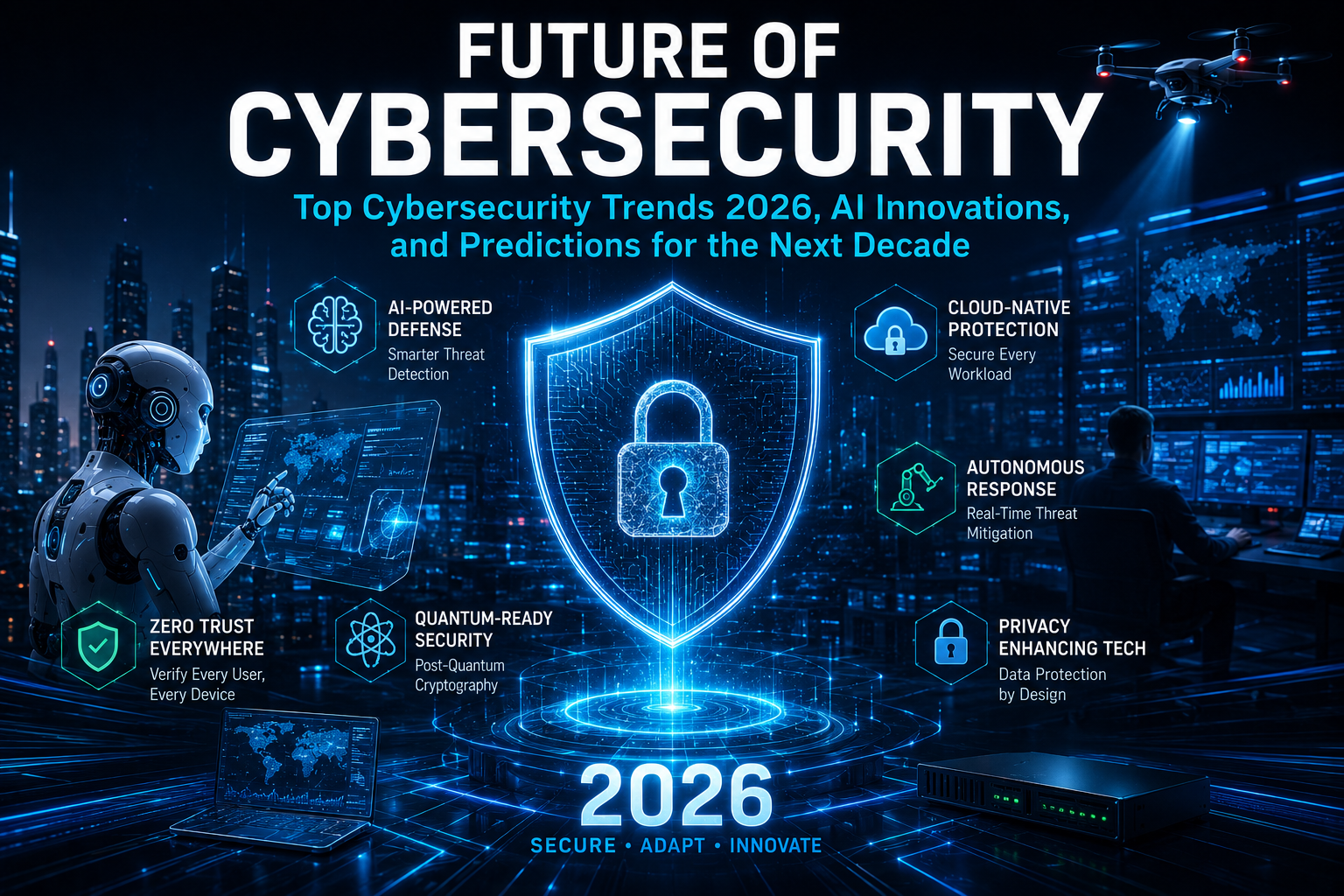
The future of cybersecurity is being shaped simultaneously by artificial intelligence, quantum computing, cloud-native architectures, automation, geopolitical conflict, and increasingly sophisticated cyber threats.
The cybersecurity predictions that once seemed futuristic are rapidly becoming operational realities.
Organizations that fail to prepare for cybersecurity trends 2026 and beyond may find themselves defending against threats they never anticipated.
This guide explores the future of cybersecurity, emerging cybersecurity technologies, AI in cybersecurity, future threats, career opportunities, and practical strategies that leaders can implement today.
Why the Future of Cybersecurity Matters More Than Ever
Cybersecurity has become a fundamental business requirement rather than a purely technical function.
Several forces are accelerating this transformation.
Digital Transformation
Organizations continue migrating critical workloads to cloud platforms while digitizing business processes.
Every digital asset becomes a potential target.
Cloud Adoption
According to Gartner projections, cloud spending continues to grow significantly year over year, making cloud security one of the most critical domains in modern cybersecurity.
AI Revolution
Artificial intelligence is changing how organizations:
- Detect threats
- Investigate incidents
- Automate responses
- Predict attacks
At the same time, attackers are leveraging AI to improve offensive capabilities.
Growing Cybercrime Economy
Cybercrime has evolved into a global underground economy.
The World Economic Forum and industry analysts estimate cybercrime damages will continue growing into the trillions annually, making cybersecurity one of the most critical business risks worldwide.
Global Attack Surface Expansion
Modern attack surfaces now include:
- Cloud workloads
- APIs
- Mobile devices
- Smart devices
- AI systems
- Supply chains
- Third-party vendors
The future of cybersecurity depends on managing this complexity without sacrificing agility.
Expert Insight
In my experience, organizations rarely fail because they lack security tools. They fail because complexity outpaces visibility.
The future belongs to organizations that simplify, automate, and continuously validate security controls.
Cybersecurity Trends 2026 That Will Shape the Industry
AI-Powered Threat Detection
Traditional detection methods struggle against modern threats.
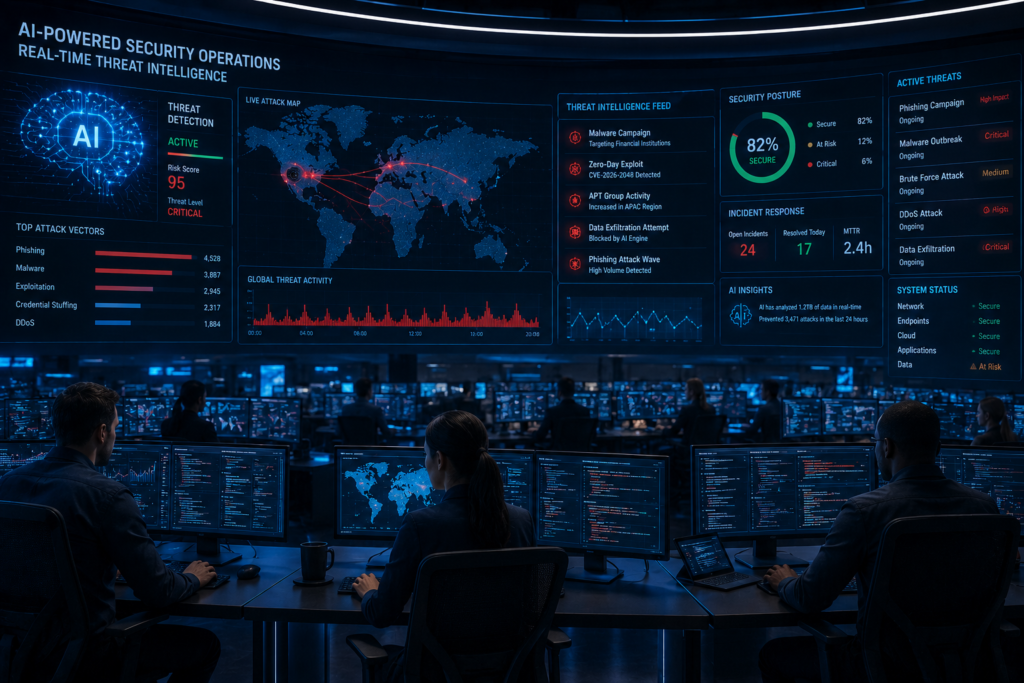
AI-driven analytics now identify:
- Behavioral anomalies
- Insider threats
- Lateral movement
- Advanced persistent threats (APTs)
Security teams increasingly rely on machine learning to detect subtle attack patterns invisible to human analysts.
Autonomous Security Operations
Security Operations Centers (SOCs) face severe talent shortages.
Automation will increasingly handle:
- Alert triage
- Threat correlation
- Incident enrichment
- Response orchestration
Autonomous SOC capabilities are rapidly moving from experimentation to production.
Zero Trust Architecture Expansion
The “never trust, always verify” model continues gaining momentum.
Future Zero Trust programs will focus on:
- Identity validation
- Device trust
- Continuous authentication
- Microsegmentation
Identity-First Security
Identity has become the new perimeter.
Future security investments will prioritize:
- Passwordless authentication
- Identity governance
- Privileged access management
- Continuous access evaluation
Cloud-Native Security
Organizations increasingly deploy applications directly into cloud-native environments.
This shift requires:
- Container security
- Kubernetes protection
- API security
- Cloud workload protection
Continuous Risk Assessment
Annual security assessments are no longer sufficient.
Future programs will continuously evaluate:
- Vulnerabilities
- Misconfigurations
- User behavior
- Threat exposure
AI in Cybersecurity – Opportunity and Threat
Artificial intelligence may become the most influential force shaping cybersecurity over the next decade.
How Defenders Use AI
Security teams leverage AI for:
- Threat detection
- Security analytics
- Malware classification
- Vulnerability prioritization
- Automated investigations
AI dramatically improves analyst efficiency.
How Attackers Use AI
Cybercriminals now use AI to:
- Generate malware variants
- Automate reconnaissance
- Improve phishing campaigns
- Evade detection systems
The offensive side of AI continues evolving rapidly.
AI-Powered Phishing
Modern phishing attacks increasingly use:
- Natural language generation
- Personalized targeting
- Context-aware messaging
Many phishing emails now appear indistinguishable from legitimate communications.
Deepfake Cybercrime
Deepfake technologies enable:
- Executive impersonation
- Financial fraud
- Social engineering attacks
- Disinformation campaigns
I have already observed organizations modifying executive verification processes due to growing deepfake risks.
Automated Threat Hunting
AI-powered threat hunting helps analysts:
- Detect hidden threats
- Correlate large datasets
- Identify attack patterns
Tasks that once required days can now be completed in minutes.
AI Security Governance
Future security leaders must address:
- AI model risks
- Data poisoning
- Model theft
- Prompt injection
- Regulatory compliance
AI governance will become a core security discipline.
Emerging Cybersecurity Technologies to Watch
Emerging Cybersecurity Technologies Comparison Table
| Technology | Purpose | Business Impact | Future Potential |
|---|---|---|---|
| XDR (Extended Detection and Response) | Unified threat visibility | Faster detection and response | Very High |
| SASE (Secure Access Service Edge) | Secure remote access | Simplified security architecture | Very High |
| AI Security Platforms | Threat intelligence and automation | Improved efficiency | Extremely High |
| Behavioral Analytics | Detect abnormal activity | Reduced insider risk | High |
| Passwordless Authentication | Eliminate password attacks | Stronger identity security | Very High |
| Confidential Computing | Protect data in use | Enhanced privacy and compliance | High |
| Cyber Deception Technology | Mislead attackers | Improved threat detection | Moderate to High |
| CNAPP Platforms | Cloud security management | Cloud risk reduction | Very High |
| Digital Risk Protection | External threat monitoring | Brand protection | High |
| Security Validation Platforms | Continuous testing | Better resilience | Very High |
Expert Observation
Over the next five years, organizations will increasingly consolidate security tools into unified platforms that provide visibility, automation, and risk management across hybrid environments.
Quantum Computing and the Future of Cybersecurity
Post-Quantum Cryptography
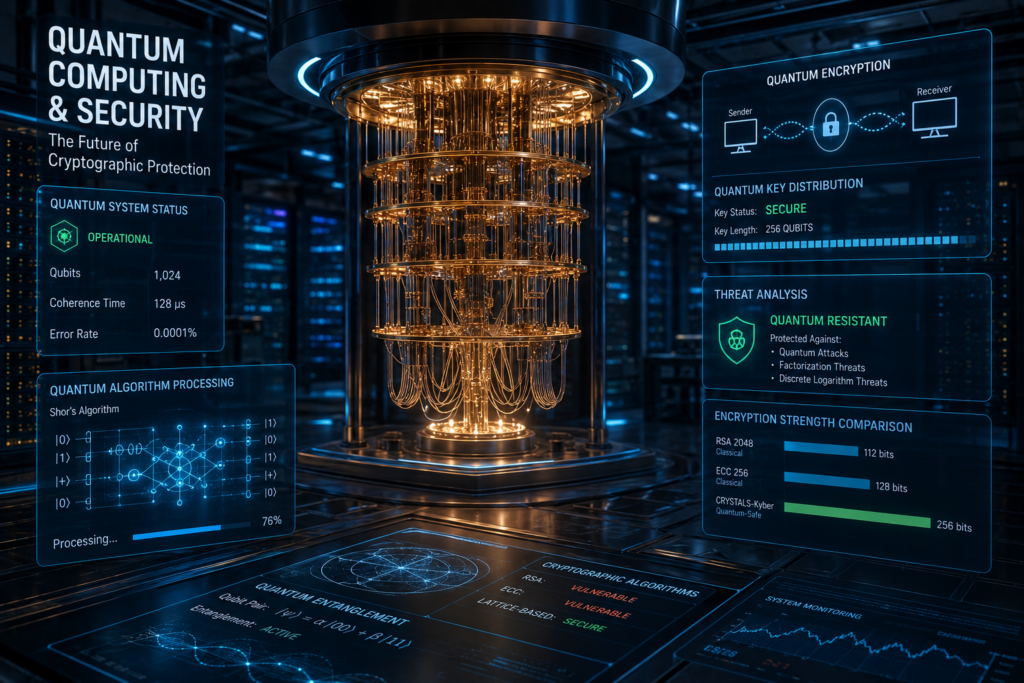
Quantum computing could eventually break widely used encryption methods.
Post-quantum cryptography seeks to protect information against future quantum threats.
Risks to Current Encryption
Potentially affected algorithms include:
- RSA
- ECC
- Diffie-Hellman
Organizations storing sensitive long-term data should already be evaluating migration strategies.
NIST Quantum Standards
NIST has begun standardizing quantum-resistant cryptographic algorithms.
Forward-thinking organizations are actively monitoring these developments.
Enterprise Preparation Strategies
Recommended actions include:
- Inventory cryptographic assets
- Identify vulnerable systems
- Develop migration roadmaps
- Test quantum-safe solutions
Future of Cloud Security
Cloud security remains central to the future of cybersecurity.
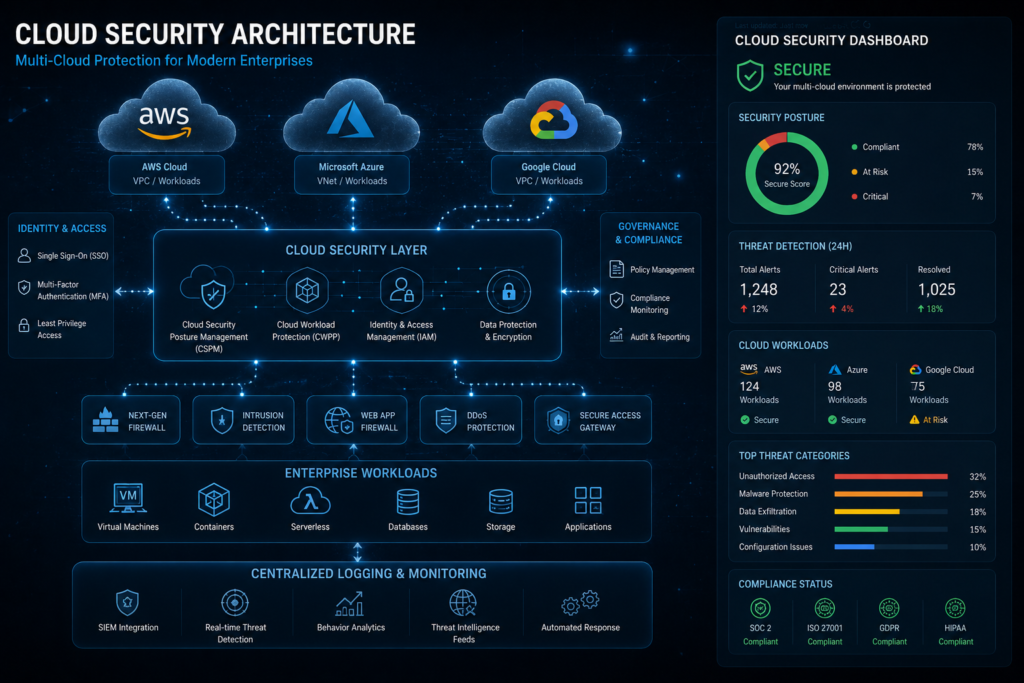
Multi-Cloud Protection
Organizations increasingly operate across:
- AWS
- Microsoft Azure
- Google Cloud
Multi-cloud visibility becomes essential.
CNAPP Platforms
Cloud-Native Application Protection Platforms provide:
- Security posture management
- Workload protection
- Compliance monitoring
Cloud Security Automation
Automation helps organizations:
- Detect misconfigurations
- Respond to threats
- Enforce policies
Data Security Posture Management
DSPM solutions focus on:
- Data discovery
- Classification
- Exposure monitoring
Cloud Threat Detection
Future cloud security programs emphasize:
- Runtime protection
- Threat intelligence
- Behavioral analytics
Cybersecurity Predictions for the Next 10 Years
Cybersecurity Predictions and Impact Analysis
| Prediction | Likelihood | Impact |
|---|---|---|
| AI Security Assistants Become Standard | Very High | Transformational |
| Passwordless Authentication Dominates | High | Significant |
| Autonomous SOC Operations | Very High | Transformational |
| Quantum-Safe Encryption Adoption | High | Critical |
| Identity-Centric Security Becomes Primary Model | Very High | Significant |
| AI-Powered Malware Escalates | Very High | Critical |
| Deepfake Fraud Increases Dramatically | High | Significant |
| Continuous Security Validation Becomes Mandatory | High | High |
| Cyber Insurance Requirements Tighten | Very High | Moderate |
| Zero Trust Becomes Standard Architecture | Very High | Transformational |
Trend Summary
The strongest cybersecurity predictions center around automation, identity security, AI adoption, and cryptographic modernization.
Organizations preparing today will gain substantial advantages tomorrow.
Future Cyber Threats Organizations Must Prepare For
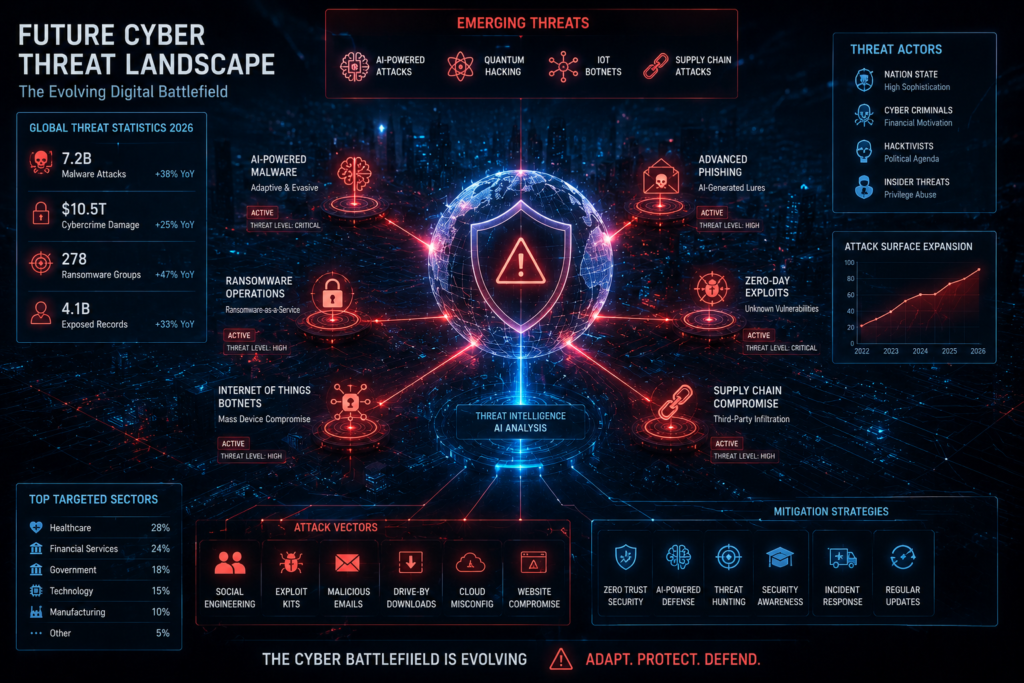
AI-Powered Malware
Future malware may:
- Rewrite itself dynamically
- Evade detection
- Adapt behavior automatically
Deepfake Attacks
Expect increasing use of:
- Voice cloning
- Video impersonation
- Synthetic identities
Supply Chain Compromise
Third-party vendors remain attractive targets.
Attackers often exploit trusted relationships.
Critical Infrastructure Attacks
Sectors facing heightened risk include:
- Energy
- Healthcare
- Transportation
- Telecommunications
Cloud-Native Threats
Cloud-focused attacks continue growing due to:
- Misconfigurations
- Credential theft
- Excessive permissions
Autonomous Ransomware
Future ransomware may:
- Discover assets automatically
- Prioritize targets
- Negotiate payments using AI
Cybersecurity Careers That Will Thrive in the Future
AI Security Engineer
Responsibilities:
- Secure AI systems
- Defend models
- Govern AI risk
Estimated salary outlook: $130,000–$220,000+
Cloud Security Architect
Responsibilities:
- Secure cloud environments
- Design controls
- Implement governance
Estimated salary outlook: $140,000–$250,000+
Threat Intelligence Analyst
Responsibilities:
- Track adversaries
- Analyze threats
- Produce intelligence reports
Estimated salary outlook: $100,000–$180,000+
Security Automation Engineer
Responsibilities:
- Build automated workflows
- Integrate security tools
Estimated salary outlook: $120,000–$200,000+
Identity Security Specialist
Responsibilities:
- Access management
- Authentication systems
Estimated salary outlook: $110,000–$190,000+
Quantum Security Researcher
Responsibilities:
- Quantum-safe cryptography
- Future encryption strategies
Estimated salary outlook: $140,000–$250,000+
Biggest Lessons I Have Learned in 25 Years of Cybersecurity
The most important lesson is surprisingly simple:
Technology alone never solves security problems.
Throughout my career, I have repeatedly seen organizations invest millions in advanced tools while neglecting:
- Security culture
- Asset visibility
- Access control
- Employee training
Industry Mistakes
Common failures include:
- Excessive complexity
- Poor visibility
- Weak governance
- Delayed patching
Security Evolution
Cybersecurity evolved from perimeter defense to continuous risk management.
Identity now matters more than location.
What Organizations Still Get Wrong
Many organizations still assume:
- Compliance equals security
- More tools equal better protection
- Security is solely an IT responsibility
These assumptions continue causing breaches.
Advice for Future Professionals
Focus on:
- Critical thinking
- Risk analysis
- Communication skills
- Automation
- AI literacy
The future rewards adaptable professionals.
How Businesses Should Prepare for Cybersecurity Trends 2026
1. Modernize Security Architecture
Invest in:
- Zero Trust
- Identity security
- Cloud-native controls
2. Build AI Governance Programs
Develop policies covering:
- AI usage
- Model security
- Risk management
3. Strengthen Security Operations
Implement:
- XDR
- Automation
- Threat intelligence
4. Improve Workforce Readiness
Train employees on:
- Phishing
- Deepfakes
- AI-assisted attacks
5. Enhance Incident Response
Update plans for:
- Cloud incidents
- Ransomware
- AI-enabled threats
6. Prepare for Quantum Risk
Begin cryptographic assessments now.
Organizations that wait may face costly transitions later.
Frequently Asked Questions
What is the future of cybersecurity?
The future of cybersecurity centers on AI-driven defense, Zero Trust architecture, cloud-native security, automation, and quantum-resistant cryptography.
What are the most important cybersecurity trends 2026?
Key cybersecurity trends 2026 include AI-powered security operations, identity-first security, autonomous SOCs, cloud security automation, and quantum preparedness.
How is AI changing cybersecurity?
AI improves threat detection, incident response, automation, and threat hunting while also enabling more sophisticated cyberattacks.
Will AI replace cybersecurity professionals?
No. AI will augment professionals by automating repetitive tasks, but human expertise remains essential for strategy, investigation, and decision-making.
What are emerging cybersecurity technologies?
Important emerging cybersecurity technologies include XDR, SASE, CNAPP, confidential computing, passwordless authentication, and cyber deception platforms.
What is the future of cloud security?
Cloud security will increasingly rely on automation, posture management, runtime protection, and continuous risk assessment.
How will quantum computing affect cybersecurity?
Quantum computing may eventually break current encryption methods, making post-quantum cryptography a critical future priority.
Which cybersecurity careers have the strongest future?
AI Security Engineer, Cloud Security Architect, Threat Intelligence Analyst, Security Automation Engineer, and Quantum Security Researcher are among the fastest-growing roles.
What are the biggest future cyber threats?
AI-powered malware, deepfake attacks, autonomous ransomware, cloud-native threats, and supply chain compromises represent major future risks.
How should businesses prepare for cybersecurity predictions?
Organizations should adopt Zero Trust, strengthen identity security, automate operations, govern AI usage, and prepare for quantum-safe cryptography.
Conclusion
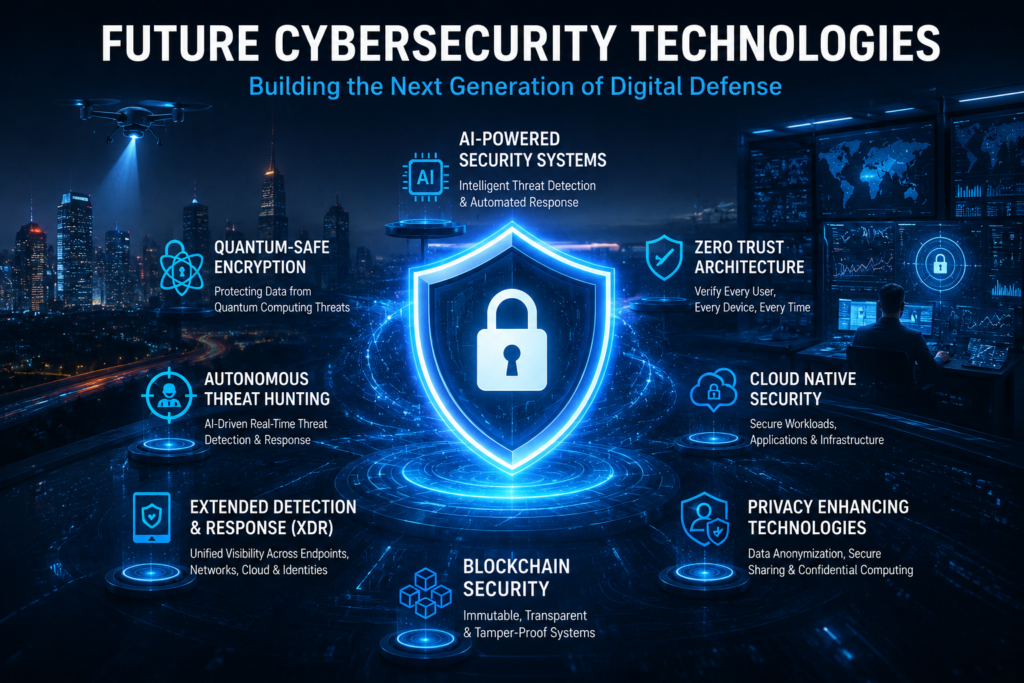
The future of cybersecurity will be defined by a convergence of artificial intelligence, automation, cloud transformation, identity-centric security, and quantum computing. These forces are reshaping how organizations defend against threats, manage risk, and secure digital ecosystems.
The most important cybersecurity trends 2026 are already emerging today. AI in cybersecurity is transforming both defense and offense. Emerging cybersecurity technologies such as XDR, SASE, CNAPP, behavioral analytics, and passwordless authentication are becoming foundational components of modern security programs. At the same time, cybersecurity predictions increasingly point toward autonomous operations, quantum-safe encryption, and continuous risk management as essential future capabilities.
After 25 years of working across cybersecurity operations, incident response, threat intelligence, cloud security, and executive advisory roles, one conclusion stands above all others: organizations that embrace adaptability will outperform those that cling to legacy security models.
The future of cybersecurity does not belong to the organizations with the largest security budgets. It belongs to those with the best visibility, strongest governance, smartest automation, and most resilient security cultures.
Now is the time to invest in AI readiness, modernize security architecture, strengthen identity controls, prepare for quantum disruption, and develop the next generation of cybersecurity talent.
Those who act today will be best positioned to thrive in the cybersecurity landscape of tomorrow.
Author

razakh6402@gmail.com
Related Posts

Browser Security Extensions: Top Chrome Security Extensions & Privacy Browser Extensions You Need in 2026
- 0
- 2,358 words
best budgeting appsEvery year, browsers become smarter, websites become faster, and online services become more convenient. Unfortunately, cybercriminals evolve just as quickly....
Read out all
Passkeys: How Passwordless Authentication Is Replacing Passwords in 2026
- 0
- 2,452 words
If you’ve ever forgotten a password, reset the same account multiple times, or worried that your login credentials were exposed in a...
Read out all
Cybersecurity Checklist: Essential Small Business Cybersecurity Guide (2026)
- 0
- 2,462 words
Cyberattacks are no longer a problem reserved for large enterprises. Over the last 15 years, I’ve worked with startups, retail stores, healthcare...

Secure Cloud Storage: Best Secure Cloud Storage Services for Business & Personal Use (2026 Guide)
- 0
- 2,443 words
Whether you’re backing up family photos, sharing confidential client documents, or managing sensitive business files, choosing the right secure cloud storage service...

AI Scams: How to Protect Yourself from AI-Powered Scams in 2026 (Expert Guide)
- 0
- 1,918 word
Artificial intelligence has transformed the way we work, communicate, and manage our finances. Unfortunately, cybercriminals have embraced the same technology to create...
Read out all
Home Network Security Guide: 25 Expert Strategies to Build a Secure Home Network in 2026
- 0
- 1,999 word
Home network security is no longer optional. https://www.effectivecpmnetwork.com/zwmk61nzik?key=c215b6a50560356c577d53e1d461ad7a Twenty-five years ago, most households connected a single desktop computer to the internet. Today,...
Read out all
1 comment