
- 0
- 1,685 word
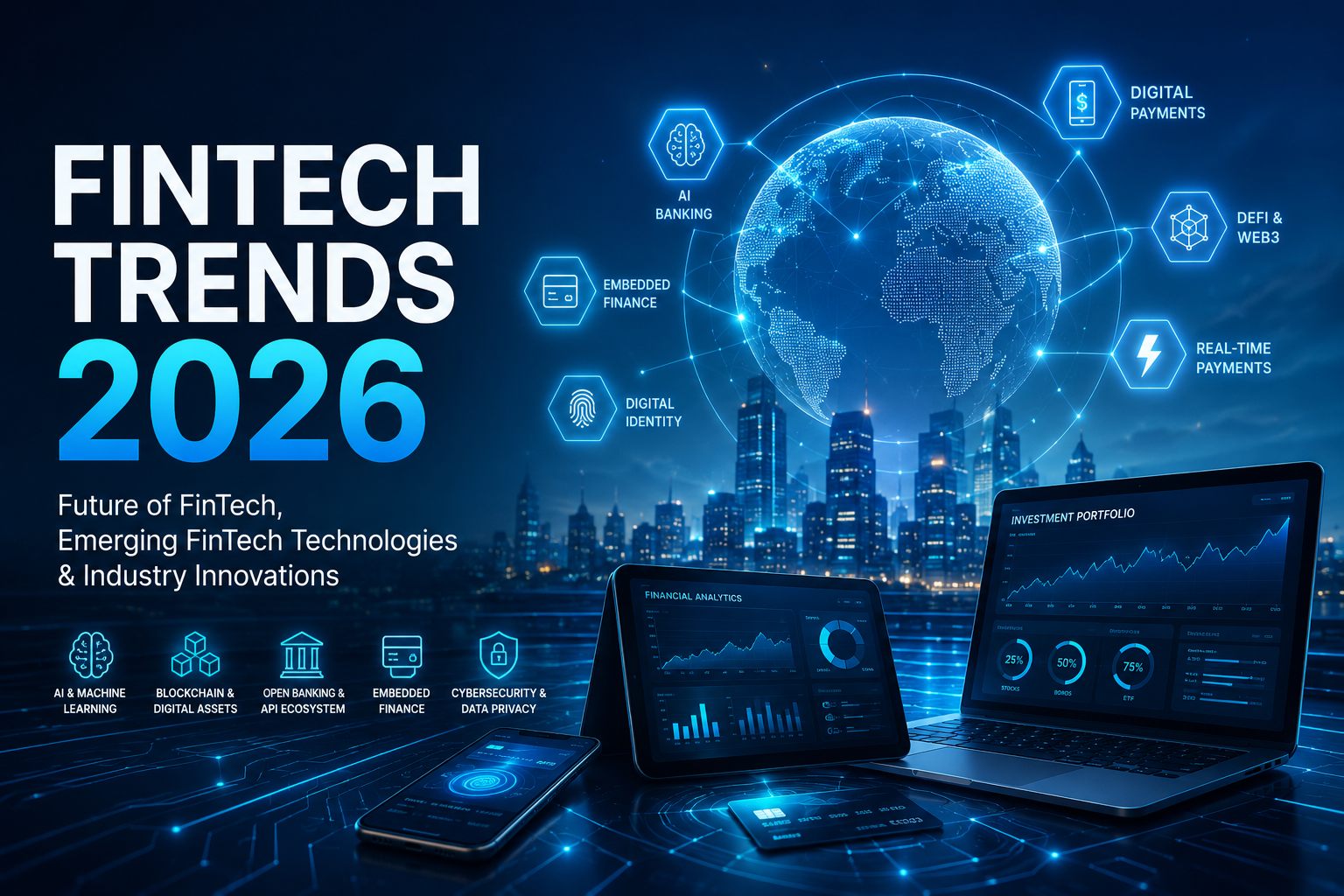
The fintech trends 2026 landscape looks dramatically different from what I witnessed when I first began consulting on digital banking transformation over 15 years ago. Back then, convincing a traditional bank to launch a mobile app felt like a major achievement. Today, financial institutions compete to deploy AI-powered advisors, real-time payment infrastructure, embedded finance platforms, and digital identity solutions.
The pace of innovation has accelerated beyond technology alone. Customer expectations, regulatory frameworks, cloud computing, artificial intelligence, and data availability now evolve simultaneously, forcing banks and fintech companies to innovate continuously.
Whether you’re a consumer, startup founder, investor, bank executive, developer, or enterprise decision-maker, understanding the future of fintech is no longer optional. The companies making the smartest investments today will likely define financial services for the next decade.

In this guide, I’ll share practical insights gathered from years of consulting on digital banking projects, reviewing fintech platforms, and observing why some financial innovations succeed while others fail.
Related Reading:
- Digital Banking Explained
- Open Banking Guide
- AI in Banking
- Best Personal Finance Apps
- Best Investment Apps
- Best Budgeting Apps
- Best Crypto Wallets
- Cybersecurity for Financial Institutions

Why FinTech Is Changing Faster Than Ever
Several forces have converged to reshape the fintech industry trends we see today.
Artificial Intelligence Has Become a Core Banking Technology
Banks no longer treat AI as an experimental project. Instead, they integrate AI across customer service, lending, fraud prevention, compliance, wealth management, and risk analysis.
In my consulting work, I’ve noticed that organizations achieving the greatest ROI don’t replace people with AI—they empower employees to make faster and more informed decisions.
Open Banking Is Expanding Financial Ecosystems
Open Banking has evolved from simple API sharing into collaborative financial ecosystems where banks, fintech companies, merchants, insurers, and developers exchange data securely to create better customer experiences.
Real-Time Payments Are Becoming the Standard
Customers expect payments to settle instantly. Businesses increasingly depend on immediate cash flow visibility, making real-time payment infrastructure one of the strongest emerging fintech technologies driving digital transformation.
Regulations Continue to Evolve
Governments worldwide are modernizing financial regulations to encourage innovation while strengthening consumer protection, cybersecurity, anti-money laundering (AML), and digital identity verification.
Organizations that proactively embrace compliance often gain a competitive advantage.
Customer Expectations Keep Rising
Modern consumers compare banking experiences with Amazon, Apple, Google, and Netflix—not with other banks. Simplicity, personalization, speed, and security now define customer loyalty.

Top FinTech Trends 2026
AI-Powered Banking
AI now supports loan underwriting, investment recommendations, customer service, document processing, and predictive analytics.

Why it matters: Banks reduce operational costs while improving customer experiences.
Example: AI assistants capable of handling complex financial inquiries around the clock.
Benefits
- Faster approvals
- Better customer support
- Lower operating costs
Challenges
- AI bias
- Data quality
- Regulatory oversight
Expert Insight
The banks seeing the best outcomes combine AI automation with experienced human advisors rather than relying entirely on automation.
Future Outlook
Expect AI to become every customer’s personal financial assistant.
Embedded Finance
Embedded finance integrates banking directly into non-financial platforms.
Think ride-sharing apps offering insurance or e-commerce stores providing instant financing.
Benefits
- New revenue streams
- Better customer convenience
Challenges
- Compliance complexity
- API reliability
Open Banking Evolution
Open Banking continues evolving toward Open Finance, where customers securely share broader financial data across multiple providers.
Financial institutions that embrace collaboration outperform those protecting outdated business models.
Real-Time Payments
Consumers increasingly expect payments within seconds rather than days.
Businesses benefit from improved liquidity, while customers enjoy instant transfers.
Payment networks supported by companies like Visa, Mastercard, and Stripe continue expanding globally.
Central Bank Digital Currencies (CBDCs)
Many central banks continue researching or piloting CBDCs to modernize payment infrastructure.
CBDCs could improve cross-border settlements while reducing transaction costs.
However, privacy concerns remain one of the largest implementation challenges.
Blockchain Beyond Cryptocurrency
Blockchain increasingly supports:
- Supply chain finance
- Trade finance
- Identity verification
- Smart contracts
- Asset tokenization
This represents one of the most practical fintech innovations beyond cryptocurrency speculation.
Digital Identity
Secure digital identity enables seamless onboarding while reducing fraud.
Biometric authentication, facial recognition, and decentralized identity frameworks continue gaining adoption.
AI Fraud Detection
Financial fraud grows more sophisticated every year.
Machine learning models now identify suspicious behavior within milliseconds, preventing losses before transactions complete.
From my experience, fraud prevention is one of the highest-return AI investments any financial institution can make.
Hyper-Personalized Finance
Banks increasingly analyze spending behavior, savings habits, investments, and financial goals to deliver tailored recommendations.
Customers now expect proactive guidance rather than reactive support.
Green FinTech
Sustainability has become a competitive differentiator.
Fintech platforms increasingly help users:
- Track carbon footprints
- Invest sustainably
- Support ESG reporting
WealthTech
AI-powered portfolio management continues lowering investment barriers.
Retail investors now access tools once reserved for institutional wealth managers.
InsurTech
Insurance companies increasingly automate underwriting, claims processing, and fraud detection while delivering personalized insurance pricing.
RegTech
Regulatory technology automates compliance, reporting, risk monitoring, and AML verification.
In my consulting experience, RegTech often delivers measurable ROI within months because compliance processes traditionally consume enormous manual effort.
Banking-as-a-Service (BaaS)
BaaS allows companies to embed banking products through APIs instead of building banking infrastructure themselves.
This dramatically lowers barriers for fintech startups.
Tokenization
Tokenization extends beyond cryptocurrencies into real estate, securities, intellectual property, and private assets.
Institutional adoption will likely accelerate over the next several years.
Financial Super Apps
Consumers increasingly prefer platforms combining:
- Banking
- Payments
- Investments
- Insurance
- Shopping
- Rewards
Asia has demonstrated the success of this model, and Western markets continue moving in the same direction.

FinTech Trends Comparison
| Trend | Adoption Level | Business Impact | Consumer Impact | Future Potential |
|---|---|---|---|---|
| AI Banking | Very High | Very High | High | Excellent |
| Embedded Finance | High | Excellent | High | Excellent |
| Open Banking | High | High | High | Excellent |
| Real-Time Payments | Very High | Excellent | Excellent | Excellent |
| CBDCs | Medium | High | Medium | High |
| Blockchain | Medium | High | Medium | High |
| Digital Identity | High | High | Excellent | Excellent |
| AI Fraud Detection | Very High | Excellent | High | Excellent |
| Green FinTech | Medium | Growing | Growing | High |
| WealthTech | High | High | High | Excellent |
| BaaS | High | Excellent | Medium | Excellent |
| Super Apps | Medium | High | Excellent | High |
Biggest Challenges Facing FinTech
Innovation always creates new opportunities, but it also introduces significant risks.
Cybersecurity
Financial institutions remain prime targets for ransomware, phishing, API attacks, and identity theft.
Regulatory Compliance
Cross-border fintech operations require compliance with multiple jurisdictions simultaneously.
Data Privacy
Organizations must balance personalization with responsible data usage.
Customer Trust
One major security incident can damage years of brand reputation.
Legacy Banking Systems
Many traditional banks still operate on decades-old infrastructure that slows innovation.
AI Risks
Poorly trained AI models can introduce bias, generate inaccurate recommendations, or create compliance concerns.
Financial Fraud
Fraudsters increasingly leverage AI, requiring financial institutions to stay one step ahead.

Expert Predictions for the Future of FinTech
After more than 15 years working alongside banks, startups, payment providers, and technology vendors, several patterns stand out.
The biggest change hasn’t been blockchain or artificial intelligence—it has been mindset. Financial institutions that once feared disruption now actively partner with fintech startups.
One recurring mistake remains unchanged: companies often invest in technology before clearly defining the customer problem. Successful fintech products solve friction first and add advanced technology second.
Some technologies receive excessive attention. Certain blockchain projects, for example, promise sweeping transformation without a compelling business case. Meanwhile, less glamorous technologies like API management, cloud infrastructure, fraud analytics, and identity verification quietly deliver substantial value.
By 2030, I expect healthcare finance, embedded insurance, SME lending, supply chain finance, and AI-powered wealth management to benefit most from continued fintech innovations.
Practical Tips for Businesses
Banks
- Modernize legacy infrastructure gradually.
- Invest in API-first architectures.
- Combine AI with human expertise.
FinTech Startups
- Solve one customer problem exceptionally well.
- Prioritize regulatory compliance from day one.
- Build trust through transparency.
SMEs
- Adopt embedded payment solutions.
- Automate invoicing and cash flow forecasting.
- Use AI-powered financial analytics.
Investors
- Evaluate sustainable revenue models instead of hype.
- Focus on companies with strong compliance capabilities.
Developers
- Learn API security.
- Understand financial regulations.
- Build privacy-first applications.
Financial Institutions
- Treat cybersecurity as a business strategy.
- Continuously improve customer experience.
- Use data responsibly.

Frequently Asked Questions
What are the biggest fintech trends in 2026?
AI banking, embedded finance, Open Banking, real-time payments, digital identity, tokenization, WealthTech, RegTech, and financial super apps lead the market.
Why is AI important in fintech?
AI improves fraud detection, customer service, lending decisions, compliance, and personalized financial advice.
Is blockchain still relevant beyond cryptocurrency?
Yes. Blockchain increasingly supports trade finance, identity verification, tokenization, and smart contracts.
What is embedded finance?
Embedded finance integrates banking and payment services directly into non-financial applications.
Will traditional banks disappear?
No. Banks that embrace digital transformation and partnerships with fintech firms will remain highly competitive.
Which industries benefit most from fintech?
Banking, insurance, healthcare, retail, logistics, e-commerce, and wealth management.
How can businesses prepare for the future of fintech?
Invest in secure APIs, AI, cloud infrastructure, compliance, cybersecurity, and customer-centric digital experiences.
Conclusion
The fintech trends 2026 shaping today’s financial landscape extend far beyond digital payments or mobile banking. Artificial intelligence, embedded finance, Open Banking, blockchain, real-time payments, digital identity, and sustainable finance are collectively redefining how money moves, how businesses operate, and how consumers interact with financial services.
From my experience advising financial institutions over the past 15 years, the organizations that consistently succeed share one common trait: they focus relentlessly on solving genuine customer problems rather than chasing every new technology trend. Innovation delivers lasting value only when it improves trust, convenience, security, and accessibility.
As the future of fintech continues to evolve, businesses that invest in scalable infrastructure, responsible AI, regulatory readiness, and customer-first innovation will be best positioned to lead the next generation of financial services. Stay informed, experiment strategically, and continue learning—because the pace of emerging fintech technologies shows no signs of slowing.
Author

razakh6402@gmail.com
Related Posts
Digital Payments: Future of Digital Payments, Payment Technology & Online Payment Trends (2026 Guide)
- 0
- 2,609 words
The way we pay for goods and services has changed more in the past decade than it did in the previous fifty...
Embedded Finance Explained: Complete Guide to Embedded Banking & Banking as a Service (2026)
- 0
- 2,288 words
Over the last fifteen years, I’ve watched financial services evolve from products that required customers to visit a bank into experiences seamlessly...

Contactless Payments Explained: Complete NFC Payment & Tap to Pay Guide (2026)
- 0
- 2,193 words
Over the past fifteen years, I’ve watched payment technology evolve from magnetic stripe cards and PIN terminals to today’s seamless contactless payments...
Neobank vs Traditional Bank: Complete Digital Banking Comparison Guide (2026)
- 0
- 2,379 words
The debate around neobank vs traditional bank has become more relevant than ever as digital banking continues to reshape how people manage...

Financial Planning Software: 10 Best Personal Financial Planning Software & Wealth Management Software (2026 Guide)
- 0
- 2,621 words
Managing money has changed dramatically over the past decade. When I first began advising clients more than 15 years ago, financial planning...
Best Expense Tracking Apps: Top Expense Tracker & Best Expense Management Software (2026 Guide)
- 2
- 2,595 words
Whether you’re running a startup, managing a growing business, freelancing full-time, or simply trying to control your personal finances, one thing remains...