
- 0
- 2,509 words
Watching this transformation firsthand has been one of the most fascinating parts of working with banks, fintech startups, and digital payment providers. I’ve seen traditional financial institutions evolve into technology-driven organizations, while digital-only banks have emerged without opening a single physical branch. Customers now expect instant payments, AI-powered support, and secure banking from anywhere in the world.
This shift is exactly why understanding digital banking has become essential. Whether you’re a student receiving scholarship payments, a freelancer managing international clients, or a business owner processing thousands of transactions, digital financial services have become part of everyday life.
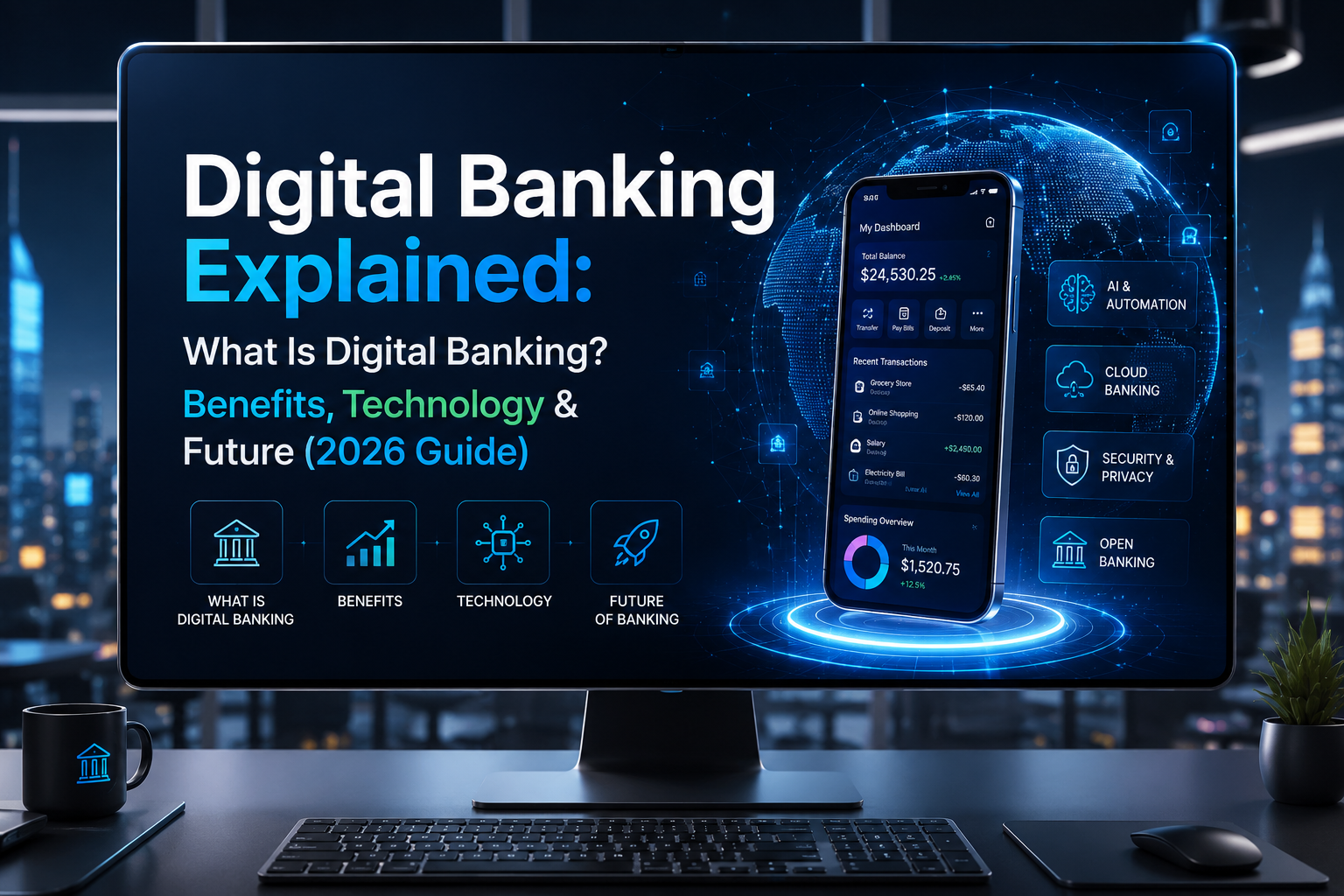
In this guide, you’ll discover what is digital banking, how online banking technology works behind the scenes, the biggest digital banking benefits, and why experts believe the next few years will completely reshape modern finance.

What Is Digital Banking?
Simply put, digital banking refers to delivering banking services entirely through digital channels instead of relying on physical branches.
Customers can:
- Open accounts online
- Transfer money instantly
- Pay utility bills
- Apply for loans
- Invest in mutual funds
- Manage debit and credit cards
- Track expenses
- Receive financial insights
—all without stepping inside a bank.
When people ask me “What is digital banking?”, I usually explain it this way:
Imagine carrying your entire bank branch inside your pocket. Everything from customer support to payments is available through your mobile phone or computer.
That simple explanation helps beginners understand why digital banking has become so popular worldwide.
The Evolution of Digital Banking
Digital banking didn’t appear overnight.
Its journey includes several important milestones:
Early Banking Era
Customers relied completely on physical branches.
Transactions involved:
- Paper forms
- Manual verification
- Long processing times
- Limited banking hours
Internet Banking Revolution
Around the late 1990s and early 2000s, banks introduced internet banking.
Customers could:
- Check balances
- Transfer funds
- Download statements
Although revolutionary at the time, these services were relatively basic.
Mobile Banking Era
Smartphones transformed everything.
Banking apps became faster, more secure, and significantly easier to use.
Today, many customers rarely visit a physical branch.
AI-Powered Digital Banking
Modern banking platforms now use:
- Artificial Intelligence
- Machine Learning
- Cloud Computing
- Big Data Analytics
- Automation
These technologies create personalized experiences while reducing fraud and improving customer service.
Why Digital Banking Matters Today
Working with fintech companies has taught me one important lesson:
Customers don’t compare banks with other banks anymore.
They compare banking experiences with apps like food delivery, ride-sharing, and online shopping.
People now expect:
- Instant payments
- Real-time notifications
- 24/7 access
- Personalized recommendations
- Frictionless user experiences
Banks that fail to meet these expectations often struggle to retain younger customers.
Digital Banking Explained
Now that we’ve covered what is digital banking, let’s explore how it actually works.
Behind every mobile banking app lies an advanced ecosystem of technologies working together within milliseconds.
From the customer’s perspective, sending money looks simple.
Behind the scenes, dozens of systems communicate instantly.
These include:
- Banking core systems
- Payment processors
- Fraud detection engines
- Cloud servers
- Identity verification systems
- Encryption services
- Regulatory compliance platforms
Having worked on digital payment integrations, I’ve learned that reliability matters just as much as speed. Users remember failed transactions far longer than successful ones, which is why banks invest heavily in resilient infrastructure and continuous monitoring.
Core Banking Systems
Every digital bank relies on a Core Banking System (CBS).
Think of it as the bank’s central brain.
It stores information such as:
- Customer accounts
- Transaction history
- Deposits
- Loans
- Interest calculations
- Card management
Whenever you transfer money through a banking app, the request travels to the core banking system for validation and processing.
Without this backbone, digital banking simply wouldn’t function.
Cloud Banking
Most modern financial institutions have adopted cloud technology to improve scalability and performance.
Instead of relying solely on expensive on-premise data centers, banks increasingly use secure cloud environments.
Cloud banking offers:
- Faster application updates
- Better disaster recovery
- Improved scalability
- Reduced infrastructure costs
- Higher service availability
Large institutions often use hybrid cloud strategies, balancing flexibility with strict regulatory requirements.
APIs: The Hidden Connectors
One of the biggest innovations I’ve seen in fintech is the rise of APIs (Application Programming Interfaces).
APIs allow different financial services to communicate securely.
For example:
- A budgeting app connects to your bank.
- A payment gateway verifies your account.
- An investment platform retrieves your balance.
- A merchant accepts instant bank payments.
This connectivity powers Open Banking, enabling customers to share financial data securely with trusted third-party services while remaining in control of permissions.
Artificial Intelligence and Automation
Artificial Intelligence has become one of the most valuable technologies in digital banking.
Banks use AI to:
- Detect suspicious transactions
- Recommend financial products
- Predict customer needs
- Automate loan approvals
- Improve customer support
One of the most noticeable improvements has been AI-powered chatbots. Years ago, customers often waited several minutes—or even hours—for basic support. Today, many routine questions are answered instantly, allowing human agents to focus on more complex issues.
Automation also reduces operational costs and improves consistency by handling repetitive tasks such as document verification, transaction monitoring, and compliance checks.
Mobile Banking and Internet Banking
Although many people use the terms interchangeably, mobile banking and internet banking aren’t exactly the same.
Mobile Banking
Mobile banking is designed specifically for smartphones and tablets.
It focuses on convenience and everyday financial activities, including:
- QR code payments
- Biometric login
- Mobile wallets
- Instant transfers
- Push notifications
Internet Banking
Internet banking primarily operates through a web browser on desktops and laptops.
It’s often preferred for tasks such as:
- Downloading detailed account statements
- Managing business accounts
- Handling payroll
- Completing complex financial transactions
In practice, most customers use both depending on the situation. I often use a mobile app for quick transfers during the day, while larger business-related tasks are easier to complete through a secure desktop portal.
How Online Banking Technology Works
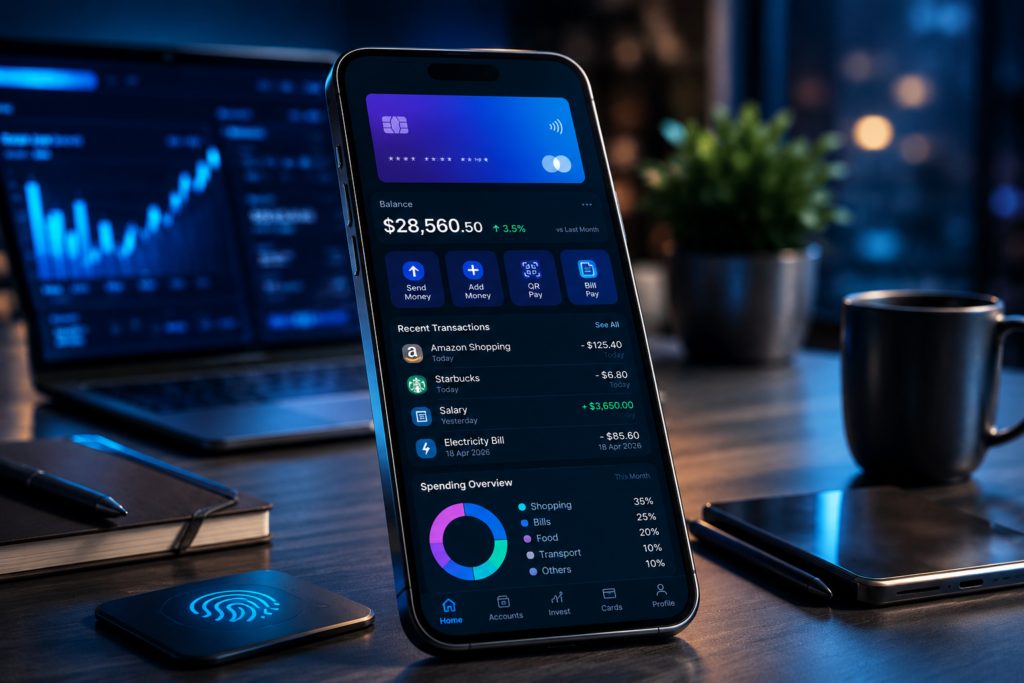
Many users assume that tapping the “Send Money” button instantly moves funds from one account to another. In reality, online banking technology performs dozens of secure processes within seconds.
A typical digital transaction follows these steps:
- User Authentication: The app verifies your identity using a password, PIN, fingerprint, or facial recognition.
- Encrypted Transmission: Your request is encrypted to protect sensitive financial information during transmission.
- Core Banking Validation: The bank checks your account balance, transaction limits, and account status.
- Fraud Detection: AI-powered systems analyze the transaction for unusual behavior or potential fraud.
- Payment Network Processing: Secure payment networks route the transaction to the recipient’s bank.
- Real-Time Confirmation: Both sender and recipient receive instant notifications once the transaction is complete.
This entire process usually takes only a few seconds, demonstrating how modern online banking technology combines cloud computing, APIs, AI, and cybersecurity to deliver fast, secure, and reliable financial services.
Digital Banking Benefits
One of the biggest reasons digital banking has grown so rapidly is the value it provides to almost every type of customer. After working with banks and fintech companies for many years, I’ve noticed one common trend: people rarely switch back to traditional banking once they experience the convenience of modern digital services.
Let’s explore the biggest digital banking benefits for different users.
For Individuals
Digital banking simplifies everyday money management.
Key benefits include:
- 24/7 account access
- Instant money transfers
- Real-time balance updates
- Automatic bill payments
- Mobile check deposits (where available)
- Personalized financial insights
- Secure biometric login
Instead of planning your day around bank opening hours, you can manage your finances whenever it’s convenient.
For Businesses
Businesses save significant time by using digital banking platforms.
Benefits include:
- Faster payroll processing
- Online tax payments
- Bulk transfers
- Cash flow monitoring
- Digital invoicing
- Better transaction records
- Reduced paperwork
Many small business owners I’ve worked with now complete tasks in minutes that previously required several visits to a bank branch.
For Students
Students benefit from:
- Instant fee payments
- Scholarship deposits
- Budget tracking
- Low-cost transfers
- Mobile payment apps
Learning to use digital banking early also helps build strong financial habits.
For Freelancers
Freelancers working with international clients appreciate:
- Faster global payments
- Digital wallets
- Currency conversion
- Expense management
- Easy invoice tracking
For SMEs
Small and medium-sized businesses gain access to:
- Digital lending
- Working capital solutions
- Online merchant payments
- Automated accounting integrations
For Banks
Banks benefit from:
- Lower operational costs
- Reduced paperwork
- Improved fraud detection
- Better customer engagement
- AI-powered automation
- Data-driven decision making
For Governments
Governments increasingly rely on digital banking to:
- Distribute welfare payments
- Improve tax collection
- Reduce financial fraud
- Promote financial inclusion
- Increase transparency
Types of Digital Banking
Not every digital banking service works the same way. Understanding the different models helps consumers choose the right financial solution.
Mobile Banking
The most common form of digital banking.
Customers use dedicated smartphone apps for:
- Fund transfers
- Bill payments
- Card management
- QR payments
- Account monitoring
Internet Banking
Accessed through a secure web browser.
Ideal for:
- Business banking
- Detailed statements
- Large transactions
- Loan management
Neobanks
Neobanks operate almost entirely online without traditional branches.
They focus on:
- Low fees
- Fast onboarding
- Excellent mobile experiences
- Innovative financial tools
Digital-Only Banks
Unlike traditional banks with branches, digital-only banks deliver every service online, from account opening to customer support.
Open Banking
Open Banking allows customers to securely share banking data with trusted third-party applications using APIs.
Examples include:
- Budgeting apps
- Investment platforms
- Accounting software
- Financial dashboards
Embedded Finance
Embedded finance integrates financial services directly into non-banking platforms.
Examples include:
- Buy Now Pay Later
- Ride-sharing payments
- E-commerce financing
- In-app insurance
Features of Modern Digital Banking
Today’s digital banking platforms offer much more than checking balances.
Modern features include:
- Instant money transfers
- Online account opening
- AI-powered chatbots
- Expense tracking
- Personal budgeting tools
- Investment management
- Card lock and unlock controls
- Bill payments
- QR code payments
- Digital lending
- Savings goal tracking
- Credit score monitoring
- Real-time spending alerts
- Virtual debit and credit cards
- Recurring payment automation
These innovations have transformed banking into a complete financial management ecosystem rather than simply a place to store money.

Traditional Banking vs Digital Banking
| Feature | Traditional Banking | Digital Banking |
|---|---|---|
| Speed | Slower | Instant or near real-time |
| Accessibility | Branch hours | 24/7 worldwide |
| Cost | Higher operational costs | Lower service costs |
| Security | Physical verification | Encryption, AI, biometrics |
| Customer Support | Branch and call centers | AI chatbots + live support |
| Transactions | Manual processing | Automated processing |
| Paperwork | Extensive | Minimal or paperless |
| Availability | Limited hours | Always available |
| User Experience | Branch-focused | Mobile-first experience |
| Innovation | Slower adoption | Rapid innovation |
Common Challenges
Although digital banking benefits are significant, users should also understand the challenges.
Cybersecurity Threats
Cybercriminals constantly develop new attack methods.
Banks invest heavily in:
- Encryption
- AI fraud detection
- Multi-factor authentication
- Continuous monitoring

Phishing Scams
Fraudsters often impersonate banks through emails, fake websites, or text messages.
Always verify communications before sharing personal information.
Privacy Concerns
Banks process enormous amounts of customer data.
Choose institutions that clearly explain how they collect, store, and protect your information.
Internet Dependency
Digital banking requires reliable internet access.
Poor connectivity can temporarily limit access to services.
Technical Outages
Even the best banking platforms occasionally experience maintenance or unexpected outages.
Most institutions maintain backup systems to restore services quickly.
Regulatory Compliance
Financial regulations continue evolving to protect consumers and improve transparency.
Banks must constantly update their systems to remain compliant.
Future of Digital Banking (2026)
The future of digital banking is incredibly exciting. Based on industry developments and discussions with fintech professionals, several technologies are reshaping financial services.
AI Banking
Artificial Intelligence will provide smarter financial advice, automate routine tasks, and detect fraud even faster.
Generative AI
Banks are beginning to use generative AI to create personalized financial guidance, explain products in plain language, and improve customer service.
Open Banking Expansion
More financial apps will securely connect through APIs, giving customers greater control over their financial data.
Embedded Finance
Financial services will become invisible, appearing exactly when customers need them inside shopping, travel, healthcare, and business applications.
Central Bank Digital Currencies (CBDCs)
Many governments continue exploring CBDCs to modernize payment systems while maintaining regulatory oversight.
Blockchain
Blockchain technology will improve cross-border payments, settlement efficiency, and transaction transparency in selected financial use cases.
Digital Identity
Secure digital identities will simplify account opening while strengthening fraud prevention and regulatory compliance.
Voice Banking
Voice assistants will increasingly help users check balances, transfer funds, and receive spending insights securely.
Hyper-Personalization
Future banking apps will analyze spending patterns and deliver customized savings plans, investment suggestions, and financial wellness recommendations.

Frequently Asked Questions
1. What is digital banking?
Digital banking delivers banking services through mobile apps, websites, and other digital channels without requiring frequent visits to physical branches.
2. Is digital banking safe?
Yes. Reputable banks use encryption, biometric authentication, multi-factor authentication, and AI-powered fraud detection to protect customer accounts.
3. How is digital banking different from online banking?
Online banking usually refers to web-based banking through a browser, while digital banking includes mobile apps, AI services, digital wallets, APIs, and other modern financial technologies.
4. What are the biggest digital banking benefits?
The main benefits include convenience, 24/7 access, faster payments, lower costs, improved security, and personalized financial management.
5. Can I open a bank account online?
Yes. Many banks now allow customers to complete identity verification and open accounts entirely online.
6. What technologies power digital banking?
Cloud computing, APIs, artificial intelligence, machine learning, blockchain, encryption, biometric authentication, and secure payment gateways.
7. What is Open Banking?
Open Banking allows customers to securely share their banking data with authorized third-party applications using APIs.
8. Will AI replace human bankers?
AI will automate repetitive tasks and improve customer support, but experienced financial professionals will remain essential for complex financial planning and relationship management.
Final Thoughts
Understanding digital banking is no longer optional it’s essential in today’s connected economy. From instant payments and AI-driven financial insights to cloud infrastructure and advanced cybersecurity, digital banking has redefined how individuals and businesses interact with money.
After more than 15 years observing the evolution of banking technology, one lesson stands out: the most successful financial institutions are those that combine innovation with trust. Customers want speed and convenience, but they also expect security, transparency, and reliable support.
As technologies like generative AI, embedded finance, Open Banking, blockchain, and digital identity continue to mature, the future of banking will become even more personalized and accessible. Whether you’re just beginning your digital banking journey or looking to optimize your financial habits, choosing reputable providers, enabling strong security features, and staying informed about emerging trends will help you make the most of the digital financial ecosystem.
Author

razakh6402@gmail.com
Related Posts
Digital Payments: Future of Digital Payments, Payment Technology & Online Payment Trends (2026 Guide)
- 0
- 2,609 words
The way we pay for goods and services has changed more in the past decade than it did in the previous fifty...
Embedded Finance Explained: Complete Guide to Embedded Banking & Banking as a Service (2026)
- 0
- 2,288 words
Over the last fifteen years, I’ve watched financial services evolve from products that required customers to visit a bank into experiences seamlessly...
Contactless Payments Explained: Complete NFC Payment & Tap to Pay Guide (2026)
- 0
- 2,193 words
Over the past fifteen years, I’ve watched payment technology evolve from magnetic stripe cards and PIN terminals to today’s seamless contactless payments...
Neobank vs Traditional Bank: Complete Digital Banking Comparison Guide (2026)
- 0
- 2,379 words
The debate around neobank vs traditional bank has become more relevant than ever as digital banking continues to reshape how people manage...

Financial Planning Software: 10 Best Personal Financial Planning Software & Wealth Management Software (2026 Guide)
- 0
- 2,621 words
Managing money has changed dramatically over the past decade. When I first began advising clients more than 15 years ago, financial planning...
Best Expense Tracking Apps: Top Expense Tracker & Best Expense Management Software (2026 Guide)
- 2
- 2,595 words
Whether you’re running a startup, managing a growing business, freelancing full-time, or simply trying to control your personal finances, one thing remains...