
- 2
- 2,556 words
Journalism has never been more dependent on digital technology, yet it has never been more vulnerable to digital threats. Every email sent, every message exchanged with a confidential source, every document stored in the cloud, and every online search can leave traces that adversaries may exploit. Whether you’re investigating corruption, organized crime, corporate fraud, or human rights abuses, protecting your communications has become as important as verifying your sources.
Over the past twenty-five years working alongside investigative journalists, newsrooms, documentary filmmakers, and nonprofit organizations, I’ve watched the threat landscape evolve from simple email hacking into sophisticated surveillance campaigns involving spyware, phishing, metadata analysis, and nation-state cyber operations. In one investigation involving financial corruption, an entire reporting team believed their encrypted emails were enough. They overlooked one crucial detail: their shared calendar exposed meeting locations and times. That single oversight nearly revealed the identity of a confidential whistleblower.
Experiences like these reinforce an important lesson. Effective privacy isn’t about using one application. It’s about building a complete operational security strategy using the right privacy tools for journalists, combining encrypted communications, secure browsing, strong authentication, careful device management, and disciplined habits.
Today’s investigative reporters face increasingly sophisticated attacks, including:
- Advanced phishing campaigns
- Mobile spyware
- Government surveillance
- Metadata collection
- Device theft
- Cloud account compromise
- Social engineering
- Public Wi-Fi interception
Fortunately, modern digital security tools for journalists make it possible to significantly reduce these risks. Choosing the right journalist privacy tools and anonymous communication tools allows reporters to protect confidential sources, secure investigations, and preserve public trust.
This guide explores the most effective solutions available in 2026, based on practical field experience, current cybersecurity best practices, and years of helping journalists protect sensitive investigations under real-world conditions.
Why Journalists Need Strong Digital Privacy Protection
Privacy is not merely about hiding information. For journalists, privacy protects the people who place enormous trust in their reporting.
When confidential sources believe their identities may be exposed, important investigations simply never happen.
Strong privacy tools for journalists create a safe environment where whistleblowers, victims, witnesses, and insiders can communicate without unnecessary fear.
Key Threats Facing Journalists in 2026
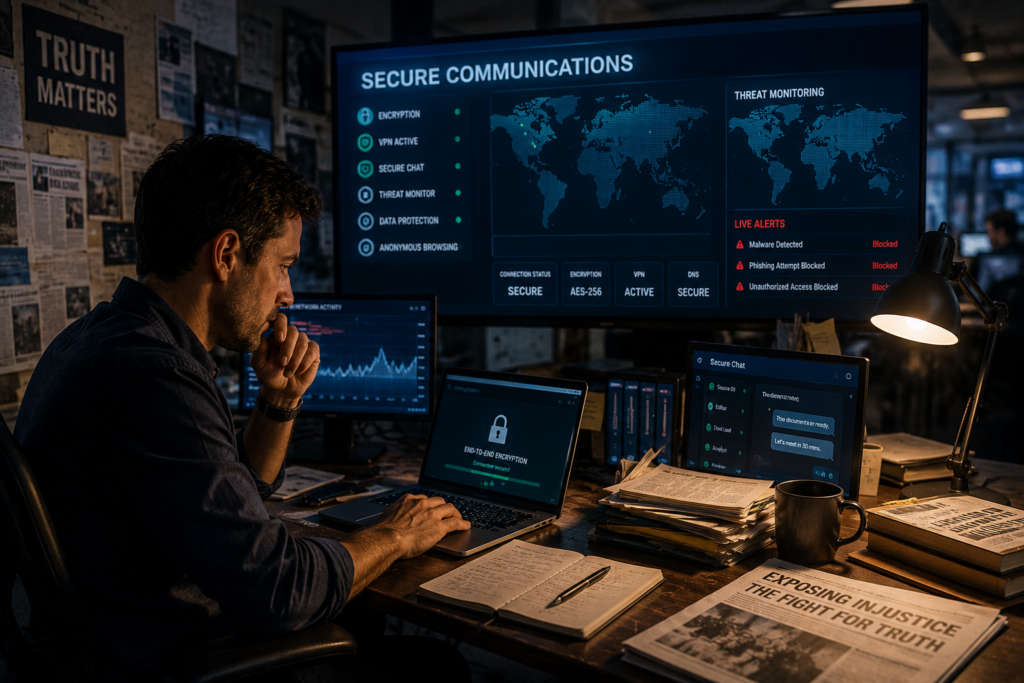
The cyber threats facing reporters continue to evolve rapidly. Artificial intelligence has made phishing more convincing, commercial spyware has become increasingly sophisticated, and metadata collection now occurs at an unprecedented scale.
Understanding these risks is the first step toward choosing the right privacy tools for journalists.
Phishing Attacks
Phishing remains the most common entry point for attackers.
Today’s phishing emails are no longer filled with spelling mistakes.
They often include:
- Personalized greetings
- Real newsroom branding
- Fake document-sharing requests
- Calendar invitations
- Secure portal logins
AI-generated messages make fraudulent emails nearly indistinguishable from legitimate correspondence.
Always verify unexpected requests through a second communication channel.
Spyware and Surveillance Software
Commercial spyware has become a major concern for investigative journalists.
Modern spyware can silently access:
- Microphones
- Cameras
- Contacts
- Messages
- Files
- GPS location
In several internationally reported cases, investigative reporters discovered infections only after independent forensic analysis.
Keeping operating systems updated and minimizing unnecessary app installations significantly reduces risk.
State-Sponsored Cyber Threats
Investigative reporting involving corruption, organized crime, national security, or political affairs increasingly attracts well-funded attackers.
Unlike ordinary hackers, these groups possess:
- Significant financial resources
- Advanced malware
- Zero-day exploits
- Long-term persistence
Their objective often isn’t immediate theft.
Instead, they quietly monitor investigations for months.
This is why experienced journalists rely on multiple digital security tools for journalists rather than depending on one application.
Social Engineering Attacks
Attackers frequently exploit human psychology instead of technical vulnerabilities.
Common tactics include:
- Fake technical support
- Impersonating editors
- Fake legal notices
- False interview requests
- Conference invitations
The most successful attacks manipulate trust rather than software.
Metadata Tracking
Even encrypted communication generates metadata.
Attackers may determine:
- Communication frequency
- Device locations
- Travel schedules
- Source relationships
Using privacy-focused browsers, VPNs, anonymous communication tools, and encrypted messaging platforms helps minimize metadata collection.
Device Compromise
Laptops and smartphones now store nearly every aspect of an investigation.
If compromised, attackers may access:
- Draft stories
- Interview recordings
- Contact databases
- Authentication tokens
- Cloud storage
Full-device encryption combined with biometric security and strong passwords provides an essential layer of protection.
Public Wi-Fi Risks
Airports, hotels, cafés, and conferences remain attractive locations for cybercriminals.
Unsecured networks enable attackers to:
- Intercept traffic
- Launch phishing attacks
- Capture login credentials
- Redirect users to fake websites
Whenever possible:
- Use a trusted VPN
- Avoid sensitive logins on unknown networks
- Disable automatic Wi-Fi connections
- Verify HTTPS before entering credentials
Best Privacy Tools for Journalists
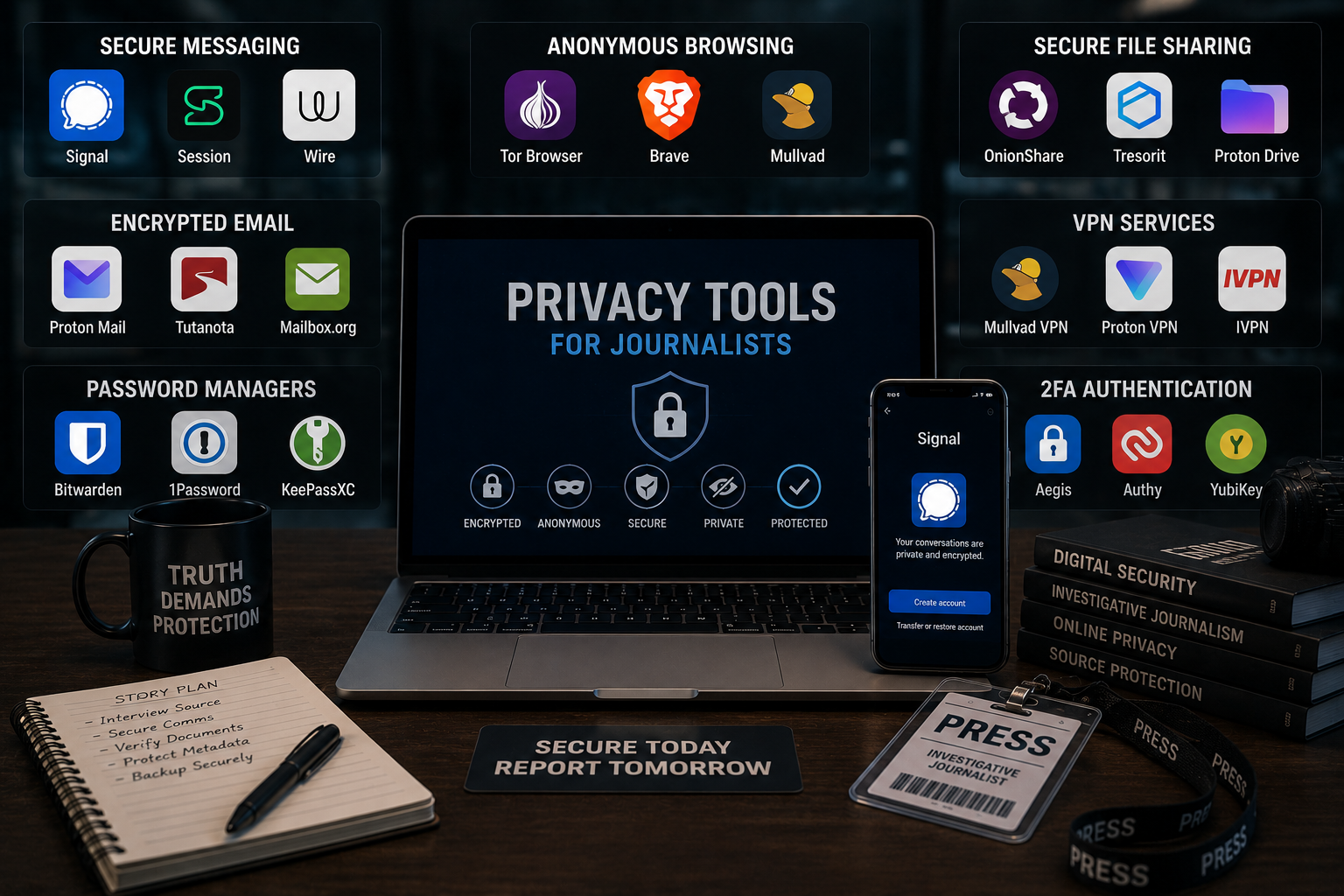
No single application solves every security challenge. The strongest protection comes from combining complementary privacy tools for journalists into a layered security strategy. In the next section, we’ll explore the best encrypted messaging apps, secure email providers, password managers, anonymous browsing tools, VPNs, and secure collaboration platforms that investigative reporters rely on today.
Best Privacy Tools for Journalists
Choosing the right privacy tools for journalists isn’t about finding the most secure application in every category. It’s about selecting tools that work together without disrupting your reporting workflow. During newsroom security assessments, I often recommend starting with communication, then protecting passwords, devices, browsing, and cloud storage. This layered approach has consistently proven more effective than relying on a single security solution.
Secure Messaging Applications
Encrypted messaging is the foundation of secure communication for journalists. When evaluating messaging platforms, I focus on four factors: end-to-end encryption, metadata protection, open-source transparency, and ease of use for confidential sources.
Signal
Signal remains my first recommendation for most reporters.
Security Features
- End-to-end encryption by default
- Open-source cryptography
- Disappearing messages
- Screen security
- Encrypted voice and video calls
- Safety number verification
Advantages
- Extremely easy for sources to use
- Strong security reputation
- Minimal metadata collection
- Regular security audits
Limitations
- Requires a phone number during registration
- Contacts must also use Signal for encrypted conversations
Session
Session offers an alternative for journalists working in high-risk environments where anonymity is essential.
Advantages
- No phone number required
- Onion-style decentralized routing
- Reduced metadata exposure
- Strong anonymity protections
Limitations
- Slightly slower message delivery
- Smaller user base than Signal
Wire
Wire is well suited for newsroom collaboration.
Advantages
- Secure group conversations
- File sharing
- Voice and video conferencing
- Business collaboration features
Limitations
- Fewer users outside professional environments
Encrypted Email Solutions
While encrypted messaging is ideal for day-to-day conversations, email remains important for exchanging longer documents and communicating with organizations.
Proton Mail
One of the most trusted encrypted email services available.
Best for
- Confidential reporting
- Secure source communication
- Encrypted attachments
- Cross-device access
Tutanota
A privacy-focused email provider with built-in encryption and encrypted calendars.
Strengths
- Excellent privacy protections
- User-friendly interface
- Strong European privacy standards
Mailbox.org
Popular among journalists seeking a traditional email experience combined with strong security features.
Best for
- Professional newsroom communications
- Secure business email
- Privacy-conscious organizations
Password Managers
Weak passwords continue to cause more newsroom breaches than sophisticated malware.
Professional digital security tools for journalists should always include a password manager.
Bitwarden
Ideal for most reporters.
Benefits
- Open source
- Strong encryption
- Cross-platform support
- Secure password generation
1Password
Excellent for investigative teams.
Strengths
- Easy sharing
- Travel mode
- Strong security architecture
KeePassXC
Perfect for journalists wanting complete local control.
Advantages
- Offline password storage
- Open source
- Highly customizable
Limitations
- Less beginner-friendly
Anonymous Browsing Tools
Online research can expose investigative interests through browser tracking.
Tor Browser
Essential when researching sensitive subjects.
Best for
- Anonymous browsing
- Protecting IP addresses
- Accessing onion services
- Investigative research
Brave Browser
Provides strong privacy without dramatically changing browsing habits.
Benefits
- Built-in tracker blocking
- Fingerprinting protection
- Private browsing improvements
Mullvad Browser
Designed specifically to reduce browser fingerprinting.
Excellent for journalists handling particularly sensitive investigations.

Secure Communication for Journalists
Communication security extends far beyond encrypted messaging.
Every investigation should consider encryption, metadata, file transfers, identity verification, and collaboration.
End-to-End Encryption
Always choose platforms where only the sender and intended recipient can read messages.
Recommended tools:
- Signal
- Element
- Wire
Metadata Protection
Encryption protects message contents.
Metadata reveals:
- Communication frequency
- Contacts
- Time of communication
- Device information
Reduce metadata by:
- Using privacy-focused services
- Separating identities
- Avoiding unnecessary cloud synchronization
Secure File Sharing
Sensitive documents deserve the same protection as conversations.
Recommended tool:
OnionShare
Benefits include:
- Temporary file sharing
- Anonymous transfers
- No third-party cloud storage
- Works through Tor
Secure Video Calls
Investigative interviews increasingly occur online.
Recommended platforms:
- Signal
- Jitsi Meet
- Element
Avoid recording conversations unless absolutely necessary.
Source Communication Security
One lesson I’ve repeated in nearly every newsroom workshop is simple:
Never assume your source understands digital security.
Provide clear guidance before exchanging sensitive information.
Encourage sources to:
- Install secure messaging apps
- Enable disappearing messages
- Verify identities
- Avoid workplace devices
- Separate personal and investigative accounts
Operational security is a shared responsibility.
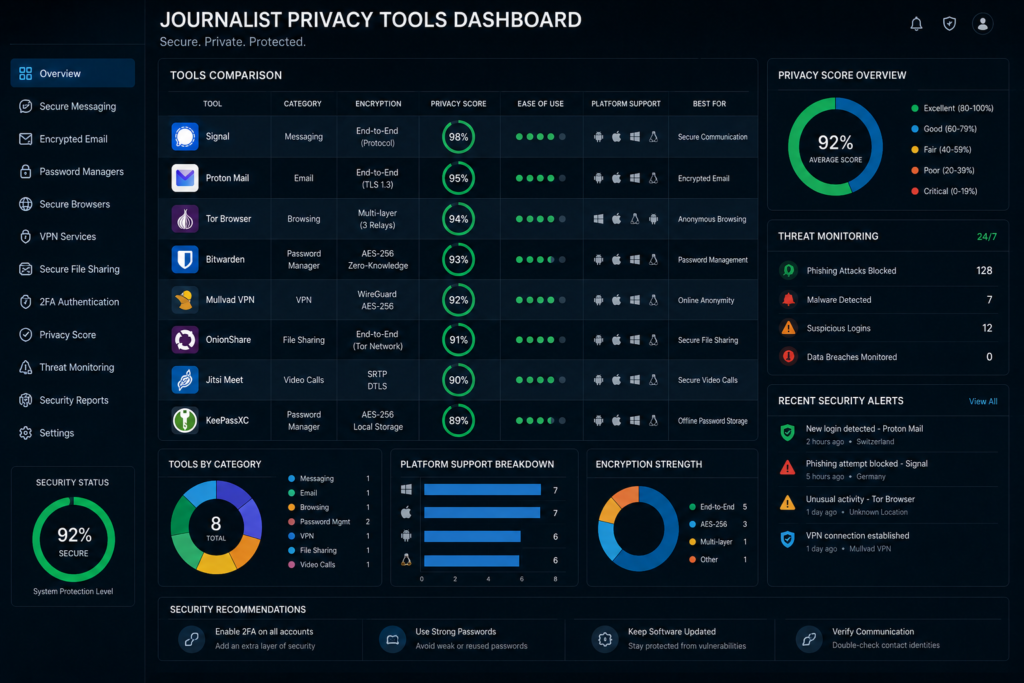
Comparison Table – Best Journalist Privacy Tools
| Tool | Category | Encryption | Ease of Use | Best Use Case |
|---|---|---|---|---|
| Signal | Secure Messaging | End-to-End | Excellent | Confidential conversations |
| Proton Mail | Encrypted Email | End-to-End | Excellent | Secure email communication |
| Tor Browser | Anonymous Browsing | Multi-layer Encryption | Moderate | Anonymous research |
| Bitwarden | Password Manager | AES-256 | Excellent | Password protection |
| OnionShare | File Sharing | Tor Encryption | Moderate | Anonymous document transfers |
| Mullvad VPN | VPN | WireGuard/OpenVPN | Excellent | Secure internet access |
Expert Recommendations
If you’re starting from scratch, prioritize your security investments in this order:
- Password manager
- Multi-factor authentication
- Signal
- Full-disk encryption
- VPN
- Secure cloud storage
- Tor Browser for sensitive investigations
Digital Security Tools for Journalists Beyond Communication
Strong communication alone cannot secure an investigation.
Every device, account, and backup should also be protected.
VPN Services
VPNs encrypt internet traffic and reduce exposure on public networks.
Recommended services:
Mullvad VPN
- Anonymous account creation
- No email required
- Excellent privacy reputation
Proton VPN
- Strong privacy features
- Secure Core servers
- Integrated with Proton ecosystem
IVPN
- Transparent privacy practices
- Minimal logging
- Excellent independent reputation
Device Encryption
Every investigative laptop should use full-disk encryption.
Recommended solutions:
- FileVault (macOS)
- BitLocker (Windows)
- VeraCrypt (Cross-platform encrypted containers)
Secure Cloud Storage
Choose providers offering end-to-end encryption.
Recommended options:
- Tresorit
- Proton Drive
- Sync.com
Multi-Factor Authentication
Enable MFA on every important account.
Use:
- Authentication apps
- Hardware security keys
- Recovery codes stored securely
Avoid SMS authentication whenever stronger options are available.
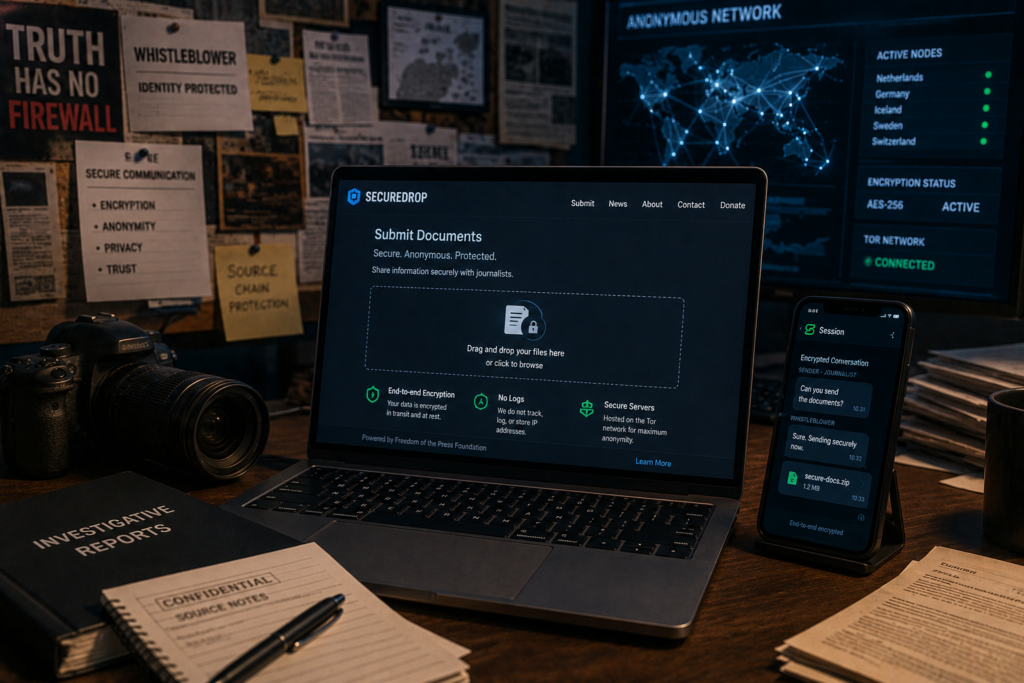
Anonymous Communication Tools for Sensitive Investigations
Sometimes ordinary encrypted messaging isn’t enough.
Anonymous communication protects both journalists and whistleblowers.
SecureDrop
Used by many major news organizations.
Allows confidential source submissions through Tor.
Ideal for:
- Leaked documents
- Whistleblower communications
- Anonymous evidence
OnionShare
Allows secure anonymous document transfers without relying on cloud providers.
Excellent for exchanging investigative materials.
Tor Hidden Services
Organizations can operate services accessible only through Tor.
Benefits include:
- Hidden infrastructure
- Increased anonymity
- Reduced exposure
Anonymous Tip Submission Systems
Secure tip portals encourage confidential reporting while protecting source identities.
Always establish verification procedures before publishing anonymously submitted information.
Privacy Best Practices Every Journalist Should Follow
Technology is only effective when paired with disciplined habits.
Best practices include:
- Use unique passwords for every account.
- Store passwords in a password manager.
- Enable multi-factor authentication.
- Encrypt every laptop and smartphone.
- Keep software updated.
- Create encrypted backups.
- Practice threat modeling before major investigations.
- Separate personal and investigative identities.
- Verify confidential sources securely.
- Avoid public USB charging stations.
- Review account permissions regularly.
- Prepare devices before international travel.
In my experience, simple operational discipline prevents far more incidents than expensive security products.
Common Privacy Mistakes Journalists Make
Even experienced reporters occasionally make avoidable mistakes.
The most common include:
- Reusing passwords
- Sending sensitive documents through ordinary email
- Ignoring metadata
- Connecting to insecure public Wi-Fi
- Leaving devices unlocked
- Delaying software updates
- Sharing investigation files through consumer cloud services
- Using personal accounts for sensitive reporting
Almost every newsroom breach I’ve investigated involved multiple small mistakes rather than a single catastrophic failure.
Future Trends in Journalist Privacy and Digital Security
The next decade will introduce both greater risks and stronger defenses.
Emerging developments include:
- AI-assisted surveillance
- AI-generated phishing campaigns
- Privacy-preserving communication protocols
- Decentralized digital identities
- Quantum-resistant encryption
- Automated threat detection
- Secure collaborative investigation platforms
- Hardware-based identity verification
Journalists who continually update their operational security practices will remain significantly better prepared for these evolving threats.

Frequently Asked Questions
What are the best privacy tools for journalists?
The best privacy tools for journalists include Signal for secure messaging, Proton Mail for encrypted email, Bitwarden for password management, Tor Browser for anonymous browsing, OnionShare for secure file sharing, and Mullvad VPN for encrypted internet access. Together, these tools provide a strong foundation for protecting investigations and confidential sources.
Why is secure communication important for journalists?
Secure communication for journalists helps protect confidential sources, prevent unauthorized interception, reduce surveillance risks, and maintain the integrity of sensitive investigations. End-to-end encryption ensures that only the intended participants can read the contents of a conversation.
Which anonymous communication tools are safest for whistleblowers?
SecureDrop, OnionShare, Tor Hidden Services, and Signal are among the safest anonymous communication tools when configured correctly. They minimize exposure while allowing confidential documents and messages to be exchanged securely.
Do journalists need a VPN?
Yes. A VPN encrypts internet traffic, protects journalists using public Wi-Fi, reduces tracking, and helps secure online research. While a VPN does not replace encrypted messaging or secure browsers, it adds an important layer of protection to a comprehensive digital security strategy.
How can journalists protect confidential sources online?
Journalists should use end-to-end encrypted messaging, encrypted email, password managers, multi-factor authentication, full-disk device encryption, secure cloud storage, and privacy-focused browsers. Just as importantly, they should train sources on safe communication practices and apply consistent operational security throughout every stage of an investigation.
Conclusion
Modern journalism depends on trust, and trust depends on security. Whether you’re reporting on corruption, organized crime, corporate misconduct, or human rights violations, investing in reliable privacy tools for journalists is no longer optional. Secure messaging platforms, encrypted email services, password managers, VPNs, anonymous browsing tools, and encrypted storage all play a critical role in protecting sensitive information and preserving the confidentiality of sources.
The most effective secure communication for journalists comes from a layered approach. No single application can defend against every threat, but combining proven digital security tools for journalists with disciplined operational security dramatically reduces risk. Likewise, anonymous communication tools such as SecureDrop and OnionShare provide essential channels for whistleblowers and vulnerable sources to share information safely.
To deepen your knowledge and stay current with evolving best practices, consult respected organizations such as the Electronic Frontier Foundation (EFF), the Freedom of the Press Foundation, Signal, Proton, the Tor Project, OWASP, CISA, NIST, and the Committee to Protect Journalists (CPJ).
Digital threats will continue to evolve, but so will the tools and strategies available to defend against them. Make it a habit to review your security posture regularly, update your software, reassess your threat model, and strengthen your workflows. The time invested today can protect your investigations, your sources, and your reputation for years to come.
Author

razakh6402@gmail.com
Related Posts

Browser Security Extensions: Top Chrome Security Extensions & Privacy Browser Extensions You Need in 2026
- 0
- 2,358 words
best budgeting appsEvery year, browsers become smarter, websites become faster, and online services become more convenient. Unfortunately, cybercriminals evolve just as quickly....
Read out all
Passkeys: How Passwordless Authentication Is Replacing Passwords in 2026
- 0
- 2,452 words
If you’ve ever forgotten a password, reset the same account multiple times, or worried that your login credentials were exposed in a...
Read out all
Cybersecurity Checklist: Essential Small Business Cybersecurity Guide (2026)
- 0
- 2,462 words
Cyberattacks are no longer a problem reserved for large enterprises. Over the last 15 years, I’ve worked with startups, retail stores, healthcare...

Secure Cloud Storage: Best Secure Cloud Storage Services for Business & Personal Use (2026 Guide)
- 0
- 2,443 words
Whether you’re backing up family photos, sharing confidential client documents, or managing sensitive business files, choosing the right secure cloud storage service...

AI Scams: How to Protect Yourself from AI-Powered Scams in 2026 (Expert Guide)
- 0
- 1,918 word
Artificial intelligence has transformed the way we work, communicate, and manage our finances. Unfortunately, cybercriminals have embraced the same technology to create...
Read out all
Future of Cybersecurity: Top Cybersecurity Trends 2026, AI Innovations, and Predictions for the Next Decade
- 1
- 2,173 words
Twenty-five years ago, cybersecurity focused primarily on protecting desktop computers, on-premises servers, and corporate networks. Firewalls, antivirus software, and perimeter defenses formed...
2 comments