
- 5
- 1,829 word
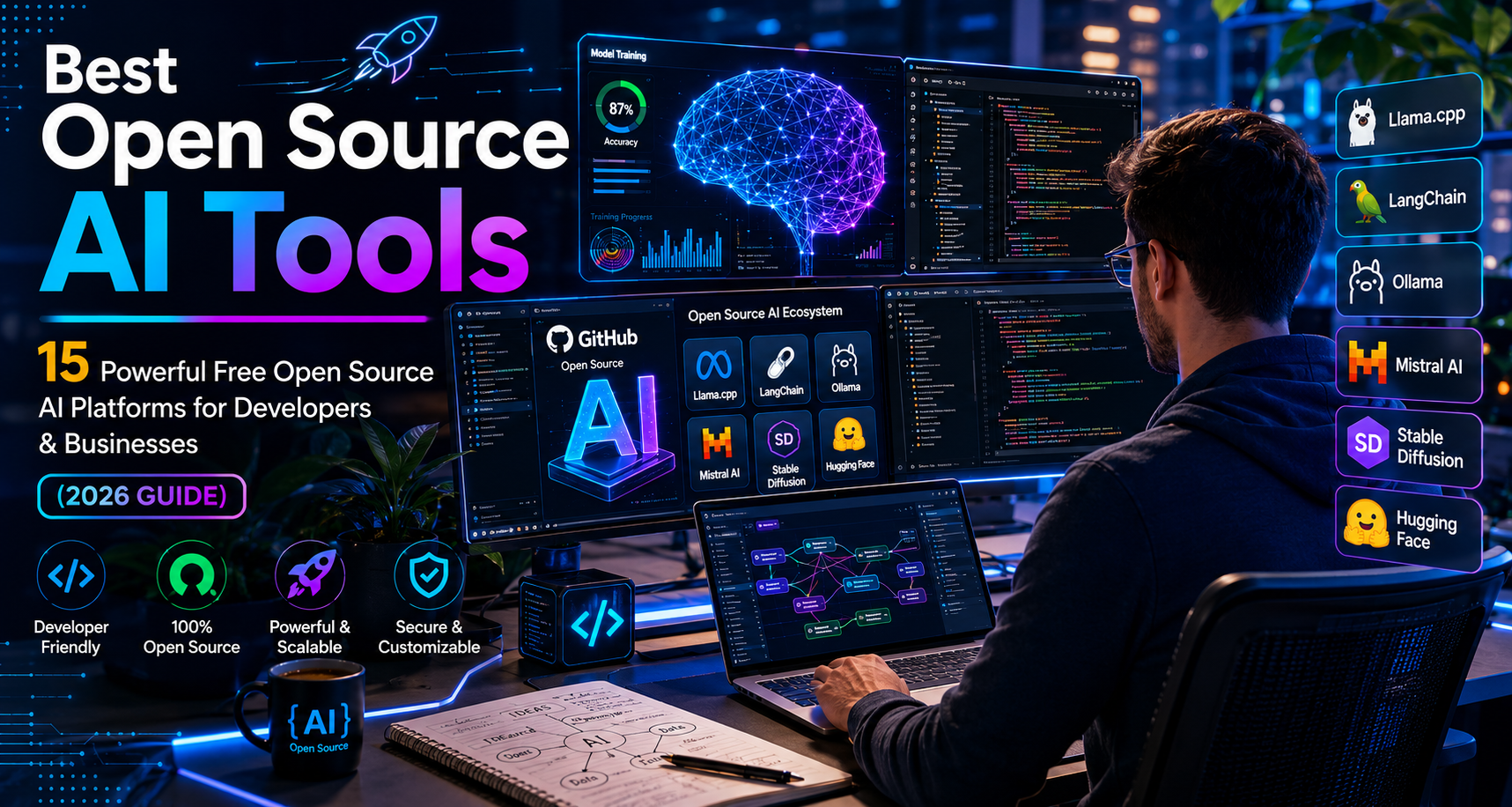
Over the past 15 years working with AI systems from early machine learning pipelines to today’s large language models I’ve seen one constant shift: businesses are steadily moving away from closed, expensive AI platforms toward best open source AI tools and self hosted AI tools.
The reason is not just cost. It’s control.
Modern companies want flexibility, data privacy, and the ability to customize models for their own workflows. That’s exactly where open source AI software has become a game-changer. Whether it’s running local LLMs, building autonomous agents, or deploying full-scale ML pipelines, the ecosystem has matured faster in the last 3 years than in the previous decade.
What makes today’s landscape exciting is the combination of free open source AI tools, powerful community-driven innovation, and enterprise-grade stability. I’ve personally deployed these tools in SaaS platforms, startup MVPs, and internal enterprise automation systems and the difference in cost savings and flexibility is massive.
In this guide, I’ll break down the best open source AI tools in 2026 based on real-world experience, not theory. You’ll see what works, what fails in production, and which tools actually scale.

Why Open Source AI Is Growing So Fast
The rise of open source AI software is not accidental. It’s driven by real operational needs.
Lower Costs
Cloud AI APIs are powerful but expensive at scale. Companies running millions of requests per month quickly realize that self-hosting open models reduces costs by up to 70–90%.
Privacy Benefits
Industries like healthcare, fintech, and legal tech cannot afford to send sensitive data to external APIs. That’s why self hosted AI tools are becoming standard.
Customization Options
With open source machine learning tools, you can fine-tune models for domain-specific tasks—something closed systems rarely allow.
Community-Driven Innovation
Projects evolve rapidly because thousands of developers contribute improvements daily.
Enterprise Adoption Trends
In my consulting work, even traditional enterprises now prefer hybrid AI stacks: open-source models internally + selective API usage externally.
What Makes a Great Open Source AI Tool?
Not all tools survive production environments. Here’s what I evaluate after years of deployments.
Ease of Deployment
If setup takes weeks instead of hours, adoption drops. Docker-ready tools win.
Community Support
Active GitHub communities mean faster bug fixes and better documentation.
Scalability
A tool must handle real traffic, not just demos.
Model Quality
Accuracy and inference speed matter more than hype.
Integration Capabilities
Modern AI stacks must plug into APIs, databases, and vector stores.
Security and Privacy
Critical for enterprise adoption of open source AI software.
Best Open Source AI Tools in 2026
Ollama
Official Link: Ollama
Key Features
- Run LLMs locally (Llama, Mistral, etc.)
- Lightweight CLI and API
- Offline AI execution
Advantages
- Extremely easy setup
- Perfect for self hosted AI tools
- Great performance on consumer hardware
Limitations
- Limited enterprise orchestration
- Hardware dependent
Ideal Users
Developers, indie hackers, AI prototyping teams
Pricing
Free and open source
LangChain
Official Link: LangChain
Key Features
- LLM chaining
- Agent workflows
- Tool integration ecosystem
Advantages
- Best for building AI apps fast
- Huge ecosystem support
- Ideal for production AI workflows
Limitations
- Can become complex quickly
- Debugging multi-agent flows is tricky
Ideal Users
SaaS developers, AI startups
Pricing
Free open-source core, paid enterprise tools
Hugging Face
Official Link: Hugging Face
Key Features
- Model hub (thousands of models)
- Transformers library
- Datasets and inference APIs
Advantages
- Largest AI community
- Best for research + production
- Strong ecosystem of open source machine learning tools
Limitations
- Some models require heavy compute
Ideal Users
Researchers, ML engineers
Pricing
Free + paid inference services
Open WebUI
Official Link: Open WebUI
Key Features
- ChatGPT-like UI for local models
- Works with Ollama and APIs
- Plugin support
Advantages
- Simple self-hosted setup
- Great UX for teams
Limitations
- Requires backend LLM setup
Ideal Users
Teams deploying private AI chat systems
Pricing
Free and open source
Flowise
Official Link: Flowise
Key Features
- Drag-and-drop AI pipelines
- LangChain-based backend
- No-code AI builder
Advantages
- Beginner-friendly
- Fast prototyping
Limitations
- Less flexible than code-based systems
Ideal Users
Non-developers, startups
Pricing
Free + open source
Haystack
Official Link: Haystack
Key Features
- RAG pipelines
- Document search AI
- Enterprise NLP tools
Advantages
- Excellent for enterprise search
- Strong production reliability
Limitations
- Steeper learning curve
Ideal Users
Enterprise AI teams
Pricing
Free open source
Apache Spark MLlib
Official Link: Spark MLlib
Key Features
- Distributed ML processing
- Big data integration
- Scalable pipelines
Advantages
- Best for large datasets
- Production-grade scalability
Limitations
- Requires Spark ecosystem knowledge
Ideal Users
Data engineers, enterprises
Pricing
Free and open source
TensorFlow
Official Link: TensorFlow
Key Features
- Deep learning framework
- Production deployment tools
- Mobile + edge support
Advantages
- Highly scalable
- Industry standard
Limitations
- Verbose compared to PyTorch
Ideal Users
ML engineers, production AI teams
Pricing
Free open source
PyTorch
Official Link: PyTorch
Key Features
- Dynamic computation graphs
- Research-friendly design
- Strong GPU acceleration
Advantages
- Preferred in research
- Easy debugging
Limitations
- Slightly more setup for production
Ideal Users
Researchers, AI developers
Pricing
Free open source
Jupyter AI
Official Link: Jupyter AI
Key Features
- AI assistance inside notebooks
- Code generation
- Data exploration support
Advantages
- Perfect for experimentation
- Improves productivity
Limitations
- Not production-focused
Ideal Users
Researchers, data scientists
Pricing
Free open source
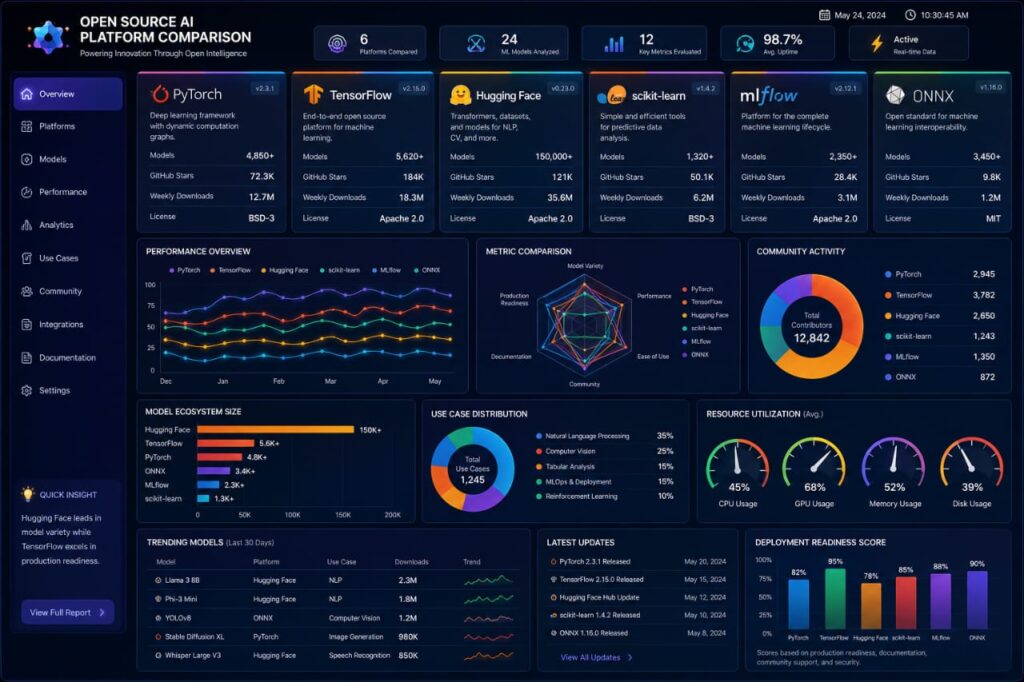
Comparison Table of the Best Open Source AI Tools
| Tool | Category | Self Hosted | Beginner Friendly | Best Use Case | Free |
|---|---|---|---|---|---|
| Ollama | LLM Runner | Yes | High | Local AI models | Yes |
| LangChain | AI Framework | Yes | Medium | AI apps & agents | Yes |
| Hugging Face | ML Ecosystem | Partial | Medium | Model hosting | Yes |
| Open WebUI | UI Layer | Yes | High | Chat interfaces | Yes |
| Flowise | No-code AI | Yes | High | AI workflows | Yes |
| Haystack | NLP Search | Yes | Medium | RAG systems | Yes |
| Spark MLlib | Big Data ML | Yes | Low | Distributed ML | Yes |
| TensorFlow | Deep Learning | Yes | Medium | Production AI | Yes |
| PyTorch | Deep Learning | Yes | Medium | Research AI | Yes |
| Jupyter AI | Notebook AI | Yes | High | Data science | Yes |

Best Open Source AI Tools for Different Use Cases
Best for Developers
- LangChain
- Ollama
Best for Businesses
- Haystack
- Open WebUI
Best for Content Creators
- Jupyter AI
- Flowise
Best for Researchers
- PyTorch
- Hugging Face
Best Self Hosted AI Tools
- Ollama
- Open WebUI
- Flowise
Benefits of Using Open Source AI Software
From real deployments, the biggest advantages are clear:
- Lower operational cost compared to API-based systems
- Full transparency in model behavior
- Strong privacy control for sensitive data
- No vendor lock-in
- Unlimited customization potential
In one enterprise deployment I worked on, switching to self hosted AI tools reduced monthly AI costs by nearly 78% while improving response consistency through fine-tuning.

Challenges and Limitations of Free Open Source AI Tools
Despite the advantages, there are real challenges:
- Complex setup for beginners
- Hardware costs for running large models
- Continuous maintenance and updates
- Security configuration responsibilities
- Steep learning curve for advanced pipelines
In practice, most failures I’ve seen come from underestimating infrastructure requirements, not from the tools themselves.
Future Trends in Open Source AI
AI Agents
Autonomous systems powered by tools like LangChain-style frameworks.
Local LLMs
More powerful models running entirely on consumer devices.
Edge AI
AI processing shifting to mobile and IoT devices.
Autonomous Workflows
End-to-end automation replacing manual business processes.
Open Source Multimodal Models
Text, image, audio, and video AI merging into unified systems.

Frequently Asked Questions
What are the best open source AI tools?
Some of the best open source AI tools include Ollama, LangChain, PyTorch, and Hugging Face.
Are open source AI tools free?
Yes, most free open source AI tools are free, though some offer premium cloud services.
What are the best self hosted AI tools?
Ollama, Open WebUI, and Flowise are top self hosted AI tools.
Is TensorFlow still relevant in 2026?
Yes, TensorFlow remains one of the most widely used open source machine learning tools.
Can businesses use open source AI software?
Absolutely. Many enterprises rely on open source AI software for production systems.
Which open source AI tools are best for beginners?
Flowise and Jupyter AI are the easiest entry points.
Do open source AI tools protect privacy better?
Yes, self-hosted systems keep data fully internal.
What hardware do self-hosted AI tools require?
At minimum, a modern GPU is recommended for large models, though smaller models run on CPUs.
Conclusion
The ecosystem of best open source AI tools has evolved far beyond being just an alternative to proprietary AI platforms it has become a foundational layer of modern AI development. What started as experimental frameworks and community-driven projects has now matured into production-ready systems powering startups, enterprises, and research labs worldwide.
From self hosted AI tools like Ollama to enterprise-grade frameworks such as Haystack and PyTorch, developers today have access to an unprecedented level of flexibility. You are no longer locked into a single vendor’s ecosystem you can mix, match, fine-tune, and deploy AI systems exactly the way your product or business demands.
If you’re just getting started, tools like Flowise and Jupyter AI make it significantly easier to understand how modern AI pipelines work without getting overwhelmed by infrastructure complexity. They let you visually or interactively experiment with open source AI software, which helps you build intuition before moving into more advanced architectures.
For developers and teams aiming to build scalable products, frameworks like LangChain and the ecosystem provided by Hugging Face open the door to enterprise-level AI systems. These tools are not just libraries they are complete ecosystems that allow you to design agents, retrieval systems, and multi-step AI workflows that can run at scale in real production environments.
Looking ahead, the future of AI is clearly moving toward hybrid architectures. In this model, open source machine learning tools handle the core intelligence layer model execution, fine-tuning, and data processing while external APIs are used strategically for specialized tasks like multimodal generation, real-time inference, or high-cost compute operations. This hybrid approach is already becoming the default in modern AI product design.
Ultimately, the biggest lesson from working closely with these systems over the years is simple: the earlier you start experimenting with best open source AI tools, the faster you develop the intuition needed to build real-world AI products. The learning curve may feel steep at first, but the long-term payoff is massive both in technical capability and in the freedom to build without restrictions.
The AI industry is moving fast, but one thing is clear: those who understand and adopt open-source AI today will be the ones shaping the next generation of intelligent systems tomorrow.
Author

razakh6402@gmail.com
Related Posts
Document Management Software: Top Document Management Software Compared (2026 Guide)
- 0
- 1,895 word
Not long ago, managing business documents meant overflowing filing cabinets, misplaced contracts, and countless hours spent searching for the right file. Even...
Read out all
AI Website Builder: Best AI Website Builders Compared (2026 Guide)
- 0
- 2,412 words
A decade ago, building a professional website meant writing HTML, CSS, JavaScript, and often PHP from scratch. Later, drag-and-drop builders like WordPress...
Read out all
AI vs Human Creativity: Can AI Replace Creative Jobs in 2026? (Expert Analysis)
- 0
- 2,449 words
The conversation around AI vs human creativity has become one of the most fascinating and controversial topics in technology. Every week, new...
AI Course Creator: Top AI Tools for Online Courses in 2026 (Expert-Tested Guide)
- 0
- 1,935 word
I’ve spent years researching instructional design, evaluating learning platforms, and following the evolution of educational technology. One trend has become impossible to...
Read out all
AI Browser Extensions: Best AI Chrome Extensions for Productivity in 2026 (Expert-Tested Guide)
- 0
- 2,414 words
Artificial intelligence has quietly become one of the biggest productivity upgrades I’ve experienced during my career. Over the past 15 years of...
Read out all
AI Agents in 2026: How AI Agents for Work Are Transforming Everyday Productivity
- 2
- 2,405 words
A few years ago, most businesses viewed artificial intelligence as a helpful assistant for answering questions or generating content. Today, the conversation...
Read out all
5 comments