
- 0
- 1,821 word
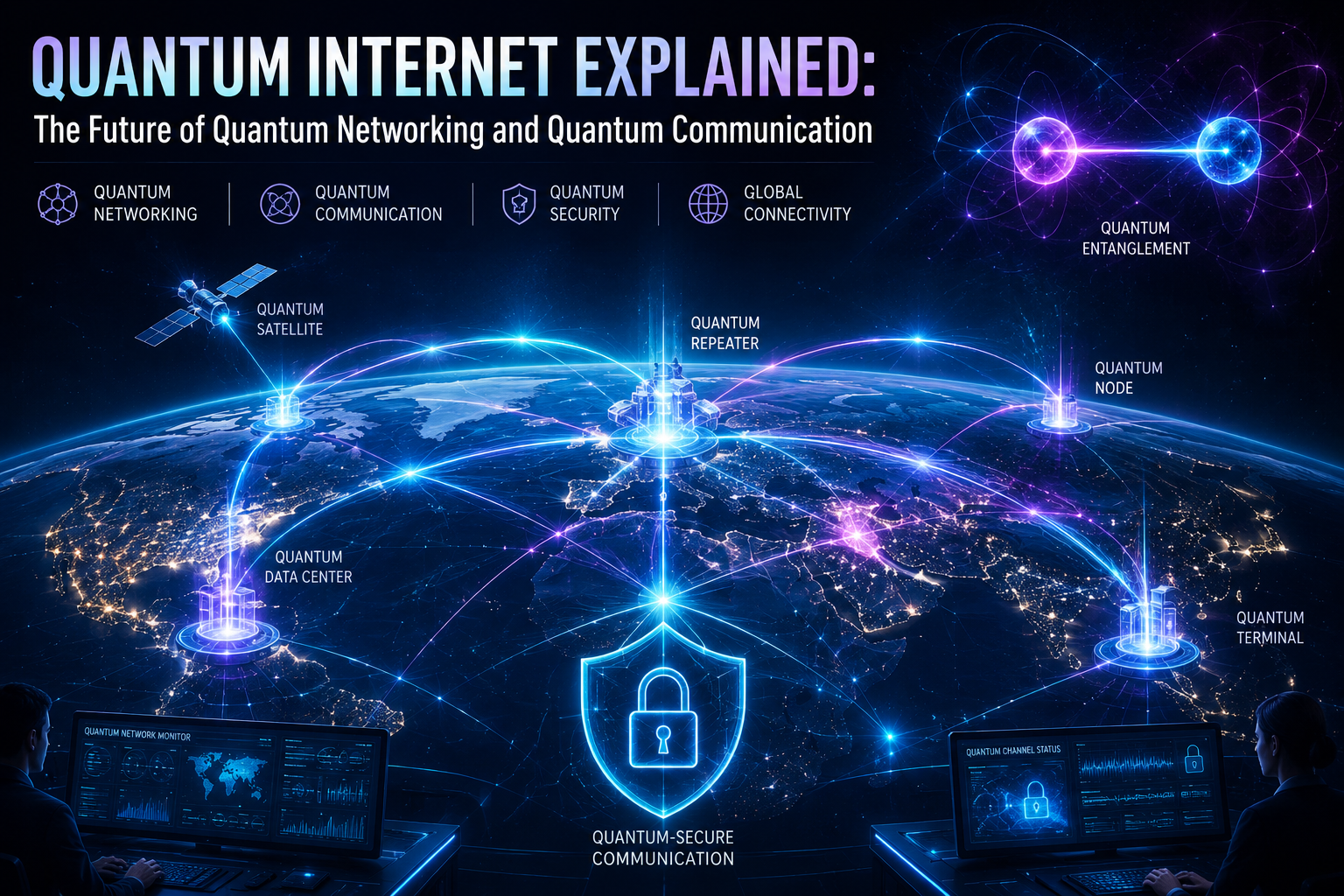
The internet has transformed nearly every aspect of modern life. From dial-up connections in the 1990s to today’s ultra-fast fiber networks, we have witnessed remarkable progress in digital connectivity. Yet after spending more than two decades working around networking technologies, telecommunications infrastructure, and cybersecurity systems, I believe the next revolutionary leap will not simply be a faster internet it will be the quantum internet.
When industry leaders discuss future communications, one question appears repeatedly: what is quantum internet, and why are governments, research institutions, and technology companies investing billions into its development?
The answer lies in a fundamentally different approach to transmitting information. Unlike traditional networks that move bits represented as zeros and ones, the quantum internet leverages the principles of quantum mechanics to create ultra-secure communication channels and entirely new networking possibilities.
In this comprehensive guide, you’ll discover quantum internet explained in simple language, learn how quantum networking functions, explore real-world applications, and understand why quantum communication may redefine global connectivity over the coming decades.
Quantum Internet Explained: Understanding the Basics
To understand what is quantum internet, we first need to understand how it differs from today’s internet.
The traditional internet transfers information through electronic or optical signals carrying bits. Every email, video stream, and website request relies on these digital bits.
The quantum internet uses quantum bits, commonly called qubits. These qubits can exist in multiple states simultaneously through a quantum property known as superposition.
At its core, quantum communication enables the transfer of quantum information rather than classical data alone.
Why Is the Quantum Internet Revolutionary?
Several characteristics make the quantum internet fundamentally different:
- Near-unbreakable security
- Quantum key distribution (QKD)
- Distributed quantum computing
- High-precision scientific synchronization
- Enhanced communication privacy
- New forms of networked computing
From my experience observing networking evolution over the last 25 years, major technological shifts occur when entirely new capabilities emerge. The internet enabled global communication. Cloud computing enabled scalable infrastructure. The quantum internet introduces capabilities that simply cannot exist on conventional networks.
How Quantum Networking Works
Understanding quantum networking becomes easier when we break it into its core components.
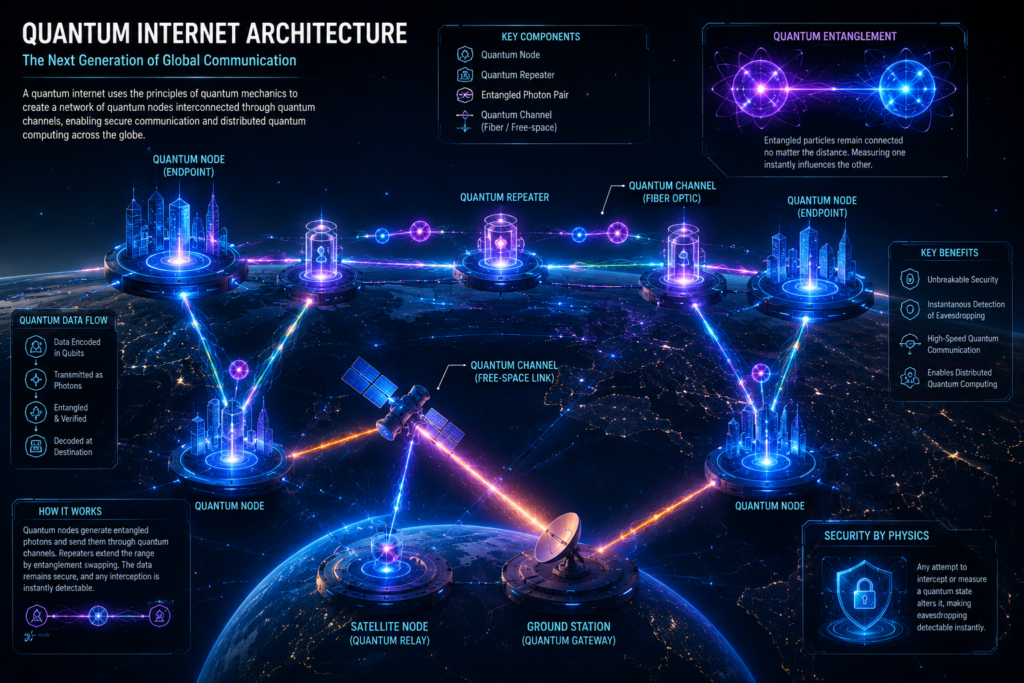
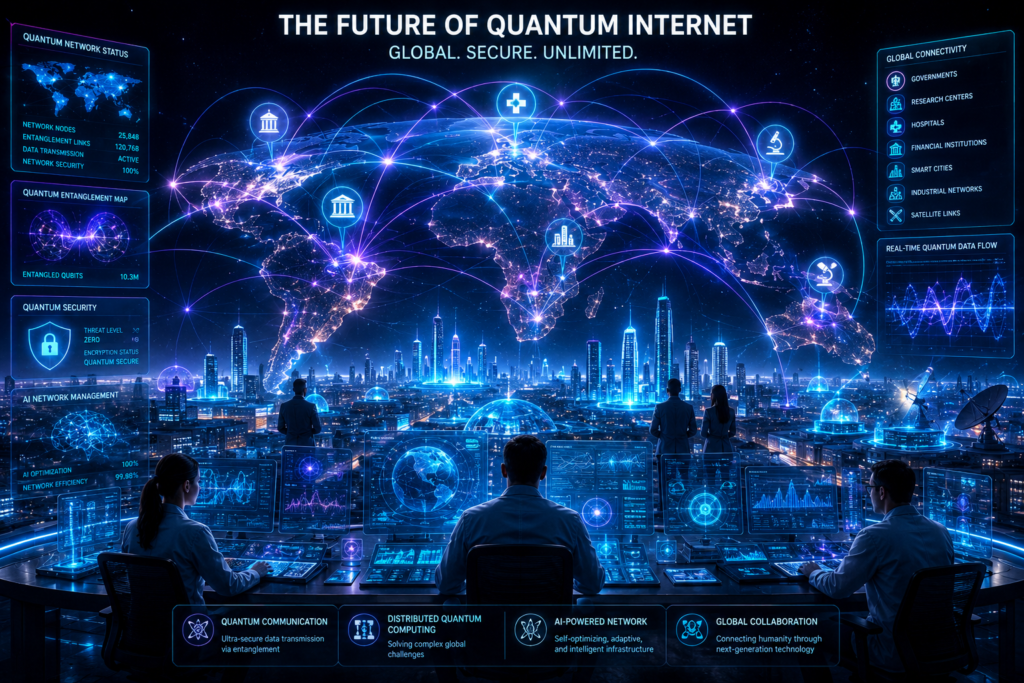
Quantum Entanglement
Quantum entanglement is one of the most fascinating concepts in modern physics.
When two particles become entangled, changes affecting one particle correlate with the other, regardless of distance.
For quantum communication, entanglement creates highly secure connections between quantum nodes.
Many researchers consider entanglement the backbone of future quantum networking systems.
Quantum Communication Channels
Quantum communication channels carry quantum information through:
- Fiber optic networks
- Free-space optical links
- Satellite-based communication systems
Unlike traditional channels, quantum communication channels can reveal interception attempts immediately, dramatically improving security.
Quantum Repeaters
One challenge facing the quantum internet is signal degradation.
Quantum repeaters extend communication distances by preserving and regenerating quantum states.
Without quantum repeaters, large-scale quantum networking would remain impractical.
Quantum Nodes
Quantum nodes act similarly to routers and servers in traditional networking.
These nodes:
- Store quantum information
- Process quantum data
- Exchange entangled particles
- Maintain network synchronization
Together, quantum nodes form the foundation of future quantum internet infrastructure.
Quantum Internet vs Traditional Internet
The easiest way to understand quantum internet explained is through direct comparison.
| Feature | Traditional Internet | Quantum Internet |
|---|---|---|
| Data Transmission | Binary bits | Quantum qubits |
| Security | Encryption-based | Physics-based security |
| Speed | High-speed digital transfer | Potentially transformative for specialized tasks |
| Encryption | Mathematical algorithms | Quantum key distribution |
| Reliability | Mature global infrastructure | Emerging technology |
| Infrastructure | Routers, switches, fiber optics | Quantum nodes, repeaters, entanglement networks |
| Applications | Web, cloud, video, email | Secure communications, distributed quantum computing, advanced research |
While the quantum internet may not replace conventional internet access, it can significantly enhance security and computational collaboration.
Real-World Quantum Internet Applications
The value of quantum communication extends far beyond research laboratories.
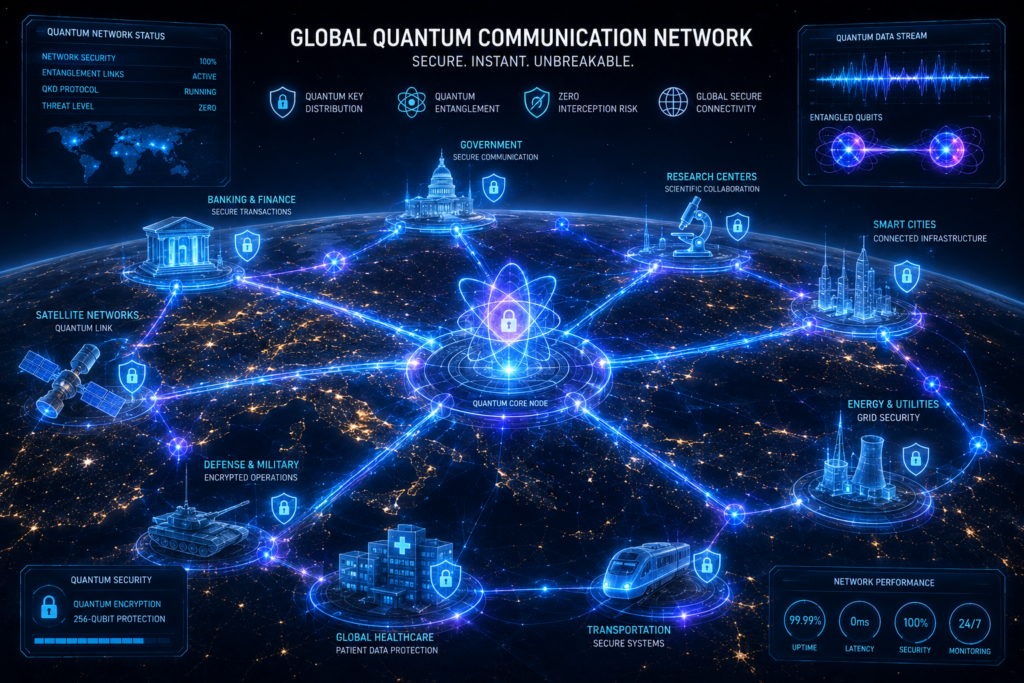
Ultra-Secure Financial Transactions
Banks process trillions of dollars in transactions annually.
Quantum encryption could protect:
- Cross-border payments
- Banking credentials
- Financial trading systems
- Digital asset platforms
Government Communications
Governments require highly secure communication systems.
The quantum internet offers protection against future cyber threats and quantum-enabled attacks.
Defense and National Security
Military organizations increasingly view quantum networking as a strategic technology.
Potential applications include:
- Secure command systems
- Intelligence sharing
- Battlefield communications
- Satellite communications
Healthcare Data Protection
Healthcare institutions manage sensitive patient information.
Quantum communication can strengthen data protection and compliance frameworks.
Scientific Research Networks
Researchers already collaborate globally.
Future quantum internet infrastructure could allow:
- Distributed quantum computing
- Shared quantum experiments
- Real-time scientific collaboration
Smart Cities and IoT
As billions of connected devices come online, security becomes increasingly important.
Quantum-enhanced networking may protect:
- Energy grids
- Transportation systems
- Water infrastructure
- Smart city platforms
Major Countries and Companies Leading Quantum Networking
Global competition in quantum networking continues to accelerate.
United States
The United States supports extensive research through government agencies, universities, and private companies.
China
China has become a global leader in quantum communication, particularly in satellite-based quantum networks.
European Union
The European Quantum Flagship initiative continues funding major quantum research projects.
Canada
Canadian institutions remain pioneers in quantum science and quantum computing development.
Japan
Japan continues investing heavily in advanced communication infrastructure and quantum technologies.
Leading Companies
Key industry players include:
- IBM
- Microsoft
- Intel
- Quantinuum
- Toshiba
Relevant resources:
- IBM Quantum
- Microsoft Quantum
- Google Quantum AI
- NIST
- IEEE
- Nature Research
- MIT Technology Review
- European Quantum Flagship
These organizations are actively shaping the future of quantum internet development.
Challenges Slowing Quantum Internet Adoption
Despite enormous promise, several obstacles remain.
Hardware Limitations
Quantum devices remain expensive and highly specialized.
Quantum Decoherence
Quantum states are extremely sensitive to environmental disturbances.
Maintaining stability remains one of the biggest technical challenges in quantum communication.
Infrastructure Costs
Building global quantum networking infrastructure requires significant investment.
Scalability Problems
Researchers must demonstrate reliable performance across large networks.
Lack of Global Standards
The industry still lacks universally accepted standards governing quantum networking systems.
From a practical perspective, every major networking revolution has faced similar challenges. Fiber-optic deployment took decades. Cloud computing adoption required years of infrastructure investment. The quantum internet will likely follow a similar trajectory.

The Future of Quantum Communication and Quantum Networking
The future of quantum communication appears exceptionally promising.
Quantum Cloud Computing
Organizations may eventually access distributed quantum computing resources through quantum-enabled networks.
Quantum Cybersecurity
Future cybersecurity systems will increasingly rely on quantum-safe technologies.
Quantum-Enabled AI Systems
Artificial intelligence and quantum computing may combine to solve highly complex problems.
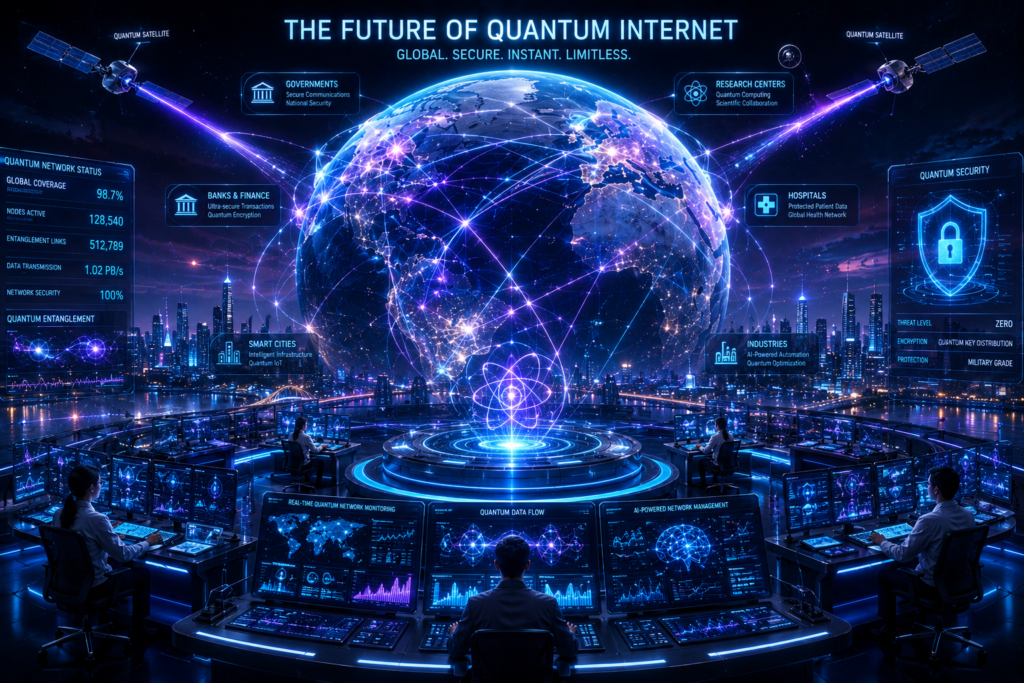
Global Quantum Communication Networks
National quantum networks will gradually connect across borders.
Intercontinental Quantum Internet
Researchers envision a truly global quantum internet spanning continents through terrestrial and satellite infrastructure.
Predictions for 2030
- National quantum networks become operational.
- Quantum-secure communications expand.
- Enterprise adoption increases.
Predictions for 2040
- International quantum networking expands.
- Quantum cloud services mature.
- Governments deploy larger-scale systems.
Beyond 2040
- Global quantum communication networks emerge.
- Quantum-enabled applications become mainstream.
- Hybrid classical-quantum networking becomes standard.
Latest Quantum Internet Statistics and Market Trends (2026)
Several indicators highlight growing momentum:
- Global quantum technology investments exceed billions of dollars annually.
- Government funding programs continue expanding worldwide.
- Major telecommunications providers are testing quantum communication infrastructure.
- Enterprise cybersecurity demand is accelerating quantum networking research.
- Quantum networking patents continue increasing year-over-year.
- International collaborations between universities and technology firms are growing rapidly.
- National quantum initiatives have launched across North America, Europe, and Asia.
Industry forecasts consistently identify the quantum internet as a critical long-term technology sector.
Expert Insights from 25 Years in Networking Technologies
Over the last 25 years, I have watched networking technology evolve through several transformational phases.
I remember when dial-up internet dominated connectivity. A simple web page could take several seconds to load.
Then broadband arrived.
Fiber optics followed.
Cloud computing reshaped enterprise infrastructure.
Cybersecurity evolved from simple antivirus software to sophisticated threat intelligence platforms.
Each technological shift changed how businesses operated.
What makes the quantum internet unique is that it is not merely an upgrade. It introduces a completely new communication model built upon the laws of physics.
In my view, the most significant impact will not be faster browsing speeds. Instead, it will be the unprecedented trust and security that quantum communication can provide.
Organizations increasingly recognize that future cyber threats will require fundamentally different security architectures. The quantum internet offers one possible solution.
Frequently Asked Questions (FAQs)
What is quantum internet?
The quantum internet is a next-generation communication network that uses quantum mechanics principles to transmit and secure information.
How does quantum communication work?
Quantum communication relies on quantum states, entanglement, and specialized transmission channels to exchange information securely.
Is quantum internet faster than traditional internet?
Not necessarily for everyday browsing. Its primary advantage lies in security and advanced computing capabilities.
What industries will benefit most?
Finance, healthcare, defense, government, telecommunications, and scientific research will benefit significantly.
Is quantum internet available today?
Limited pilot networks and research projects exist, but widespread deployment remains years away.
How secure is quantum networking?
Quantum networking can detect eavesdropping attempts, making communications significantly more secure.
Which countries are leading development?
China, the United States, European Union member states, Canada, and Japan lead quantum internet research.
Can quantum internet replace current internet?
Most experts expect a hybrid model where classical internet and quantum networking operate together.
What is quantum entanglement?
Quantum entanglement is a phenomenon where connected particles remain correlated regardless of distance.
When will quantum internet become mainstream?
Most analysts expect meaningful adoption between 2030 and 2040, with broader implementation occurring afterward.
Conclusion
Understanding what is quantum internet has become increasingly important as governments, enterprises, and technology leaders accelerate investments in next-generation communications.
As this quantum internet explained guide demonstrates, the technology combines quantum mechanics, advanced networking infrastructure, and innovative security models to create entirely new possibilities for global connectivity.
The future of quantum communication extends beyond secure messaging. It could transform financial systems, healthcare networks, defense communications, scientific collaboration, and distributed computing.
Significant challenges remain, including hardware limitations, scalability concerns, infrastructure costs, and standardization requirements. However, the trajectory resembles other major networking revolutions that initially seemed impractical before becoming indispensable.
The coming decades will determine how quickly quantum networking evolves from research laboratories into real-world infrastructure. Based on the pace of innovation, growing investment, and global competition, one conclusion appears increasingly clear: the quantum internet is no longer science fiction it is the next frontier of digital connectivity.
Author

razakh6402@gmail.com
Related Posts

Lead Generation Software: 12 Best Lead Generation Tools for B2B Sales (2026 Guide)
- 0
- 2,300 words
If someone had asked me 15 years ago what the biggest challenge in sales was, my answer would have been simple: finding...
Survey Software: 12 Best Online Survey Tools & Feedback Software for Businesses (2026 Guide)
- 0
- 1,871 word
Whether I was helping a SaaS startup validate a new feature, assisting an HR team with employee engagement, or optimizing customer experience...
Read out all
Online Course Platform: 12 Best LMS Software & eLearning Platforms for Course Creators (2026 Guide)
- 0
- 1,900 word
The online education industry has changed dramatically over the last 15 years. When I built my first digital training portal, simply uploading...

Team Communication Software: 12 Best Business Messaging Apps for Modern Workplaces in 2026 (Expert Tested)
- 0
- 2,305 words
I’ve personally tested dozens of team communication software platforms while consulting for marketing agencies, software companies, HR departments, remote development teams, and...
Invoice Software: 12 Best Invoicing Software for Small Business in 2026 (Expert Tested)
- 0
- 2,493 words
I’ve worked with freelancers chasing late payments, agencies managing hundreds of monthly invoices, startups scaling internationally, and established businesses struggling with outdated...

Generate one SEO-optimized title thatdigital asset management software
- 6
- 2,632 words
One of the most memorable projects I led involved migrating nearly half a million digital assets from a traditional file server into...