
- 0
- 2,052 words
25 when I first started working with connected home systems, the idea of controlling lights, security cameras, and appliances from a single device sounded like science fiction. Back then, home automation technology was expensive, unreliable, and available only to a small group of technology enthusiasts.
Fast forward to today, and smart home technology has become a mainstream part of everyday life. I have witnessed the transition from basic programmable thermostats to sophisticated AI smart home ecosystems capable of learning our habits, predicting our needs, and optimizing energy consumption automatically.
In this article, I’ll share my personal observations, industry insights, and predictions about the future smart homes that will transform how we live over the next decade.
Why Smart Home Technology Is Entering a New Era
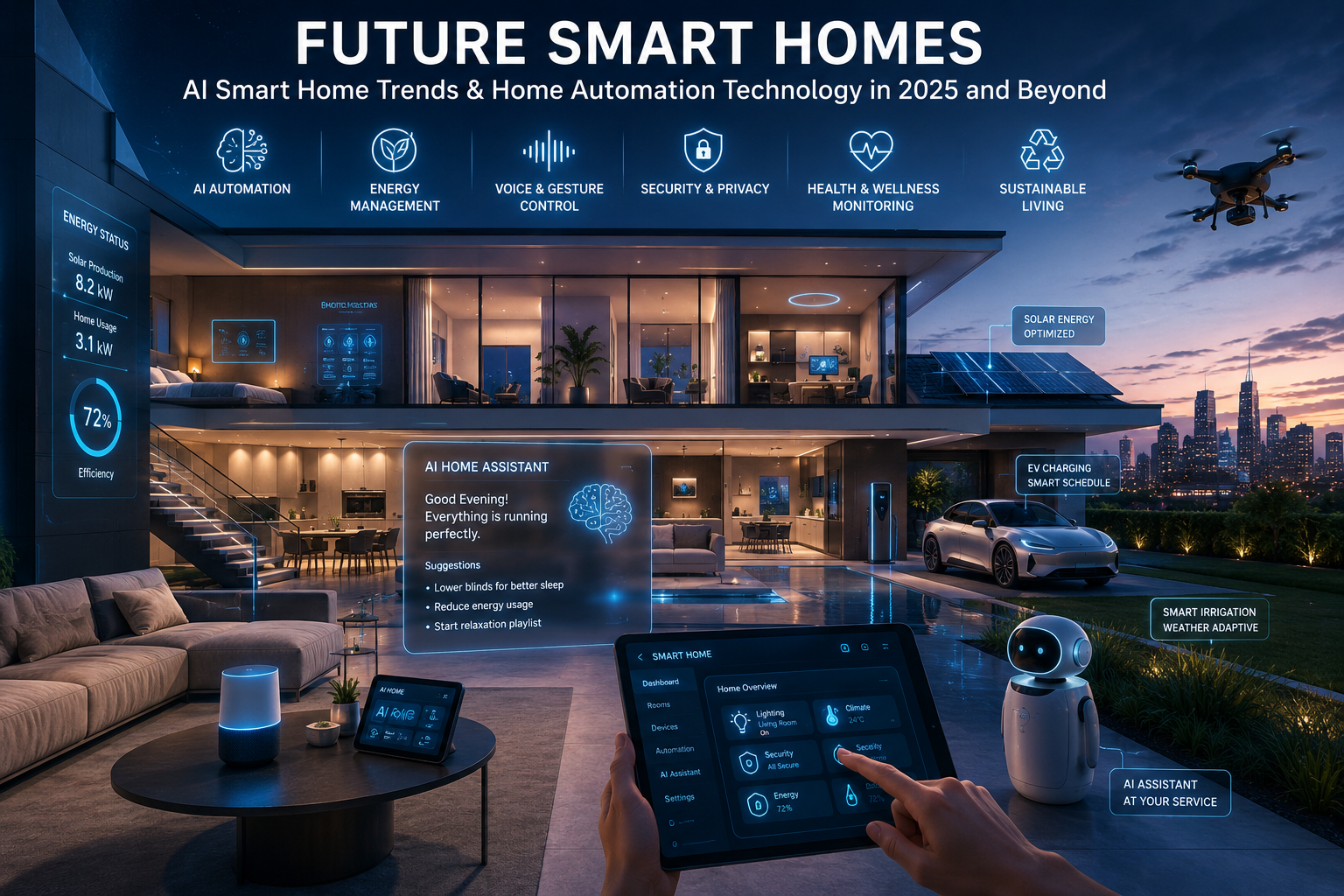
The biggest shift I have observed recently is that smart home technology is no longer focused on individual devices. Instead, the industry is moving toward fully integrated ecosystems.
A decade ago, homeowners purchased smart bulbs, cameras, and speakers separately. Today, consumers expect these devices to work together seamlessly.
The future smart homes of tomorrow will be built around three key pillars:
- Artificial Intelligence
- Predictive Automation
- Sustainable Living
These pillars are driving the latest smart home trends and reshaping the home automation technology landscape.
How AI Smart Home Systems Are Changing Everyday Living
The most significant advancement in smart home technology is artificial intelligence.

When I installed my first smart thermostat nearly two decades ago, it required constant manual adjustments. Today’s AI smart home systems learn occupant behavior automatically.
For example:
- Lights adjust based on occupancy.
- Thermostats optimize energy consumption.
- Security systems recognize family members.
- Appliances predict maintenance needs.
Companies like Google Nest and Amazon Alexa continue to invest heavily in AI smart home capabilities.
What impresses me most is how quickly these systems adapt. Modern AI smart home platforms can identify routines within days and create personalized automation scenarios.
Smart Home Trends Defining the Next Decade
Based on current industry developments and my own experience consulting on residential technology projects, several smart home trends are likely to dominate the future.
Hyper-Personalized Automation
Future smart homes will understand individual preferences.
Imagine entering your home and having:
- Lighting adjusted automatically.
- Preferred music playing softly.
- Temperature optimized.
- Work mode or relaxation mode activated instantly.
This level of personalization is becoming a reality thanks to advances in smart home technology and AI smart home systems.
Energy-Aware Homes
Rising energy costs have accelerated demand for intelligent energy management.
Modern home automation technology can:
- Monitor electricity consumption.
- Optimize HVAC systems.
- Coordinate solar panel usage.
- Manage battery storage.
According to the International Energy Agency (IEA), smart energy systems will play a crucial role in improving residential efficiency worldwide.
Predictive Maintenance
One emerging smart home trend that excites me is predictive maintenance.
Future smart homes will detect:
- Water leaks before damage occurs.
- HVAC performance degradation.
- Appliance failures.
- Electrical issues.
Instead of reacting to problems, homeowners will prevent them.
Comparison Table: Traditional Homes vs Future Smart Homes
| Feature | Traditional Homes | Future Smart Homes |
|---|---|---|
| Lighting | Manual operation | AI-powered automation |
| Security | Basic alarms | Intelligent monitoring |
| Energy Management | Limited control | Real-time optimization |
| Maintenance | Reactive repairs | Predictive maintenance |
| Climate Control | Manual settings | Adaptive AI smart home systems |
| Device Connectivity | Standalone devices | Fully integrated ecosystem |
| Personalization | Minimal | Highly personalized experiences |
| Cost Efficiency | Moderate | Long-term savings |
Home Automation Technology Will Become Invisible
One thing I often tell clients is that the best technology is the technology you barely notice.
In the early days, home automation technology required apps, remote controls, and constant management.
The future smart homes I envision will operate quietly in the background.
Technology will:
- Anticipate needs.
- Reduce manual interactions.
- Improve comfort automatically.
- Enhance safety without interruption.
This invisible automation represents the next stage of smart home technology evolution.
The Role of Voice and Conversational AI
Voice assistants have evolved significantly.
Initially, voice control was limited to simple commands such as turning lights on or off.
Today’s AI smart home assistants can understand context and natural language.
In future smart homes, homeowners may say:
“I’m going to bed.”
The system could then:
- Lock doors.
- Turn off lights.
- Adjust temperature.
- Activate security systems.
- Prepare morning routines.
This conversational interaction will become one of the most important smart home trends moving forward.
Security and Privacy in Future Smart Homes
As smart home technology expands, security becomes increasingly important.
Many homeowners ask me whether connected homes are safe.
My answer is simple:
They can be extremely secure if implemented correctly.
Recommended best practices include:
Strong Authentication
Use:
- Multi-factor authentication
- Biometric verification
- Password managers
Secure Networks
Invest in:
- Modern routers
- Encrypted Wi-Fi
- Separate IoT networks
Regular Updates
The latest home automation technology relies heavily on firmware updates to maintain security.
For additional cybersecurity guidance, homeowners can refer to resources from the Cybersecurity and Infrastructure Security Agency (CISA).
AI Smart Home Technology and Sustainable Living
Sustainability is becoming a major driver behind smart home trends.
Future smart homes will actively reduce environmental impact through:
Intelligent Energy Monitoring
Systems continuously analyze:
- Electricity usage
- Water consumption
- Appliance efficiency
Renewable Energy Integration
Smart home technology increasingly integrates:
- Solar panels
- Battery storage
- Electric vehicle charging
Automated Resource Optimization
AI smart home systems will automatically shift energy usage to periods when electricity rates are lower.
This not only reduces costs but also contributes to environmental sustainability.
The Rise of Smart Health Monitoring at Home
One area receiving significant attention is health-focused smart home technology.
Future smart homes may include:
- Sleep monitoring systems
- Air quality sensors
- Fall detection technology
- Wellness analytics
For aging populations, these innovations can dramatically improve independent living.
Over the last few years, I’ve seen healthcare providers increasingly collaborate with home automation technology companies to create safer living environments.
Smart Home Trends That May Surprise You
Some of the most exciting smart home trends are still emerging.
Digital Twins for Homes
Future smart homes may create virtual replicas of physical properties.
These digital models will help homeowners:
- Simulate energy usage
- Predict maintenance issues
- Optimize renovations
Autonomous Home Robots
Robotic assistants are becoming increasingly capable.
Future AI smart home ecosystems may include robots that:
- Clean automatically
- Deliver household items
- Monitor security
- Assist elderly residents
Context-Aware Homes
Smart home technology will increasingly understand emotional and behavioral context.
For example:
- Adjusting lighting during stressful periods.
- Promoting healthy sleep routines.
- Supporting productivity and wellness goals.
Challenges Facing the Future Smart Homes Industry
Despite rapid innovation, several challenges remain.
Interoperability
Many devices still struggle to communicate effectively.
The adoption of standards such as Matter Smart Home Standard is helping address this issue.
Privacy Concerns
Consumers remain cautious about data collection.
Manufacturers must prioritize transparency and data protection.
Cost Barriers
Although prices continue to fall, advanced home automation technology can still require substantial investment.
Fortunately, increased competition is making smart home technology more affordable every year.
My Predictions for Smart Home Technology by 2035
After 25 years of observing this industry evolve, I believe the future smart homes of 2035 will feature:
- Fully autonomous energy management.
- AI smart home assistants with near-human conversational abilities.
- Predictive health and wellness monitoring.
- Self-healing cybersecurity systems.
- Integrated robotics.
- Carbon-neutral home automation technology.
- Personalized environments adapting continuously to occupants.
Most importantly, smart home technology will become less visible and more helpful.
Homeowners won’t think about managing devices. Instead, homes themselves will manage daily life intelligently
Emerging Innovations That Will Shape Future Smart Homes Beyond 2035
While most discussions about smart home technology focus on the next five to ten years, some of the most transformative innovations are likely to emerge beyond 2035. From my experience following the industry for more than two decades, breakthrough technologies often arrive gradually and then suddenly become part of everyday life. The same pattern will likely define the future smart homes of the coming decades.
Ambient Intelligence Will Replace Traditional Interfaces
One of the biggest shifts I expect is the rise of ambient intelligence. Today, users still interact with apps, touchscreens, and voice assistants. However, future smart homes will rely less on direct commands and more on contextual understanding.
An advanced AI smart home system will recognize:
- Occupancy patterns
- Daily routines
- Environmental conditions
- Personal preferences
- Household schedules
Instead of asking your home to adjust settings, the system will understand what needs to be done and execute tasks automatically. This evolution represents the next major milestone in smart home technology.
Digital Health Ecosystems Inside Homes
Healthcare integration is rapidly becoming one of the most promising smart home trends. Future smart homes will function as proactive wellness environments rather than simply places to live.
Imagine waking up in a bedroom where sensors have already analyzed:
- Sleep quality
- Breathing patterns
- Room air quality
- Stress indicators
- Heart rate trends
An AI smart home platform could then recommend adjustments to lighting, temperature, nutrition, or daily activity levels.
I believe this area will become one of the fastest-growing segments of home automation technology because consumers are increasingly prioritizing preventive healthcare.
Smart Homes and Smart Cities Will Work Together
Another fascinating development is the convergence of smart home technology with smart city infrastructure.
Future smart homes may communicate directly with:
- Utility providers
- Public transportation networks
- Emergency services
- Energy grids
- Weather forecasting systems
For example, if severe weather is expected, your AI smart home system could automatically secure windows, charge backup batteries, and prepare emergency resources.
Similarly, connected energy networks may allow homeowners to sell excess solar energy back to the grid automatically. This level of integration will redefine how home automation technology contributes to broader community resilience.
The Growing Importance of Edge AI
One concern many homeowners have about smart home technology is privacy. Over the years, I’ve noticed increasing awareness around data security and ownership.
This is where Edge AI becomes important.
Instead of sending data to cloud servers, future smart homes will process much of their information locally.
Benefits include:
- Faster response times
- Better privacy protection
- Reduced internet dependency
- Improved system reliability
As AI smart home solutions mature, Edge AI will likely become a standard feature across the industry.
The Long-Term Vision for Future Smart Homes
Looking ahead, I believe future smart homes will evolve into intelligent living ecosystems that continuously learn, adapt, and improve. The combination of smart home technology, AI smart home capabilities, advanced sensors, renewable energy systems, and next-generation home automation technology will create homes that are safer, healthier, and more efficient than ever before.
The most successful smart home trends will not be those that showcase the most technology. Instead, they will be the innovations that make daily life simpler, more comfortable, and more meaningful. That is ultimately the true promise of smart home technology and the reason the future smart homes revolution is only beginning.
Final Thoughts: Why the Future Smart Homes Revolution Has Only Just Begun
Having spent more than two decades working with smart home technology, I can confidently say that we are still in the early stages of transformation.
The convergence of AI smart home innovation, advanced home automation technology, predictive analytics, and sustainability initiatives is creating opportunities we could only imagine a few years ago.
The most exciting aspect of future smart homes is not the technology itself. It is how these systems will improve comfort, safety, health, efficiency, and quality of life.
As smart home trends continue to evolve, homeowners who embrace intelligent automation today will be better prepared for the connected living experiences of tomorrow.
The future of smart home technology is not merely about smarter devices. It is about creating homes that truly understand, support, and enhance the lives of the people who live in them.
Author

razakh6402@gmail.com
Related Posts

Lead Generation Software: 12 Best Lead Generation Tools for B2B Sales (2026 Guide)
- 0
- 2,300 words
If someone had asked me 15 years ago what the biggest challenge in sales was, my answer would have been simple: finding...
Survey Software: 12 Best Online Survey Tools & Feedback Software for Businesses (2026 Guide)
- 0
- 1,871 word
Whether I was helping a SaaS startup validate a new feature, assisting an HR team with employee engagement, or optimizing customer experience...
Read out all
Online Course Platform: 12 Best LMS Software & eLearning Platforms for Course Creators (2026 Guide)
- 0
- 1,900 word
The online education industry has changed dramatically over the last 15 years. When I built my first digital training portal, simply uploading...

Team Communication Software: 12 Best Business Messaging Apps for Modern Workplaces in 2026 (Expert Tested)
- 0
- 2,305 words
I’ve personally tested dozens of team communication software platforms while consulting for marketing agencies, software companies, HR departments, remote development teams, and...

Invoice Software: 12 Best Invoicing Software for Small Business in 2026 (Expert Tested)
- 0
- 2,493 words
I’ve worked with freelancers chasing late payments, agencies managing hundreds of monthly invoices, startups scaling internationally, and established businesses struggling with outdated...

Generate one SEO-optimized title thatdigital asset management software
- 6
- 2,632 words
One of the most memorable projects I led involved migrating nearly half a million digital assets from a traditional file server into...