
- 0
- 1,953 word
If I were starting over in cybersecurity today, knowing what I know after 25 years in security operations centers, incident response teams, consulting engagements, penetration testing projects, and executive advisory roles, I would still choose cybersecurity without hesitation.
Few industries offer the combination of career stability, continuous learning, high earning potential, remote work opportunities, and meaningful impact that cybersecurity provides.
Organizations across every sector now depend on digital systems. At the same time, cybercriminals continue to launch ransomware attacks, credential theft campaigns, supply chain compromises, and AI-powered phishing operations. As a result, cybersecurity professionals have become some of the most sought-after specialists in the global workforce.
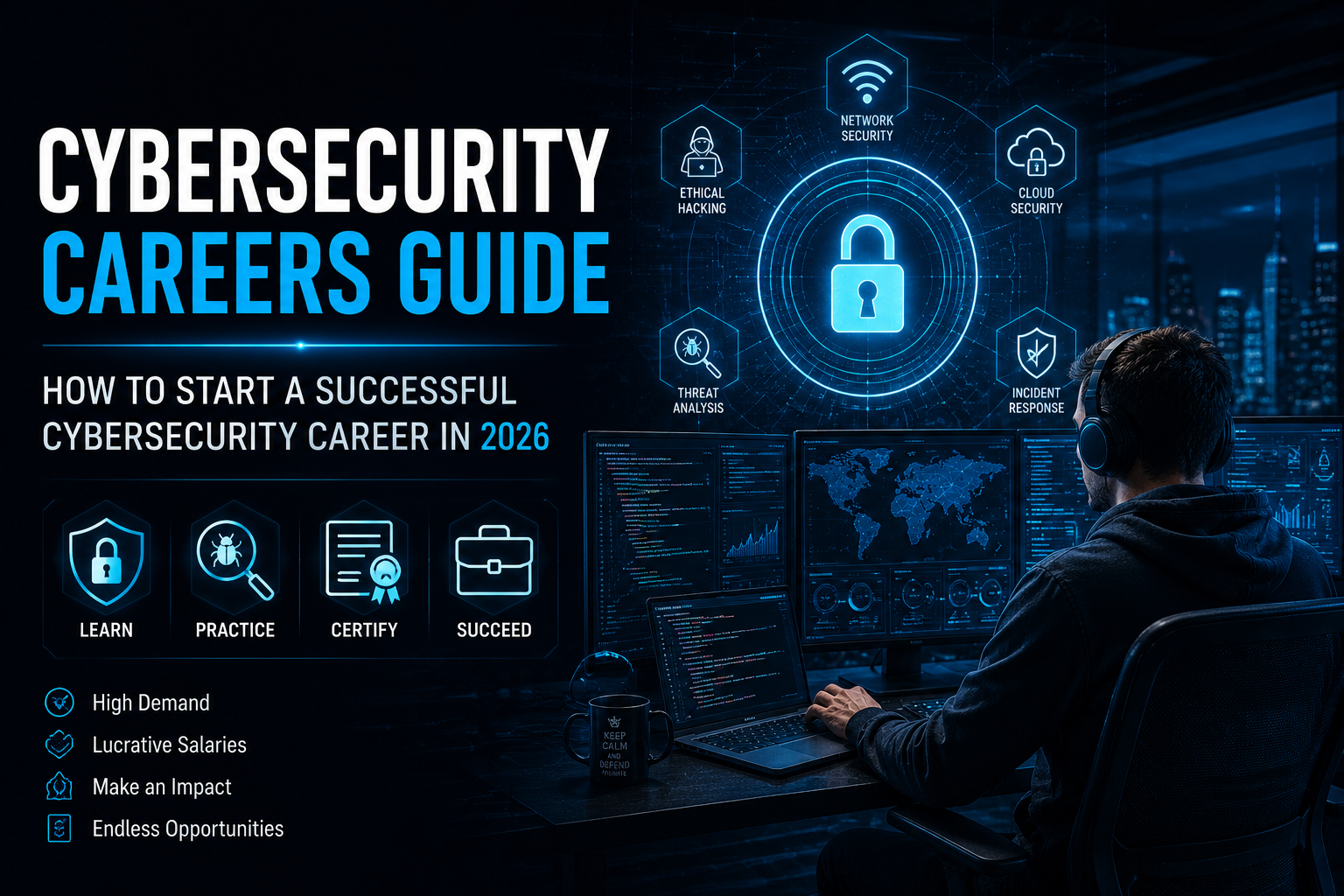
This cybersecurity jobs guide is designed for students, career changers, IT professionals, and anyone interested in building a successful cybersecurity career path. Whether you’re exploring entry level cybersecurity jobs or planning your journey toward becoming a security architect or Chief Information Security Officer (CISO), this guide provides a practical roadmap based on real-world experience.
One lesson I’ve learned after reviewing thousands of resumes and interviewing hundreds of candidates is simple: cybersecurity rewards practical skills far more than theoretical knowledge alone. The professionals who succeed combine technical expertise, curiosity, communication skills, and continuous learning.

Why Cybersecurity Careers Are Growing Faster Than Ever
The demand for cybersecurity talent continues to increase globally.
Several major trends drive this growth.
Global Cybercrime Growth
Cybercrime has evolved into a multi-trillion-dollar global economy. Organizations face constant threats from ransomware groups, nation-state actors, insider threats, and criminal syndicates.
Resources from IBM Security and CrowdStrike consistently highlight the growing sophistication of cyber attacks.
Talent Shortage
According to research from ISC2, millions of cybersecurity positions remain unfilled globally.
This skills gap creates significant opportunities for newcomers.
Digital Transformation
Organizations continue migrating applications, infrastructure, and data to cloud environments.
Every new cloud deployment creates security responsibilities.
AI-Driven Threats
Artificial intelligence now enables attackers to automate:
- Phishing campaigns
- Malware generation
- Social engineering attacks
- Vulnerability discovery
This increases demand for cybersecurity specialists capable of defending AI-powered environments.
Cloud Adoption
Cloud security has become one of the fastest-growing specialties within cybersecurity careers.
Professionals with cloud security expertise remain highly sought after.
How to Start Cybersecurity Career in 2026
Many beginners ask me the same question:
“How do I start a cybersecurity career if I have no experience?”
The answer is simpler than most people think.
Build Fundamental IT Skills
Cybersecurity builds upon IT.
Learn:
- Computer hardware
- Operating systems
- User administration
- Active Directory
- Virtualization
Learn Networking
Networking knowledge is essential.
Focus on:
- TCP/IP
- DNS
- DHCP
- Routing
- Switching
- VPNs
The majority of security investigations involve network traffic analysis.
Understand Operating Systems
Become comfortable with:
- Windows
- Linux
- Basic scripting
Most security tools interact directly with operating systems.
Learn Security Fundamentals
Study:
- Authentication
- Authorization
- Encryption
- Risk management
- Incident response
- Security frameworks
Helpful resources include:
Build Home Labs
One of the biggest mistakes beginners make is relying solely on courses.
Create a lab using:
- VirtualBox
- VMware
- Kali Linux
- Windows Server
Hands-on practice dramatically improves learning.
Gain Practical Experience
Volunteer.
Participate in:
- Capture The Flag competitions
- Bug bounty programs
- Open-source projects
- Security communities
Create Portfolio Projects
Build evidence of your skills.
Examples:
- Vulnerability assessments
- Threat hunting reports
- Security dashboards
- SIEM implementations
Apply for Entry Level Cybersecurity Jobs
Start with:
- SOC Analyst
- Security Analyst
- Vulnerability Analyst
- GRC Analyst
- Junior Penetration Tester
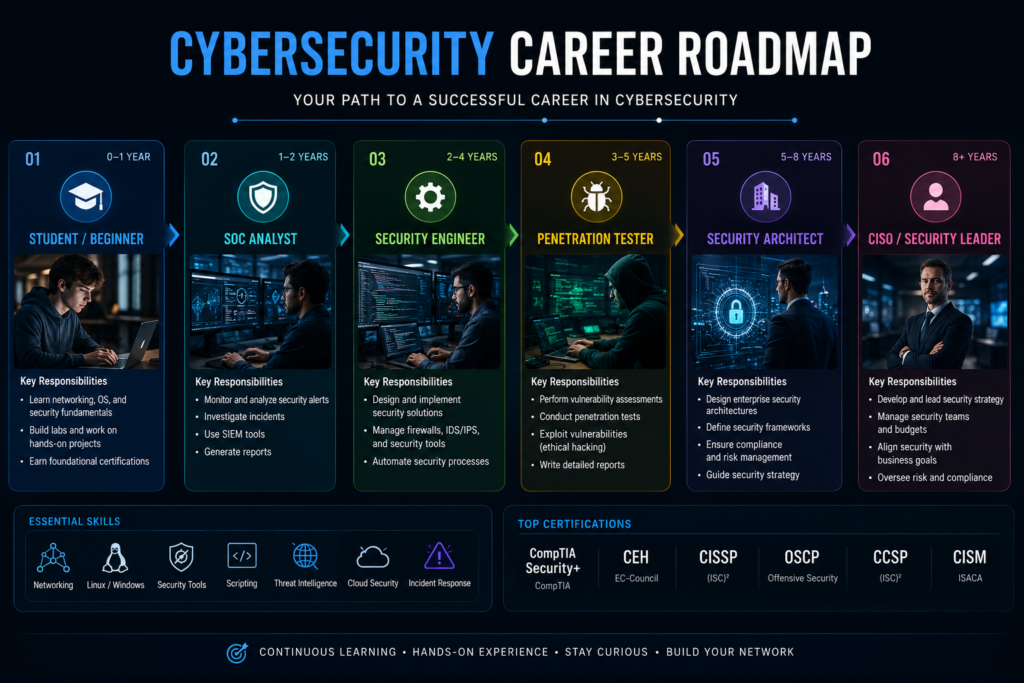
Cybersecurity Career Path Explained
| Career Stage | Role | Experience | Core Skills |
|---|---|---|---|
| Beginner | Security Intern | 0-1 Years | Networking, Linux, Security Basics |
| Entry Level | SOC Analyst | 0-2 Years | SIEM, Monitoring, Incident Handling |
| Early Career | Security Analyst | 2-4 Years | Threat Detection, Vulnerability Management |
| Mid Career | Security Engineer | 3-6 Years | Security Architecture, Automation |
| Specialist | Penetration Tester | 3-8 Years | Offensive Security, Exploitation |
| Specialist | Cloud Security Engineer | 3-8 Years | AWS, Azure, Identity Security |
| Advanced | Incident Responder | 5-10 Years | Forensics, Malware Analysis |
| Senior | Security Architect | 8-15 Years | Enterprise Security Design |
| Executive | CISO | 10-20+ Years | Leadership, Risk Management |
Key Takeaway
Cybersecurity is not a single career.
It is an ecosystem of specialized career paths.
Best Entry Level Cybersecurity Jobs
SOC Analyst
Typical Salary: $55,000–$85,000
Responsibilities:
- Monitor security alerts
- Investigate incidents
- Escalate threats
- Perform threat hunting
Best starting point for many professionals.
Security Analyst
Typical Salary: $65,000–$95,000
Responsibilities:
- Risk assessments
- Security monitoring
- Vulnerability management
IT Support to Security Transition
Many successful professionals begin in:
- Help Desk
- System Administration
- Network Administration
This remains one of the most realistic paths into cybersecurity careers.
Junior Penetration Tester
Typical Salary: $70,000–$100,000
Responsibilities:
- Vulnerability testing
- Security assessments
- Report writing
Vulnerability Analyst
Typical Salary: $65,000–$95,000
Responsibilities:
- Scanning infrastructure
- Prioritizing vulnerabilities
- Supporting remediation
GRC Analyst
Typical Salary: $65,000–$100,000
Responsibilities:
- Compliance
- Policy development
- Risk management

Best Cybersecurity Certifications for Career Growth
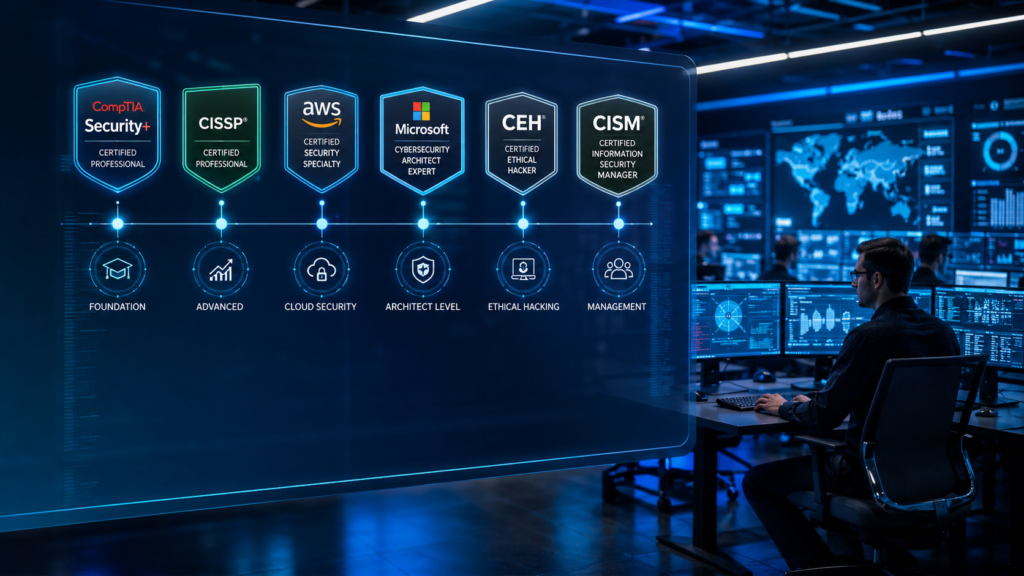
| Certification | Difficulty | Cost | Career Impact |
|---|---|---|---|
| Network+ | Beginner | Moderate | Foundation |
| Security+ | Beginner | Moderate | Excellent Entry Point |
| CySA+ | Intermediate | Moderate | SOC & Analyst Roles |
| CEH | Intermediate | High | Penetration Testing |
| CISSP | Advanced | High | Leadership Roles |
| AWS Security Specialty | Advanced | Moderate | Cloud Security |
| Microsoft Security Certifications | Beginner-Advanced | Moderate | Enterprise Security |
Professional Advice
Security+ remains one of the best first certifications for beginners.
However, certifications alone do not get jobs.
Hands-on experience consistently wins interviews.
Degree vs Certification vs Self-Learning
| Factor | Degree | Certification | Self-Learning |
|---|---|---|---|
| Cost | High | Medium | Low |
| Time | 3-4 Years | Months | Flexible |
| Employer Recognition | High | High | Varies |
| Practical Skills | Moderate | Moderate | High |
| ROI | Long-Term | Strong | Excellent |
The strongest candidates usually combine all three approaches.
Cybersecurity Salaries by Career Level
| Level | Salary Range |
|---|---|
| Entry Level | $55,000–$85,000 |
| Mid-Level | $90,000–$140,000 |
| Senior | $140,000–$220,000 |
| Architect | $180,000–$280,000 |
| CISO | $250,000–$500,000+ |
Salary varies based on geography, specialization, and industry.
Biggest Mistakes I See New Cybersecurity Professionals Make
- Chasing certifications without practical experience.
- Ignoring networking opportunities.
- Avoiding communication skill development.
- Focusing only on offensive security.
- Not building a public portfolio.
- Refusing entry-level opportunities.
- Expecting immediate six-figure salaries.
The best professionals remain humble learners.

Future of Cybersecurity Careers
High-growth specialties include:
AI Security
Protecting AI systems and machine learning environments.
Cloud Security
AWS, Azure, and multi-cloud security remain dominant growth areas.
Identity Security
Zero Trust initiatives drive strong demand.
Threat Intelligence
Organizations need analysts who understand attacker behavior.
Digital Forensics
Incident response and forensic investigations continue expanding.
Zero Trust Architecture
Organizations increasingly adopt identity-centric security models.
My 25-Year Career Advice for Anyone Starting Today
If I were mentoring my younger self, I would recommend:
- Learn networking first.
- Build projects immediately.
- Document everything publicly.
- Develop communication skills.
- Focus on solving business problems.
- Learn cloud security early.
- Network with professionals consistently.
- Stay curious.
Technology changes.
Fundamentals endure.
Frequently Asked Questions
What are cybersecurity careers?
Cybersecurity careers involve protecting systems, networks, applications, and data from cyber threats.
How to start cybersecurity career with no experience?
Build IT fundamentals, create labs, earn foundational certifications, and apply for entry level cybersecurity jobs.
What is the best cybersecurity career path?
The best cybersecurity career path depends on your interests, including SOC operations, cloud security, penetration testing, or leadership.
What are the best entry level cybersecurity jobs?
SOC Analyst, Security Analyst, Vulnerability Analyst, and GRC Analyst.
Do I need a degree for cybersecurity?
No. Many successful professionals enter through certifications and self-learning.
Which certification should I get first?
CompTIA Security+ is an excellent starting point.
Can cybersecurity jobs be remote?
Yes. Many organizations now offer remote and hybrid security roles.
Is cybersecurity a good career in 2026?
Absolutely. Demand continues growing across nearly every industry.
Conclusion
After spending more than 25 years working across security operations centers, incident response teams, penetration testing engagements, risk management programs, cloud security initiatives, and cybersecurity consulting projects, I can confidently say that cybersecurity remains one of the most rewarding and resilient career choices available today.
Unlike many technology fields that experience rapid cycles of growth and decline, cybersecurity continues to expand because cyber threats never stop evolving. Every organization from small startups and healthcare providers to multinational corporations and government agencies—depends on skilled professionals who can protect critical systems, sensitive data, and digital infrastructure. As businesses accelerate cloud adoption, embrace artificial intelligence, and expand remote work environments, the need for qualified cybersecurity talent continues to grow faster than the available workforce.
One of the biggest misconceptions I encounter is the belief that cybersecurity is only for highly technical individuals or computer science graduates. In reality, some of the most successful professionals I’ve worked with came from diverse backgrounds, including IT support, networking, military service, law enforcement, business administration, auditing, and even completely unrelated industries. What separates successful cybersecurity professionals from everyone else is not their starting point—it’s their willingness to learn, adapt, and solve problems continuously.
If you’re exploring cybersecurity careers for the first time, focus on building a strong foundation rather than chasing shortcuts. Learn networking. Understand operating systems. Practice in home labs. Participate in Capture The Flag competitions. Build projects that demonstrate your skills. Develop communication abilities alongside technical expertise. Employers consistently hire candidates who can explain security risks clearly and contribute to business objectives, not just those who collect certifications.
For professionals already working in technology, cybersecurity offers numerous specialization opportunities. Whether your interests lie in threat hunting, cloud security, penetration testing, digital forensics, governance and compliance, security engineering, threat intelligence, identity security, or executive leadership, there is a cybersecurity career path that aligns with your strengths and long-term goals.
The industry will continue to evolve over the next decade. Artificial intelligence will transform both cyber attacks and defensive operations. Cloud security will remain a critical focus area. Identity protection, Zero Trust architecture, threat intelligence, and security automation will become increasingly important. Professionals who embrace continuous learning and adapt to emerging technologies will be exceptionally well-positioned for future opportunities.
Most importantly, remember that cybersecurity is not simply a job—it is a profession built on trust, responsibility, and lifelong learning. Every skill you develop has the potential to help protect organizations, communities, and individuals from increasingly sophisticated threats.
Final Verdict
If I were advising someone starting from scratch in 2026, my recommendation would be straightforward:
- Build strong IT and networking fundamentals.
- Earn an entry-level certification such as CompTIA Security+.
- Create a home lab and gain hands-on experience.
- Build a portfolio showcasing real-world projects.
- Pursue entry level cybersecurity jobs such as SOC Analyst, Security Analyst, Vulnerability Analyst, or GRC Analyst.
- Continue developing specialized expertise in high-demand areas like cloud security, AI security, threat intelligence, identity security, or incident response.
For students and career changers, cybersecurity offers one of the clearest paths to long-term career growth, strong salaries, and global job opportunities.
For IT professionals, transitioning into cybersecurity can significantly increase earning potential and open doors to highly specialized roles.
For experienced security practitioners, the future remains incredibly promising as organizations continue investing heavily in cyber resilience, cloud protection, digital identity security, and advanced threat detection capabilities.
The cybersecurity careers landscape has never been more exciting. The demand is real, the opportunities are expanding, and the skills you build today will remain valuable for years to come. Whether your goal is landing your first entry level cybersecurity job, advancing along a specialized cybersecurity career path, or eventually becoming a Security Architect or Chief Information Security Officer (CISO), there has never been a better time to start.
The most important step is the first one. Begin learning, gain practical experience, stay curious, and commit to continuous improvement. Those who do will find cybersecurity to be not only a financially rewarding profession but also one of the most impactful careers in the modern digital world.
Author

razakh6402@gmail.com
Related Posts

Browser Security Extensions: Top Chrome Security Extensions & Privacy Browser Extensions You Need in 2026
- 0
- 2,358 words
best budgeting appsEvery year, browsers become smarter, websites become faster, and online services become more convenient. Unfortunately, cybercriminals evolve just as quickly....
Read out all
Passkeys: How Passwordless Authentication Is Replacing Passwords in 2026
- 0
- 2,452 words
If you’ve ever forgotten a password, reset the same account multiple times, or worried that your login credentials were exposed in a...
Read out all
Cybersecurity Checklist: Essential Small Business Cybersecurity Guide (2026)
- 0
- 2,462 words
Cyberattacks are no longer a problem reserved for large enterprises. Over the last 15 years, I’ve worked with startups, retail stores, healthcare...

Secure Cloud Storage: Best Secure Cloud Storage Services for Business & Personal Use (2026 Guide)
- 0
- 2,443 words
Whether you’re backing up family photos, sharing confidential client documents, or managing sensitive business files, choosing the right secure cloud storage service...

AI Scams: How to Protect Yourself from AI-Powered Scams in 2026 (Expert Guide)
- 0
- 1,918 word
Artificial intelligence has transformed the way we work, communicate, and manage our finances. Unfortunately, cybercriminals have embraced the same technology to create...
Read out all
Future of Cybersecurity: Top Cybersecurity Trends 2026, AI Innovations, and Predictions for the Next Decade
- 1
- 2,173 words
Twenty-five years ago, cybersecurity focused primarily on protecting desktop computers, on-premises servers, and corporate networks. Firewalls, antivirus software, and perimeter defenses formed...