
- 0
- 852 words
Over the past 25 years working in telecommunications and wireless networking, I have witnessed the industry evolve from basic voice-centric mobile networks to today’s ultra-connected digital ecosystem. The journey from 1G analog systems to sophisticated 5G architectures has transformed how people communicate, work, learn, and interact with technology.
Yet despite the global rollout of 5G still being underway in many regions, researchers, network operators, equipment vendors, and standards organizations are already investing heavily in 6G technology.
Why?
Because every generation of wireless technology has eventually encountered limitations. As artificial intelligence, immersive computing, autonomous systems, digital twins, and billions of connected devices become mainstream, the capabilities of current networks will no longer be sufficient.
The future of 6G is not simply about achieving faster download speeds. It represents a fundamental transformation toward intelligent, autonomous, AI-native connectivity capable of supporting applications that today exist only in research labs and futuristic concepts.
Organizations such as ITU, 3GPP, Nokia Bell Labs, Qualcomm Research, Ericsson, Samsung Research, Huawei, IEEE, and GSMA are actively shaping the vision for what may become the most transformative communications platform in history.
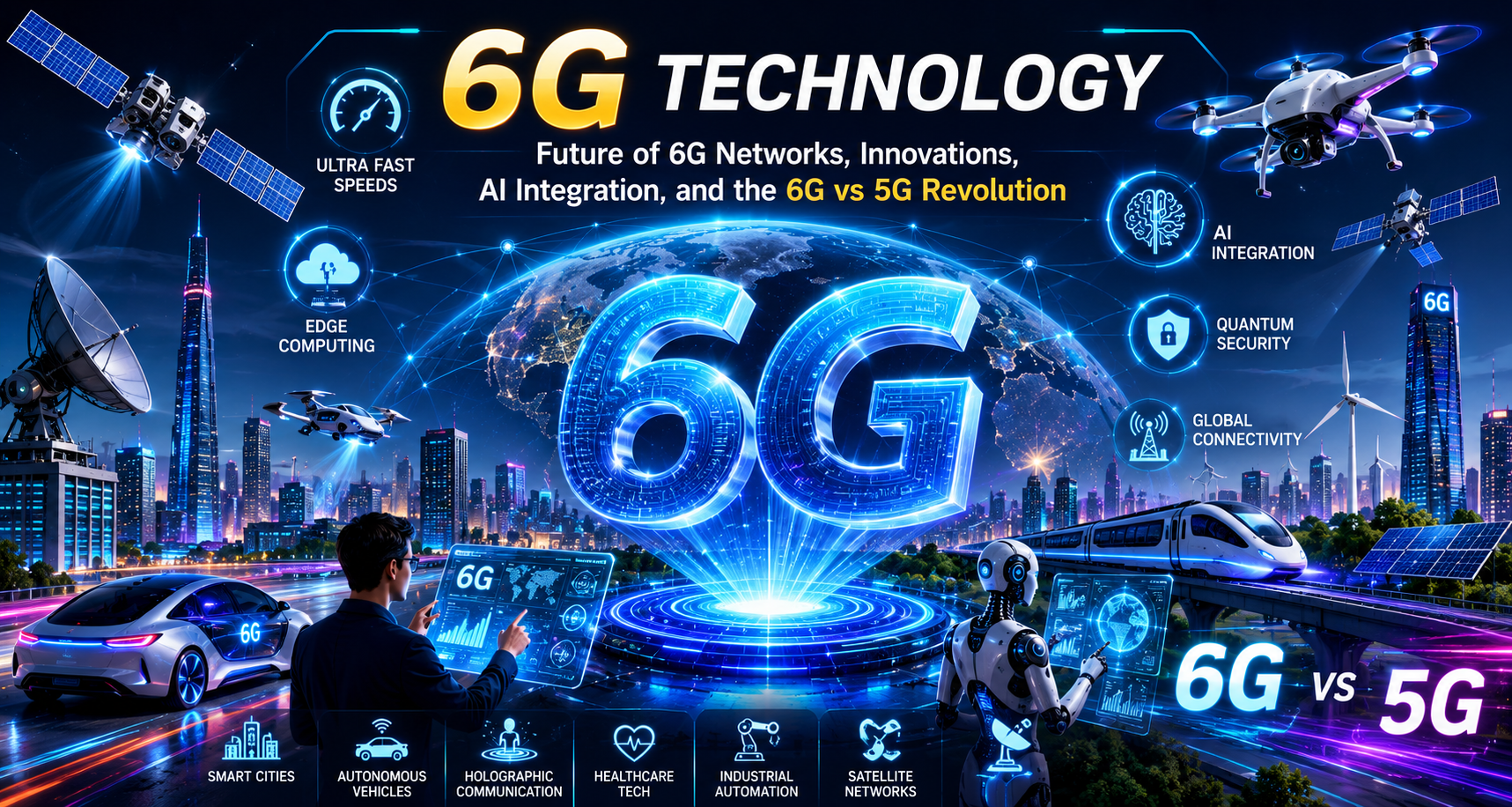
This article explores everything you need to know about 6G network technology, including how it works, how it compares with 5G, the industries it will transform, and what businesses should do today to prepare.
What Is 6G Technology?
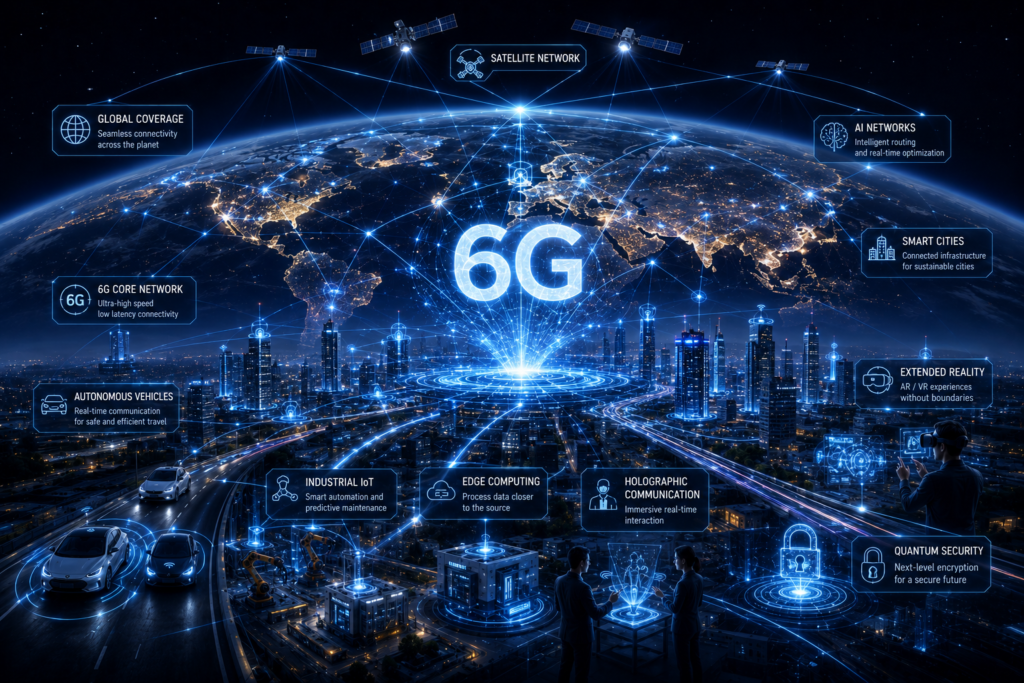
6G technology refers to the sixth generation of wireless communication systems expected to succeed 5G around 2030.
The vision extends beyond traditional mobile broadband by creating intelligent networks capable of integrating communications, computing, sensing, positioning, and artificial intelligence into a unified digital infrastructure.
Key goals include:
- Terabit-per-second data rates
- Sub-millisecond latency
- AI-native operations
- Global connectivity
- Integrated satellite communications
- Massive machine intelligence
- Sustainable energy-efficient networking
How 6G Differs From Previous Generations
Previous generations focused on specific objectives:
- 1G: Analog voice
- 2G: Digital voice and SMS
- 3G: Mobile internet
- 4G: Broadband mobility
- 5G: Massive connectivity and low latency
- 6G: Intelligent autonomous networks
Unlike earlier generations, 6G aims to merge communication and intelligence into a single ecosystem.
Why 6G Matters
The world is moving toward:
- Autonomous transportation
- Smart factories
- Digital twins
- Extended reality
- AI-driven economies
- Space-terrestrial integration
These technologies require capabilities beyond current networks.
The Evolution From 1G to 6G
Table 1: Network Evolution (1G–6G)
| Generation | Launch Period | Main Feature | Peak Speed |
|---|---|---|---|
| 1G | 1980s | Analog Voice | 2.4 Kbps |
| 2G | 1990s | Digital Voice & SMS | 64 Kbps |
| 3G | 2000s | Mobile Internet | 2 Mbps |
| 4G | 2010s | Mobile Broadband | 1 Gbps |
| 5G | 2020s | Massive Connectivity | 20 Gbps |
| 6G | 2030s | AI-Native Intelligent Networks | Up to 1 Tbps |
Every generation has expanded network capabilities while enabling entirely new industries.
6G continues this trend but at a significantly larger scale.
Future of 6G and Why It Will Transform Connectivity
Ultra-Low Latency
Researchers envision latency below 100 microseconds.
Potential applications:
- Remote robotic surgery
- Industrial automation
- Real-time digital twins
- Autonomous mobility
Terabit Speeds
Early research suggests theoretical speeds approaching 1 Tbps.
Such speeds could enable:
- Holographic communication
- Immersive virtual worlds
- Real-time AI processing
- Ultra-high-resolution streaming
AI-Native Networks
Unlike 5G, AI will not be an add-on.
AI will become a foundational network component.
Intelligent Connectivity
Networks will understand context, user behavior, and application requirements.
Global Coverage
6G aims to connect:
- Cities
- Rural communities
- Oceans
- Airspace
- Space environments
Key Technologies Behind 6G Network Technology
Artificial Intelligence
AI will manage:
- Traffic optimization
- Resource allocation
- Security monitoring
- Service delivery
Machine Learning
ML models will predict:
- Congestion
- Failures
- User demand
- Spectrum utilization
Terahertz Communication
THz frequencies may provide enormous bandwidth capacity.
Benefits include:
- Ultra-fast speeds
- Massive capacity
- New wireless applications
Edge Computing
Computing resources move closer to users.
Advantages:
- Reduced latency
- Faster responses
- Better scalability
Digital Twins
Networks will create virtual replicas of:
- Cities
- Factories
- Infrastructure
- Transportation systems
Intelligent Surfaces
Smart surfaces can redirect and enhance wireless signals dynamically.
Quantum Communications
Future quantum-safe networking may enhance security and reliability.
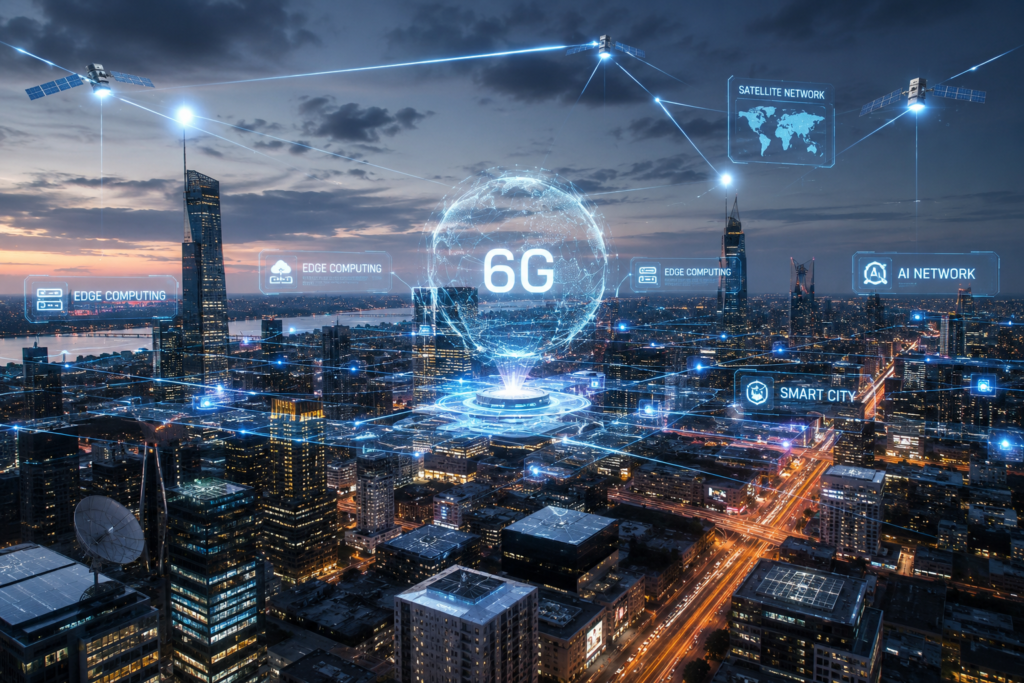
Satellite Integration
6G will integrate:
- LEO satellites
- Ground networks
- Aerial platforms
Creating truly global connectivity.
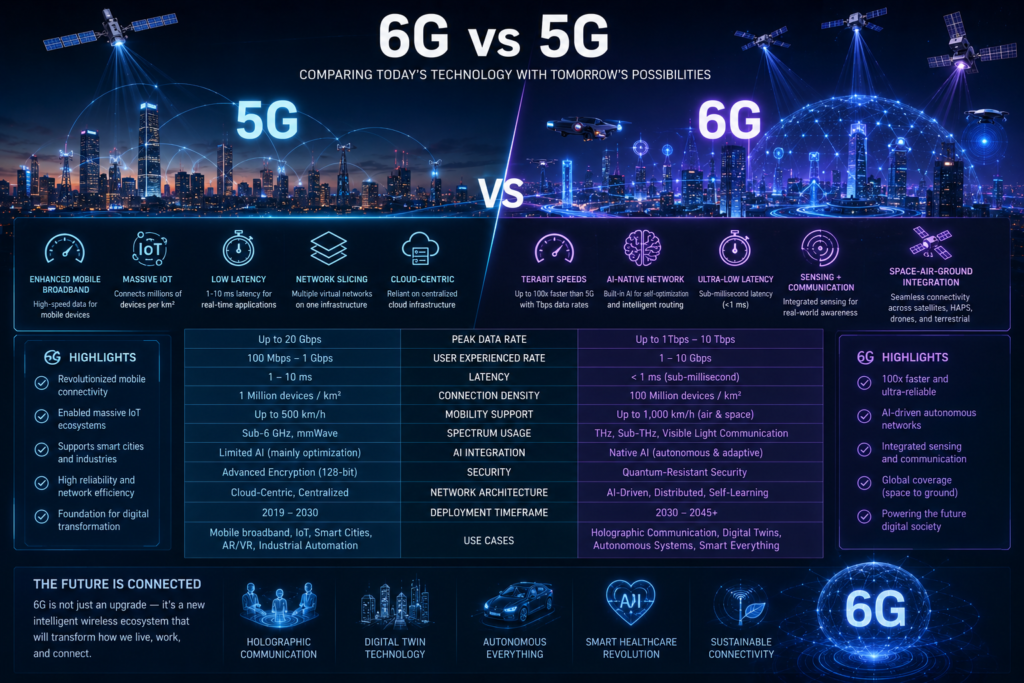
6G vs 5G Comparison Table
Table 2: 6G vs 5G Comparison
| Feature | 5G | 6G |
|---|---|---|
| Peak Speed | 20 Gbps | Up to 1 Tbps |
| Latency | 1 ms | <0.1 ms |
| AI Integration | Assisted | Native |
| Spectrum | Sub-6 GHz & mmWave | THz + Advanced Spectrum |
| Reliability | Very High | Near Autonomous |
| Applications | IoT, Streaming | Digital Twins, Holograms |
| Energy Efficiency | Improved | AI-Optimized |
| Coverage | Primarily Terrestrial | Space-Air-Ground Integrated |
| Network Management | Automated | Self-Learning |
| Security | Advanced | AI + Quantum Safe |
Industries That Will Benefit From 6G Technology
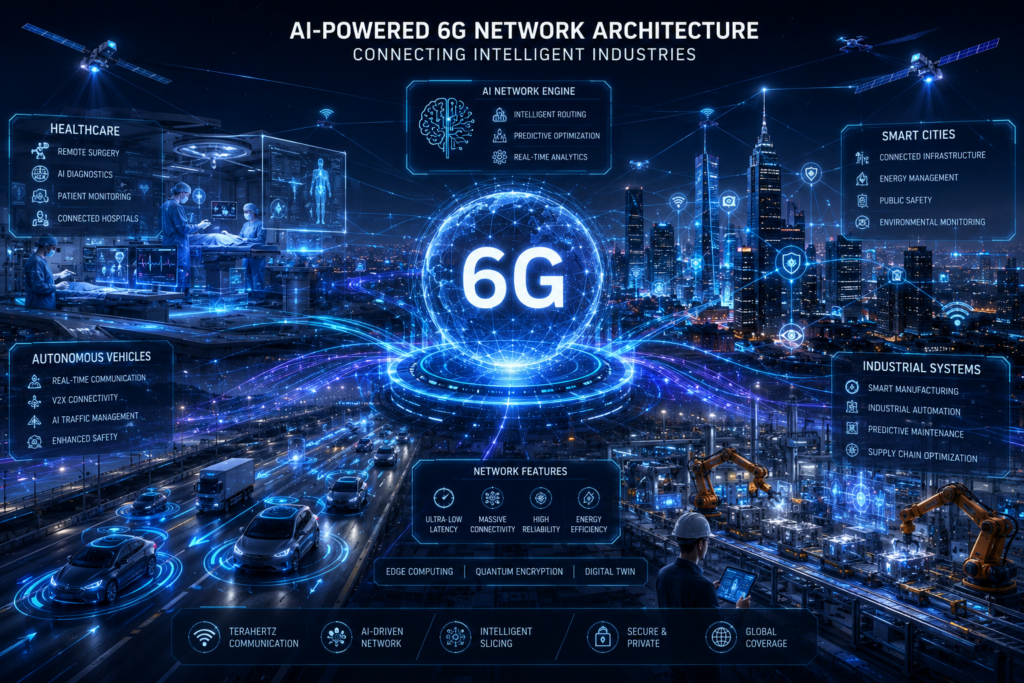
Healthcare
Future applications include:
- Remote surgery
- AI diagnostics
- Real-time patient monitoring
Smart Cities
Cities will benefit from:
- Intelligent traffic systems
- Smart energy grids
- Environmental monitoring
Autonomous Vehicles
Vehicles will exchange information instantly for safer transportation.
Manufacturing
Factories will leverage:
- Robotics
- Predictive maintenance
- Digital twins
Education
Immersive learning experiences may become commonplace.
Entertainment
Expect:
- Holographic communication
- Hyper-realistic virtual experiences
- Cloud gaming evolution
Defense
Military applications may include:
- Secure communications
- Autonomous systems
- Situational awareness
Agriculture
Farmers can deploy:
- Precision irrigation
- Autonomous equipment
- Environmental sensors
AI and the Future of 6G
AI-Native Networking
AI becomes embedded into every network layer.
Predictive Maintenance
Networks identify failures before they occur.
Automated Network Optimization
Resources dynamically adjust based on demand.
Self-Healing Networks
Systems recover without human intervention.
Intelligent Resource Allocation
Networks automatically optimize:
- Spectrum
- Energy
- Computing power
- Connectivity
The integration of AI represents one of the most significant differences in the 6G vs 5G evolution.
Challenges Facing 6G Deployment
Infrastructure Costs
Building new infrastructure requires massive investment.
Spectrum Availability
THz spectrum presents regulatory and technical challenges.
Security Concerns
Greater connectivity increases attack surfaces.
Energy Consumption
Future networks must remain sustainable.
Regulatory Issues
Global spectrum harmonization remains difficult.
Global Standardization
Industry alignment through ITU and 3GPP will be critical.
Security and Privacy in 6G Networks
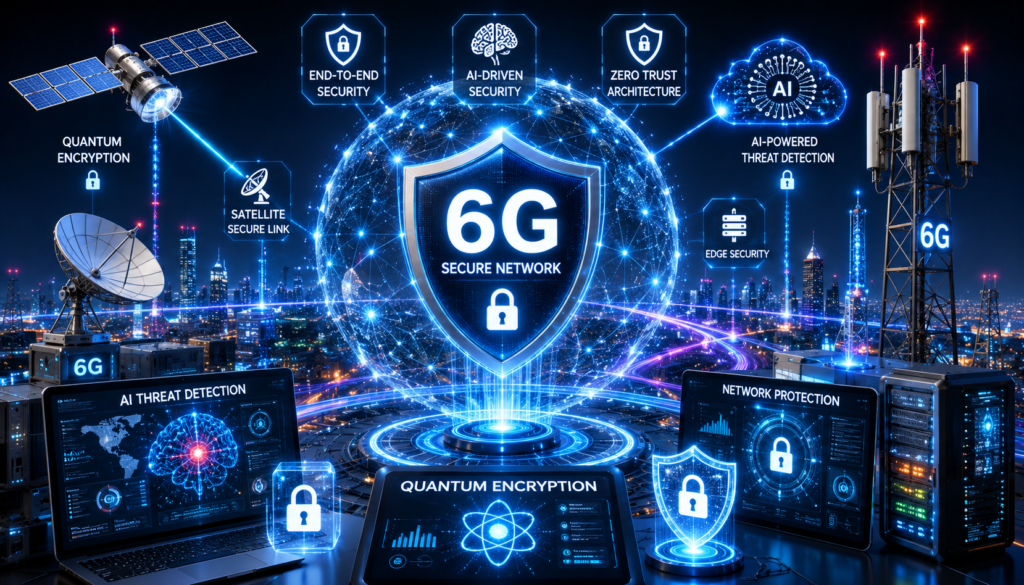
AI-Powered Threat Detection
AI systems will identify anomalies instantly.
Quantum-Safe Encryption
Future-proof cryptographic methods will protect communications.
Privacy Protection
Enhanced privacy frameworks will become mandatory.
Network Resilience
Self-healing architectures improve service continuity.
Future of 6G Technology Timeline
Table 3: Future 6G Deployment Timeline
| Stage | Timeline |
|---|---|
| Research Phase | 2020–2025 |
| Standards Development | 2025–2028 |
| Large-Scale Pilots | 2027–2029 |
| Initial Commercial Launch | Around 2030 |
| Global Expansion | 2030–2035 |
Most analysts expect meaningful commercialization to begin around 2030.
My 25 Years of Telecom Industry Insights on the Future of 6G
Having worked through the transitions from 2G to 3G, 3G to 4G, and 4G to 5G, several lessons stand out.
Lesson 1: Adoption Always Takes Longer Than Expected
Industry forecasts often underestimate deployment complexity.
Lesson 2: Killer Applications Drive Success
Networks alone do not create value.
Applications do.
Lesson 3: Infrastructure Remains Critical
The strongest networks combine:
- Fiber
- Wireless
- Edge computing
- Cloud infrastructure
Lesson 4: AI Will Become Essential
Unlike previous generations, AI is becoming inseparable from network operations.
Lesson 5: Businesses Should Prepare Now
Organizations should invest in:
- AI readiness
- Edge computing
- IoT platforms
- Data governance
- Digital transformation strategies
The biggest mistake I observed during 5G adoption was waiting too long to prepare.
Frequently Asked Questions
What is 6G technology?
6G technology is the next generation of wireless communications expected to succeed 5G around 2030, delivering AI-native intelligent networking, terabit speeds, and integrated sensing capabilities.
When will 6G be available?
Commercial deployment is expected to begin around 2030, with research and standardization continuing throughout this decade.
How fast will 6G be?
Researchers anticipate theoretical speeds approaching 1 terabit per second.
Is 6G real today?
Yes. Research programs are already underway globally, although commercial networks do not yet exist.
What is the future of 6G?
The future of 6G includes AI-native networking, global satellite integration, digital twins, immersive experiences, and autonomous systems.
What is the biggest difference between 6G vs 5G?
The most significant difference is AI integration. 6G is expected to be AI-native rather than AI-assisted.
Will 6G replace Wi-Fi?
Not entirely. Wi-Fi and cellular technologies will likely continue to complement one another.
Is 6G safer than 5G?
Future 6G network technology is expected to include advanced security features such as AI-powered threat detection and quantum-safe encryption.
What role will satellites play in 6G?
Satellites will become a core part of 6G architecture, enabling global connectivity across remote and underserved regions.
Conclusion
The story of wireless communications has always been about removing barriers between people, devices, information, and opportunity. From the analog voice networks of the 1980s to today’s intelligent mobile ecosystems, every generation has expanded what society can achieve through connectivity.
6G technology represents the next major leap forward. However, the future of 6G is not simply a continuation of the speed race that defined earlier generations. It marks the emergence of a truly intelligent communications platform where networking, computing, sensing, artificial intelligence, satellite systems, and digital services operate as a unified ecosystem.
The evolution of 6G network technology will likely introduce terabit-class speeds, near-instant responsiveness, AI-native operations, global satellite-terrestrial integration, digital twins, immersive holographic experiences, autonomous transportation, precision healthcare, and self-optimizing infrastructure. These capabilities have the potential to reshape entire industries and redefine how humans interact with the digital world.
When comparing 6G vs 5G, the key distinction is intelligence. While 5G focuses on connectivity, 6G aims to create networks that can understand, predict, adapt, and optimize themselves in real time. That shift may prove more transformative than any increase in raw bandwidth.
From a practical industry perspective, organizations should avoid viewing 6G as a distant technology. The businesses that benefit most from the next generation of connectivity will begin preparing today by investing in AI, edge computing, automation, cybersecurity, cloud-native infrastructure, IoT ecosystems, and advanced data strategies.
The road to 6G will involve significant challenges, including spectrum management, infrastructure investment, security requirements, energy efficiency goals, and global standardization efforts. Yet history has shown that every wireless generation creates opportunities that far exceed initial expectations.
For telecom operators, enterprises, governments, researchers, and technology innovators, the message is clear: the future of connectivity is already being designed. Those who understand the direction of 6G technology today will be best positioned to lead the digital economy of tomorrow.
Author

razakh6402@gmail.com
Related Posts

Lead Generation Software: 12 Best Lead Generation Tools for B2B Sales (2026 Guide)
- 0
- 2,300 words
If someone had asked me 15 years ago what the biggest challenge in sales was, my answer would have been simple: finding...

Survey Software: 12 Best Online Survey Tools & Feedback Software for Businesses (2026 Guide)
- 0
- 1,871 word
Whether I was helping a SaaS startup validate a new feature, assisting an HR team with employee engagement, or optimizing customer experience...
Read out all
Online Course Platform: 12 Best LMS Software & eLearning Platforms for Course Creators (2026 Guide)
- 0
- 1,900 word
The online education industry has changed dramatically over the last 15 years. When I built my first digital training portal, simply uploading...

Team Communication Software: 12 Best Business Messaging Apps for Modern Workplaces in 2026 (Expert Tested)
- 0
- 2,305 words
I’ve personally tested dozens of team communication software platforms while consulting for marketing agencies, software companies, HR departments, remote development teams, and...

Invoice Software: 12 Best Invoicing Software for Small Business in 2026 (Expert Tested)
- 0
- 2,493 words
I’ve worked with freelancers chasing late payments, agencies managing hundreds of monthly invoices, startups scaling internationally, and established businesses struggling with outdated...

Generate one SEO-optimized title thatdigital asset management software
- 6
- 2,632 words
One of the most memorable projects I led involved migrating nearly half a million digital assets from a traditional file server into...